
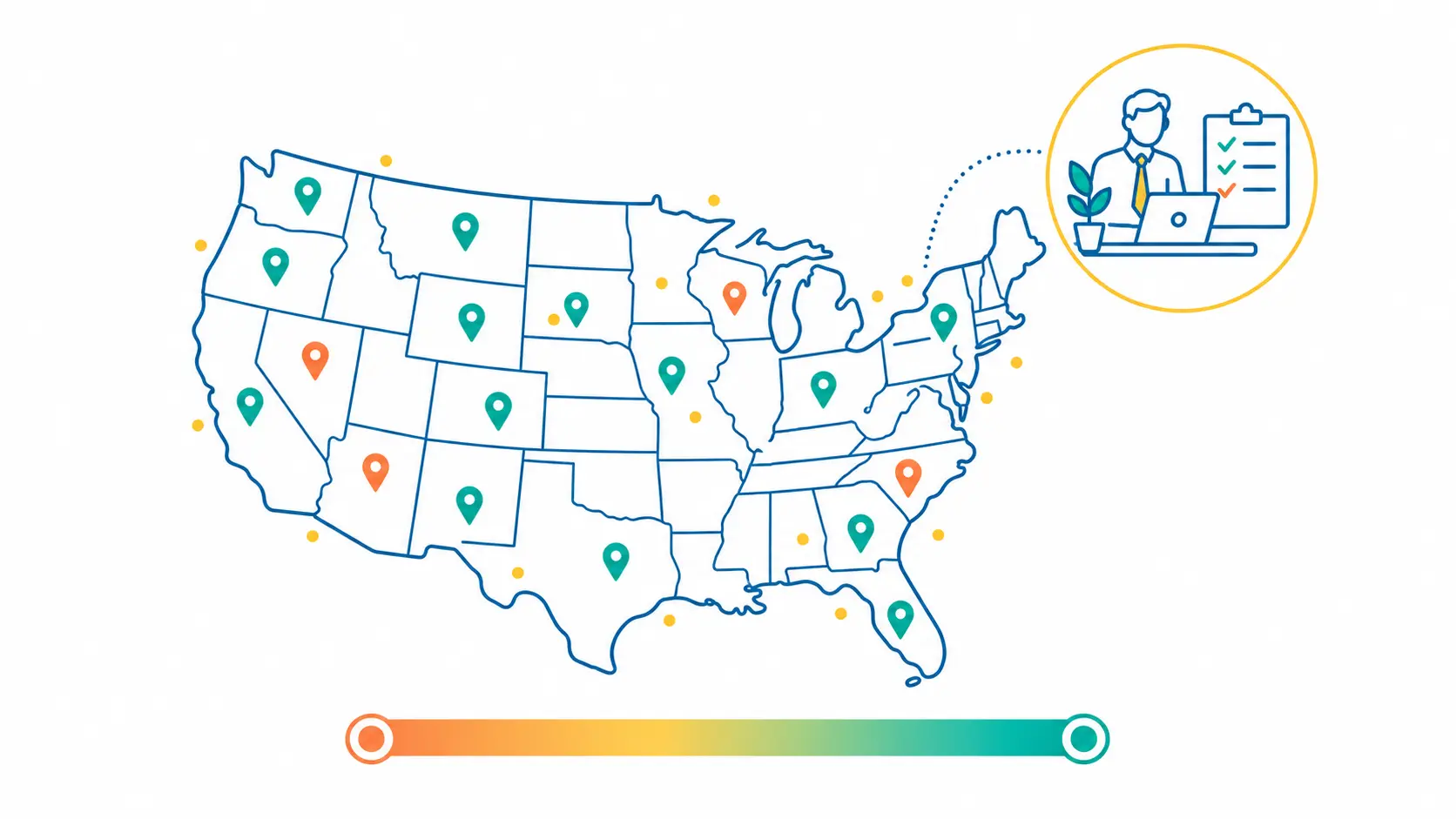
A CFO at a growing distribution company once told her team that managing sales tax across 18 states felt less like running a compliance program and more like “playing a board game where the rules change by state, by product, and by quarter and nobody printed the instructions.”
That description is more accurate than it sounds. A company that filed in 12 states last year may be filing in 18 this year. Each of those six new states has its own registration process, its own rate structure, its own filing frequency, and its own definition of what’s taxable. Kansas has no minimum threshold at all for remote sellers, the first dollar of revenue can trigger nexus. Colorado has the lowest state rate in the country at 2.9%, but its home-rule cities administer their own separate tax systems, making it one of the most complex states operationally despite the low headline number.
“Multi-state sales tax compliance” is not a problem that resolves itself as a company grows. It compounds. And for CFOs overseeing distributed operations, the action plan that works at 5 states rarely survives contact with 20.
This is the plan that does.
Multi-state sales tax compliance for enterprise companies requires systematic management of nexus across all states where physical or economic presence exists. Following South Dakota v. Wayfair (2018), all 45 states with a sales tax enforce economic nexus, most commonly at $100,000 in annual revenue, though California and Texas use $500,000 and Kansas has no minimum threshold. Illinois eliminated its 200-transaction threshold on January 1, 2026. A CFO’s multi-state action plan includes eight steps: nexus mapping, taxability review, exemption certificate audit, exposure quantification, filing calendar establishment, billing system integration, cross-function notification protocols, and continuous nexus monitoring. Equipment exemptions in some states can reduce capital expenditure costs by 5–8%.
Multi-state sales tax compliance for enterprises requires an eight-step action plan: map the nexus footprint, run a taxability review, audit exemption certificates, quantify prior-period exposure, build a state-specific filing calendar, integrate real-time tax calculation into billing systems, establish cross-function notifications for nexus-triggering events, and monitor the footprint continuously. Each step must be completed in sequence, diagnostic steps first, operational steps second, for the plan to close audit exposure effectively.
Why Multi-State Sales Tax Gets Harder as the Business Scales
At 3 states, sales tax compliance is manageable. A spreadsheet, a calendar, and a reasonably organized controller can handle it. At 15 states, the same approach produces late filings, rate errors, missed exemption certificate renewals, and exposure that accumulates faster than anyone realizes.
The problem is structural. Multi-state sales tax compliance requires three distinct functions to work simultaneously: knowing where obligations exist (nexus analysis), knowing what to collect on (taxability determination), and executing the collection and filing correctly (operational compliance). Most enterprise companies have partial coverage in each area but no systematic process connecting all three.
The gaps that result are predictable. Common audit triggers include filing an income or gross receipts tax return without filing a corresponding sales tax return, or reporting sales in a state without filing income taxes where remote workers are located. Both patterns are invisible to the teams responsible for filing because neither team sees the other’s work.
As the business scales, new states, new products, new remote employees, new customers in exempt categories, the nexus map expands faster than the compliance infrastructure. And the exposure compounds quietly until an auditor, an AI-powered state review system, or a pre-acquisition due diligence process surfaces it.
The Eight-Step CFO Action Plan for Multi-State Sales Tax Compliance
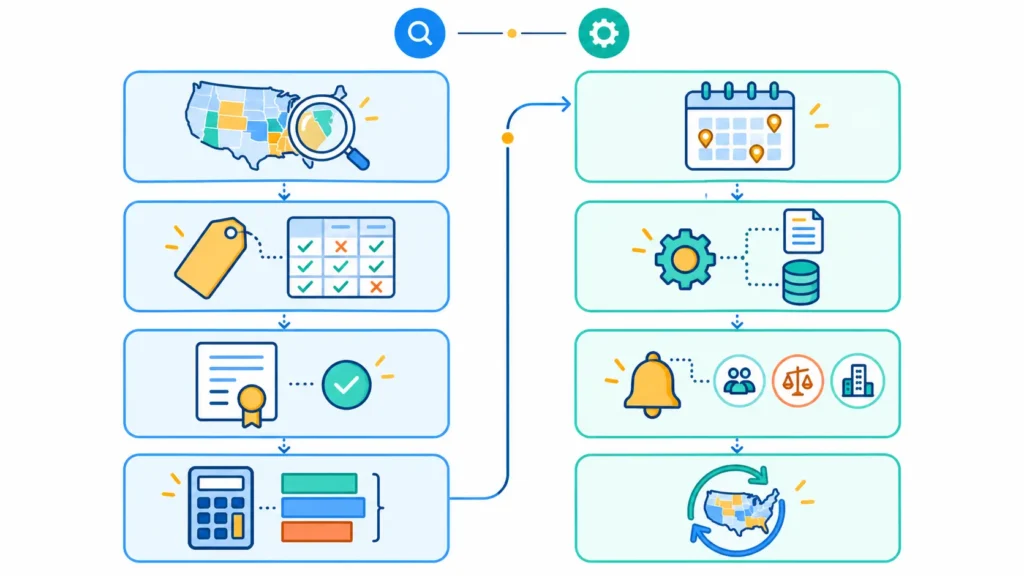
This plan is designed to be executed in sequence. Steps 1 through 4 are diagnostic. Steps 5 through 8 are operational. Neither set works without the other.
Step 1: Map the current nexus footprint completely
Identify every state where the company has nexus, physical presence through offices, warehouses, or remote employees, and economic nexus through revenue or transaction thresholds. Include every state where any employee works, regardless of job function. Include every state where inventory is held, even third-party fulfillment centers. Include every state where economic nexus thresholds have been crossed based on the current and prior calendar year’s revenue data.
Cross-reference that footprint against the company’s current registration list. Every state with nexus and no registration is an open exposure period that is accruing liability right now.
Step 2: Run a taxability review for every product and service line
Nexus determines where the company has obligations. Taxability determines what those obligations actually cover. These are separate analyses that must be done for each state independently. Many states exempt manufacturing equipment, computing equipment, and renewable energy property from sales tax. Properly classifying equipment and claiming exemptions can save 5–8% of capital expenditures. The reverse is equally true: a company that incorrectly treats a taxable service as exempt in a state where it has nexus is building liability with every invoice.
Step 3: Conduct an exemption certificate audit
Pull the company’s full list of tax-exempt customers and verify that a current, valid exemption certificate exists for each one, in each state where that customer is purchasing. Certificates have different validity periods by state. A certificate that was valid three years ago in California may have expired. A resale certificate that covers product purchases may not cover service purchases.
In a company with significant B2B revenue, the difference between a clean certificate file and a gap-riddled one can represent six figures of additional audit exposure. This step is consistently underweighted and consistently found by auditors.
Step 4: Quantify any prior-period exposure
For each state where the nexus map reveals unregistered periods, calculate the base tax exposure using actual revenue data and applicable rates. Then apply the actual state penalty and interest structure to produce a maximum exposure figure. That number belongs in the CFO’s risk register, not as an approximation, but as a calculated range by state.
This step also determines whether voluntary disclosure is the right path for any identified exposure. A voluntary disclosure agreement can be a way for a company to self-report back taxes owed; in exchange, states generally waive penalties and limit the lookback period. The decision to pursue VDA should be made before any new registration is filed in the affected state, because filing a registration can signal to the state that prior periods may be open.
Step 5: Establish a filing calendar with state-specific frequencies
Every state assigns a filing frequency based on the company’s revenue in that state. High-volume filers typically file monthly. Lower-volume filers file quarterly or annually. Common filing frequencies include monthly filing for larger businesses, quarterly filing for mid-range filers, and annual filing for low-volume sellers. The critical point: filing frequencies can change. A company whose Texas revenue grew significantly in the past year may have been moved from quarterly to monthly filing without realizing it. Building the filing calendar in a live system, not a static spreadsheet, ensures due dates are current.
Step 6: Integrate sales tax calculation into transaction systems
Economic nexus thresholds established after South Dakota v. Wayfair mean that a company can trigger obligations in a state where it has zero physical presence. As the nexus footprint expands, accurate rate determination at the point of invoice becomes the critical operational challenge.
Manual rate lookups don’t scale. A company processing 10,000 invoices per month across 20 states needs automated, real-time rate calculation connected directly to the billing system or ERP. The calculation must apply the correct combined rate, state plus local district, at the customer’s location, not a single blended state rate.
Colorado makes this concrete. Its state rate is 2.9%. But its home-rule municipalities administer their own sales tax systems, and the combined rate for a Denver delivery can reach 8.81%. A company applying 2.9% to Colorado transactions is systematically undercollecting.
Step 7: Build cross-function notifications for nexus-triggering events
Multi-state sales tax compliance fails at the organizational boundary between HR, legal, real estate, procurement, and finance. Each of those functions makes decisions that create compliance obligations, a remote hire, a new office lease, a warehouse agreement, a new enterprise custome, without routing those decisions through the tax team.
The action: build a notification protocol so that any of the following events triggers an automatic review by the compliance function before it is executed:
– A new remote employee in a state where the company is not registered
– A lease or warehouse agreement in a new state
– A new enterprise customer contract that would push revenue over an economic nexus threshold in their state
– A new product line or acquisition that changes the taxability profile
– A location change for any existing remote employee
This is not a new approval process. It’s an information flow, the compliance team receives a notification and assesses whether a new registration obligation has been created.
Step 8: Monitor and update the nexus footprint continuously
When expanding into new states, even slight changes in activity can create filing requirements. Maintaining an updated picture of where business activity and personnel are located helps identify which states may need filings. The nexus map is not a document. It’s a live system. Revenue grows, employees move, products change, states update their thresholds. A nexus analysis conducted in January 2025 may be materially incomplete by January 2026 because the business changed, not because the analysis was wrong.
Build the review cadence into the compliance calendar: a full nexus review at least annually, with a triggered review any time a material operational change occurs.
Common Audit Triggers for Multi-State Enterprises in 2026
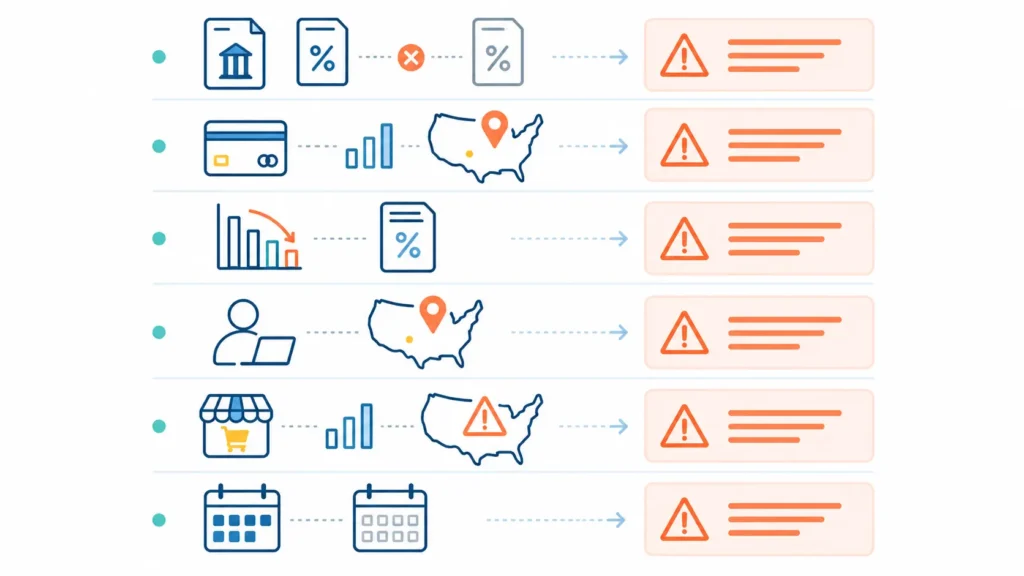
State AI audit systems in 2026 are specifically designed to surface the discrepancies that result from incomplete multi-state compliance. The patterns they flag most consistently:
| Audit Trigger | Why It Gets Flagged |
| Income tax return filed without corresponding sales tax return | Cross-agency data matching reveals the inconsistency |
| Sales reported in a state with no sales tax registration | Economic nexus visible through payment processor data |
| Sudden drop in exemption ratio without business model change | Algorithmic scoring flags the statistical anomaly |
| Remote employees in states with no registration | HR data accessible through 1099 and W-2 filings |
| Marketplace revenue visible without corresponding registration | Marketplace facilitator reports cross-referenced with state records |
| Filing one year but not the next | Return pattern analysis flags the gap year |
Each of these triggers is detectable before a human auditor ever makes a selection decision. Building the eight-step action plan closes them.
Final Words
Multi-state sales tax compliance is not an administrative burden. For enterprise CFOs, it is a financial risk management function, one that directly affects cash flow, audit exposure, deal value, and the accuracy of financial reporting in every state where the company operates.
The companies that manage it well are not the ones with the largest compliance teams. They are the ones that built the eight-step plan deliberately, connected the compliance function to every business decision that creates a new obligation, and automated the operational execution so that growth doesn’t outpace compliance infrastructure.
The companies that manage it poorly are the ones that discover the gap when a state AI system finds it first, or when a buyer’s due diligence team quantifies what was always there, hiding in plain sight.
Build Your Enterprise Sales Tax Action Plan with IST
IST works with enterprise CFOs and tax teams to execute every step of the multi-state compliance action plan, from the initial nexus analysis and taxability review through exemption certificate management, voluntary disclosure for prior-period exposure, state registrations, and the AI-powered automation that keeps the footprint current as the business grows.
The plan exists. The question is whether IST builds it with you now, or a state auditor builds it for you later.
Talk to an IST advisor today & Get your multi-state sales tax compliance action plan, built for where your enterprise is today and where it’s going.
Frequently Asked Questions
What is multi-state sales tax compliance and who does it apply to?
Multi-state sales tax compliance is a business’s obligation to register, collect, report, and remit sales tax in every state where it has established nexus, either physical presence or economic nexus through revenue thresholds. It applies to any enterprise selling goods or services across state lines. Following South Dakota v. Wayfair (2018), all 45 states with a sales tax enforce economic nexus, making virtually every multi-state business subject to filing obligations in multiple jurisdictions.
How do economic nexus thresholds vary across states for multi-state enterprises?
Most states use a $100,000 annual revenue threshold to establish economic nexus. California and Texas use $500,000. Alabama and Mississippi use $250,000. Kansas has no minimum threshold, any remote sale can trigger nexus. New York and Connecticut require both revenue ($500,000 and $100,000 respectively) and transaction counts to be met. Illinois eliminated its 200-transaction threshold on January 1, 2026, moving to a $100,000 revenue-only standard.
What are the most common multi-state sales tax compliance failures for enterprises?
The most common failures are: filing income tax returns without corresponding sales tax returns in the same state; reporting sales in a state without registering for sales tax; applying exemptions without current, valid exemption certificates on file; using a single blended state rate instead of the correct combined state and local rate; and failing to update nexus monitoring when remote employees move to new states or when new enterprise contracts cross economic nexus thresholds.
How does a CFO build a multi-state sales tax filing calendar?
The filing calendar must list every registered state, the assigned filing frequency for each (monthly, quarterly, or annual based on revenue volume in that state), and the specific due date for each period. Filing frequencies can change as revenue grows, a quarterly filer in Texas may be moved to monthly without notification. The calendar should be maintained in a live system, not a static spreadsheet, and reviewed at the start of each calendar year against current state assignments.
What is Colorado’s home-rule sales tax system and why does it matter for multi-state enterprises?
Colorado has the lowest state sales tax rate in the country at 2.9%, but its home-rule municipalities administer their own sales tax systems independently of the state. Denver’s combined rate reaches 8.81%; other home-rule cities have their own rates and filing requirements. A multi-state enterprise applying only the 2.9% state rate to Colorado transactions is systematically undercollecting. Each home-rule jurisdiction requires separate compliance, making Colorado operationally one of the most complex states despite its low headline rate.
When should a multi-state enterprise pursue a voluntary disclosure agreement?
A voluntary disclosure agreement should be evaluated when a nexus analysis reveals states where the company has had nexus but has not been registered, meaning prior-period sales tax liability may exist. VDA caps the lookback period to 3–4 years in most states and waives all penalties. The VDA decision should be made before the company files a new registration in the affected state, because registering first can signal to the state that open prior periods exist without the protection of a VDA.
How does multi-state sales tax compliance change when a company adds remote employees?
Each new remote employee in a state creates immediate physical nexus in that state, regardless of the company’s revenue there and with no minimum threshold. The company must register for sales tax before the employee’s first day if the company sells taxable goods or services in that state. HR, legal, and the compliance function must have a notification protocol so that remote hire decisions are reviewed for compliance implications before the offer is extended.
What audit triggers do state AI systems look for in multi-state enterprise filers?
State AI audit systems in 2026 cross-reference multiple data sources to detect compliance gaps. The most common triggers are: income tax returns filed without corresponding sales tax returns; marketplace or payment processor data showing sales in states with no registration; remote employee W-2 data showing presence in unregistered states; sudden drops in exemption ratios; and filing returns in one year but not the next. Companies whose compliance data is internally consistent, filed returns match transaction data, exemptions match certificates, registrations match nexus footprint, score lower in audit selection models.
Leave a Reply