
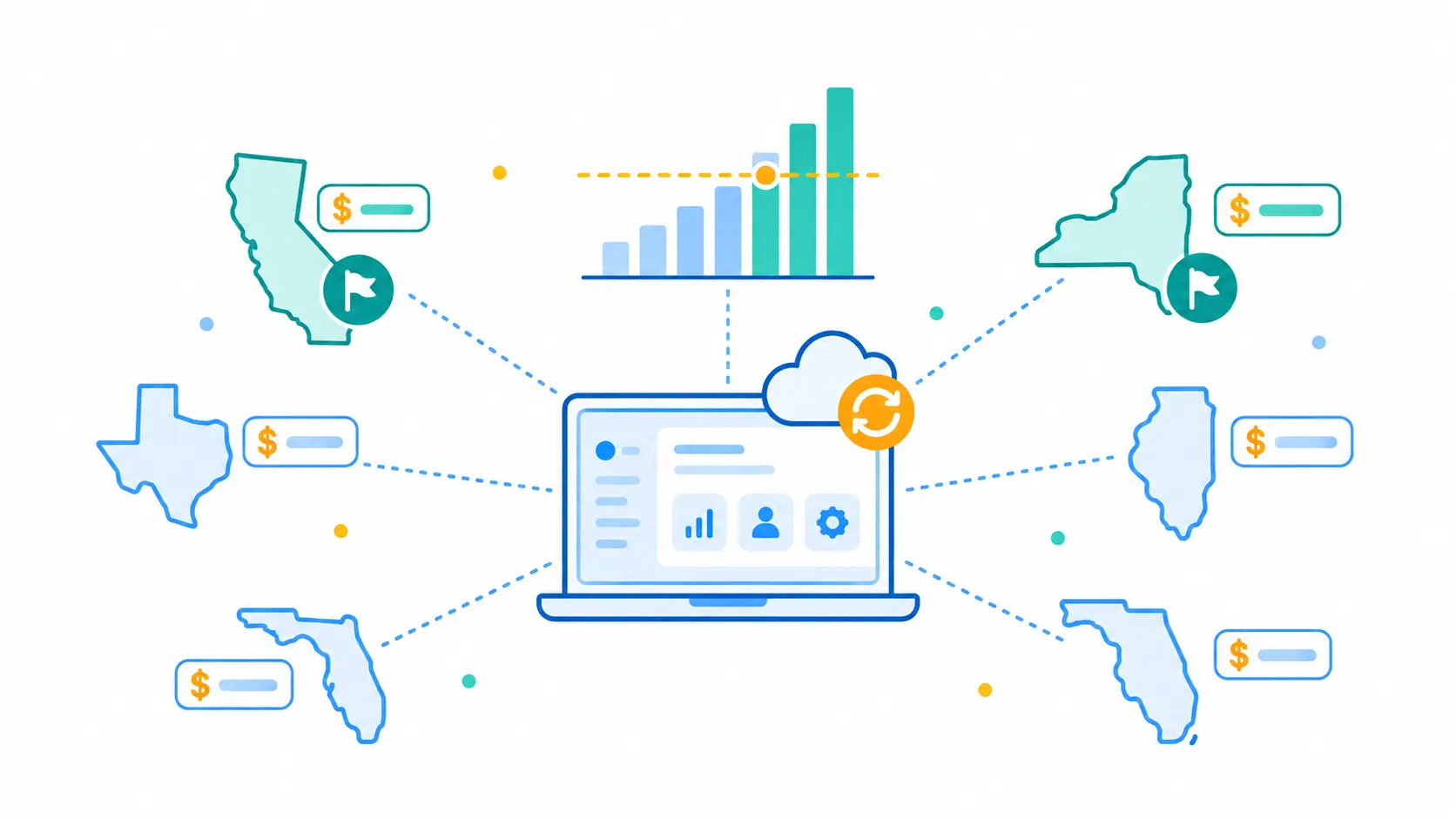
A SaaS company closes a $200,000 annual contract with a client in Texas. The deal goes through procurement, legal reviews the MSA, finance sends the invoice. Nobody asks whether the company has crossed Texas’s economic nexus threshold. Nobody registers for a Texas sales tax permit. The invoice goes out without sales tax and a liability starts accruing from that first payment date.
This scenario is not unusual. It’s the default outcome when a SaaS company’s go-to-market motion outpaces its compliance infrastructure, which happens constantly, because enterprise SaaS growth is designed to move fast and compliance is not designed to move with it.
“Economic nexus for SaaS” is the rule that makes every new customer in a new state a potential compliance obligation. Understanding it, specifically, not generally, is the difference between a company that registers proactively and one that discovers four years of uncollected Texas sales tax during pre-acquisition due diligence.
Economic nexus for SaaS companies is established when annual revenue from in-state customers exceeds a state’s threshold, typically $100,000, or $500,000 in California, Texas, and New York. Following South Dakota v. Wayfair (2018), all 45 states with a sales tax now enforce economic nexus regardless of physical presence. SaaS companies have no protection under P.L. 86-272, which applies only to tangible personal property. As of January 1, 2026, Illinois eliminated its 200-transaction threshold. As of July 2025, 15 states use revenue-only thresholds. SaaS taxability varies by state: taxable in Texas, New York, and Pennsylvania; generally exempt in California and Florida.
Economic nexus for SaaS companies is triggered when annual revenue from customers in a state exceeds that state’s threshold, most commonly $100,000, or $500,000 in California, Texas, and New York. Once triggered, the company must register for a sales tax permit and collect sales tax in that state, regardless of physical presence. Illinois eliminated its 200-transaction threshold on January 1, 2026, making revenue the sole trigger.
What Economic Nexus Actually Is
Economic nexus is the legal connection between a remote seller and a state, established when the seller exceeds a defined revenue or transaction threshold in that state, regardless of physical presence. Once nexus is established, the seller must register for a sales tax permit, collect sales tax from buyers in that state, and remit it to the state’s revenue department.
Before 2018, states could only require sales tax collection from sellers with physical presence, offices, employees, warehouses. The Supreme Court’s decision in “South Dakota v. Wayfair” ended that. Since Wayfair, all 45 states with a sales tax now enforce economic nexus rules, and a company doesn’t need a single employee in a state to have a sales tax obligation there.
For SaaS companies specifically, this creates a compliance exposure that scales directly with revenue growth. Every new enterprise customer in a new state is a transaction. Enough transactions or enough revenue and economic nexus is established. The registration obligation exists whether the sales team knows about it or not.
The Threshold Structure: What Triggers Economic Nexus in 2026
States typically use one or both of two thresholds: transaction volume (most commonly 200 retail sales) or annual revenue (most commonly $100,000). But the variation between states is material enough to matter for enterprise SaaS planning:
| State | Revenue Threshold | Transaction Threshold | Notes |
| California | $500,000 | None | Revenue-only; higher threshold than most |
| Texas | $500,000 | None | Revenue-only; SaaS broadly taxable |
| New York | $500,000 | 100 transactions | Both must be met |
| Illinois | $100,000 | None | Eliminated 200-transaction threshold Jan 1, 2026 |
| Florida | $100,000 | None | Revenue-only; SaaS generally not taxable |
| Pennsylvania | $100,000 | None | Revenue-only; SaaS taxable |
| Washington | $100,000 | None | Revenue-only; SaaS taxable |
| Colorado | $100,000 | None | Revenue-only |
| Georgia | $100,000 | 200 transactions | Either threshold triggers nexus |
| Ohio | $100,000 | 200 transactions | Either threshold triggers nexus |
| Alabama | $250,000 | None | Revenue-only; higher threshold |
| Connecticut | $100,000 | 200 transactions | Both must be met |
Two 2026 developments matter specifically for SaaS
Illinois eliminated its 200-transaction economic nexus threshold on January 1, 2026. It now uses a revenue-only $100,000 standard. For enterprise SaaS companies with a small number of large contracts in Illinois, say, three contracts at $40,000 each, the previous transaction threshold kept them below 200 sales and outside nexus. Under the new rule, $120,000 in Illinois revenue alone triggers the obligation.
Second, as of July 2025, 15 states have eliminated the 200-transaction threshold entirely, moving to revenue-only standards. This is a trend, not a one-off. Enterprise SaaS companies with high average contract values and low transaction counts, which is nearly every B2B SaaS company, should not assume the transaction threshold offers protection in any state without checking the current rule.
Why SaaS Companies Have No Safe Harbor Under P.L. 86-272
Public Law 86-272 is a federal statute that limits states from imposing income tax on remote sellers whose only in-state activity is soliciting orders for tangible personal property. Many CFOs and controllers assume it provides some protection against sales tax obligations. It doesn’t, for two reasons.
First, P.L. 86-272 is an income tax provision. It has no effect on sales tax nexus. A SaaS company protected from Illinois income tax nexus under P.L. 86-272 is not protected from Illinois sales tax nexus when it crosses $100,000 in revenue. SaaS and subscription software companies have no protection under P.L. 86-272. The statute applies only to sales of tangible personal property. Software delivered electronically, which is what every SaaS product is, falls outside its scope. A SaaS company that believes P.L. 86-272 limits its state tax exposure is operating on a mistaken assumption that auditors in every state have already accounted for.
How Exempt Sales and Non-Taxable Revenue Count Against the Threshold
This is the specific fact that most enterprise SaaS finance teams miss. Most states count exempt sales, even if they are not taxable, toward the economic nexus threshold.
A SaaS company selling into California generates $420,000 in annual B2B subscription revenue. Some of those contracts are with resellers who provide valid resale certificates. The underlying transactions are tax-exempt. But in California, those exempt sales still count toward the $500,000 threshold. If the company also has $90,000 in directly taxable B2C subscriptions in California, the combined $510,000 in total sales crosses the threshold and the taxable portion requires registration, collection, and remittance.
This matters because SaaS companies with mixed customer bases, direct enterprise customers and reseller channels, often calculate their threshold exposure using only taxable revenue. That calculation understates the actual threshold position in most states and creates unexpected nexus obligations.
SaaS Taxability: Economic Nexus Doesn’t Mean You Owe Tax Everywhere
Crossing the economic nexus threshold in a state creates a registration obligation. Whether the company actually owes sales tax depends on a second question: is SaaS taxable in that state?
The answer varies dramatically:
| SaaS Tax Treatment | States |
| SaaS broadly taxable | Texas, New York, Pennsylvania, Washington, Connecticut, Tennessee, Minnesota, Rhode Island, Arizona, Hawaii |
| SaaS generally exempt | California, Florida, New Hampshire (no sales tax), Oregon (no sales tax), Delaware (no sales tax) |
| SaaS taxable with conditions | Illinois (taxable if sold to end users, exempt for certain B2B), Ohio (taxable if accessed remotely), Massachusetts (taxable for B2C, complex for B2B) |
The enterprise implication: a SaaS company with economic nexus in 20 states may owe sales tax in 12 of them, owe nothing in 5, and face a fact-specific determination in 3. Economic nexus triggers the registration question. Taxability determines the collection question. Both analyses must be done for every state where the threshold has been crossed.
A company that registers everywhere it has nexus but applies the wrong taxability determination, treating a taxable state as exempt, or an exempt state as taxable, has converted its compliance effort into a new error category. Accurate registration requires both analyses done correctly.
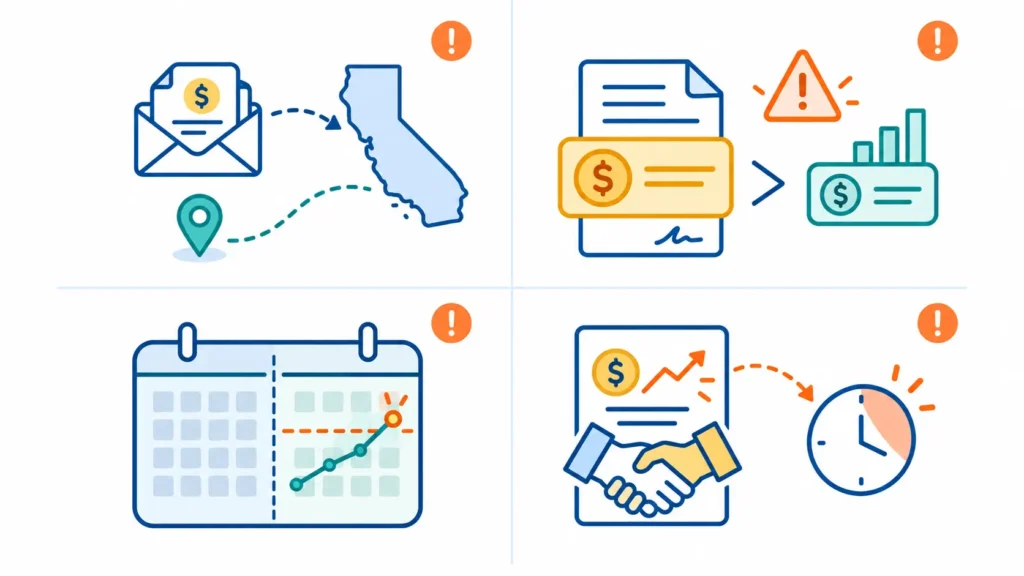
The Four Enterprise SaaS Mistakes That Create Economic Nexus Exposure
Mistake 1: Monitoring revenue by invoiced state rather than customer location
Economic nexus is measured by where the customer uses the software, not where the invoice is sent. An enterprise customer headquartered in Delaware but with users in Texas, New York, and California may generate nexus in all three states, regardless of where the invoice is addressed. SaaS companies that track revenue by billing address routinely understate their nexus footprint.
Mistake 2: Using total contract value rather than annual recognized revenue for threshold monitoring
A three-year $450,000 contract recognized ratably produces $150,000 in year one, which crosses the $100,000 threshold in most states. Monitoring against total contract value ($450,000, which only crosses California and Texas thresholds) rather than annual recognized revenue produces a different and incorrect nexus determination.
Mistake 3: Assuming prior-year revenue is the only relevant measurement
Most states use either the current or previous calendar year as the evaluation period. A SaaS company that had $85,000 in Ohio revenue in the prior calendar year and $110,000 in the current year may have crossed the Ohio threshold mid-year in the current period and owe sales tax from the date the threshold was crossed, not from January 1 of the following year.
Mistake 4: Not updating nexus monitoring when closing new enterprise contracts
Economic nexus can be triggered by a single large enterprise contract in a state where the company previously had no presence. A company signing a $150,000 first-year contract with a New York enterprise customer, its first New York customer, just crossed New York’s $100,000 threshold in a single transaction. The registration obligation exists from the date that threshold was crossed. Monitoring at the end of the quarter is too late.
What Enterprise SaaS Companies Should Do Now
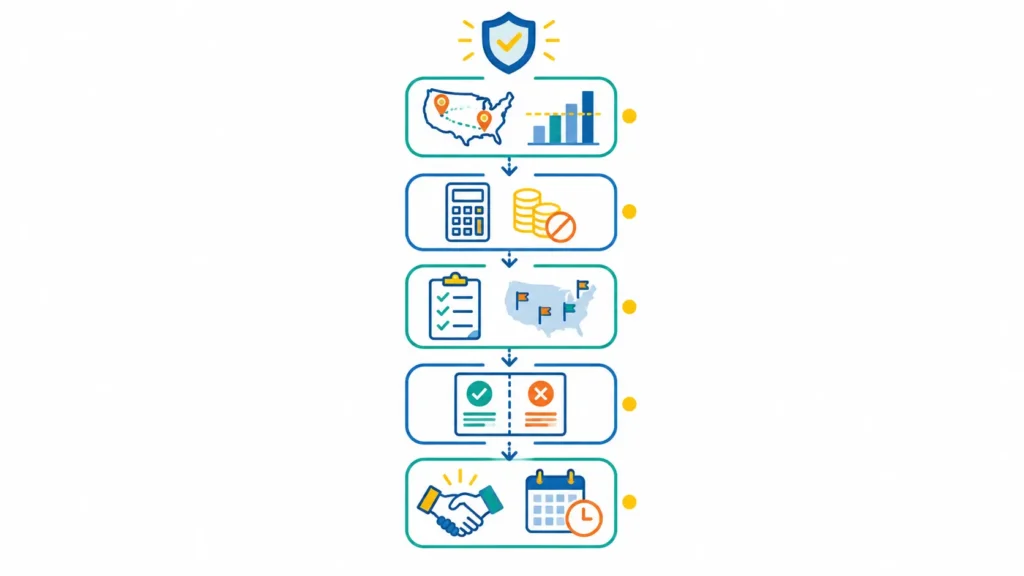
The economic nexus compliance process for an enterprise SaaS company has five specific steps:
1. Map current revenue by customer location (not billing address) for the current and prior calendar year. Identify every state where recognized annual revenue exceeds $100,000, or $500,000 for California, Texas, and New York.
2. Include exempt and non-taxable revenue in the threshold calculation. Don’t filter out reseller revenue, revenue from tax-exempt customers, or revenue from states where SaaS is not taxable. Most states count all of it.
3. Cross-reference threshold crossings against current registration list. Every state where the threshold has been crossed and the company is not registered is an unregistered nexus exposure.
4. Determine SaaS taxability for each unregistered nexus state. Registration is required regardless of taxability. Taxability determines whether the company must collect and remit sales tax on future transactions in that state.
5. Address prior-period exposure through voluntary disclosure before filing the first registration. In states where the company has crossed the threshold but hasn’t been collecting, a VDA limits the lookback period and waives penalties. Filing a registration without addressing historical exposure first can inadvertently alert the state to prior uncollected periods without the protection of a VDA.
Final Words
Economic nexus turned every state into a potential compliance obligation for every enterprise SaaS company. The Wayfair decision happened in 2018. By 2026, there is no longer any legitimate uncertainty about whether the rule applies, only uncertainty about whether a specific company has crossed a specific threshold in a specific state at a specific point in time.
That uncertainty is measurable. The threshold data exists. The taxability rules are documented. The monitoring process is defined. What most enterprise SaaS companies lack is not information, it’s a systematic process for applying that information to their actual revenue data before the threshold is crossed, not after the audit is opened.
The companies that manage this well are not the ones with the most sophisticated legal teams. They’re the ones who built the monitoring process early enough that nexus registration happens before the first uncollected dollar of tax becomes a liability.
Find Out Exactly Where Your SaaS Company Has Economic Nexus Today
IST conducts economic nexus analyses for enterprise SaaS companies, mapping revenue by customer location against current state thresholds, identifying unregistered nexus states, determining SaaS taxability by jurisdiction, and managing voluntary disclosure for any prior-period exposure before the company registers and begins collecting.
The analysis starts with your revenue data. The output is a state-by-state nexus map with a clear action sequence, what to register, what to disclose, and what to collect going forward.
Talk to an IST advisor today & Find out exactly where your SaaS company has crossed an economic nexus threshold & what to do about it before a state does.
Frequently Asked Questions
What is economic nexus and how does it apply to SaaS companies?
Economic nexus is the legal obligation to collect and remit sales tax in a state when annual revenue or transaction volume from in-state customers exceeds a defined threshold, regardless of physical presence. For SaaS companies, the most common threshold is $100,000 in annual sales. Following South Dakota v. Wayfair (2018), all 45 states with a sales tax enforce economic nexus. SaaS companies trigger nexus through subscription revenue from customers in new states as their business grows.
What are the economic nexus thresholds for SaaS companies in 2026?
The most common threshold is $100,000 in annual sales, used by most states. California, Texas, and New York use a $500,000 revenue-only threshold. Alabama uses a $250,000 threshold. Connecticut and New York require both revenue and transaction thresholds to be met. Illinois eliminated its 200-transaction threshold on January 1, 2026, and now uses a $100,000 revenue-only standard. Five states have no statewide sales tax: Alaska, Delaware, Montana, New Hampshire, and Oregon.
Does P.L. 86-272 protect SaaS companies from economic nexus?
No. P.L. 86-272 is a federal income tax statute that limits states from imposing income tax on remote sellers whose only in-state activity is soliciting orders for tangible personal property. It has no effect on sales tax nexus and does not apply to SaaS or electronically delivered software. SaaS companies have no federal safe harbor from state sales tax economic nexus obligations.
Is SaaS taxable in every state where economic nexus exists?
No. Economic nexus creates a registration obligation, but whether sales tax is owed depends on each state’s taxability rules for SaaS. Texas, New York, Pennsylvania, Washington, and Connecticut broadly tax SaaS. California and Florida generally exempt SaaS from sales tax. Illinois, Ohio, and Massachusetts apply conditional rules based on customer type or delivery method. A SaaS company must complete both a nexus analysis and a taxability analysis for each state before determining collection obligations.
Do tax-exempt sales count toward the economic nexus threshold for SaaS companies?
Yes, in most states. Most states count exempt sales, including sales to resellers with valid resale certificates, toward the economic nexus revenue threshold, even if those sales are not subject to sales tax. SaaS companies with reseller channels or tax-exempt enterprise customers must include that revenue in their threshold calculations. Using only taxable revenue to monitor nexus exposure understates the actual threshold position in most states.
When does a SaaS company need to register after crossing an economic nexus threshold?
Registration is required from the point the threshold is crossed, not from the beginning of the next calendar year. Most states use either the current or prior calendar year as the evaluation period. A SaaS company that crosses the $100,000 threshold mid-year in a state must register and begin collecting sales tax on transactions from the date the threshold was exceeded. Companies that delay registration until year-end can accumulate months of uncollected tax liability.
What is the risk of not registering for sales tax after crossing an economic nexus threshold?
The company becomes liable for all uncollected sales tax from the date the threshold was crossed, plus state penalties (typically 10%–29% of base tax owed) and interest (3%–18% annually depending on the state). A 3–4 year uncollected period typically accumulates to 140% of the original tax owed after penalties and interest compound. Voluntary disclosure before state contact caps the lookback period and waives penalties, significantly reducing total liability.
How should an enterprise SaaS company monitor economic nexus thresholds across all states?
The most reliable method is real-time monitoring of recognized annual revenue by customer location, not billing address, against each state’s current threshold. Monitoring should include both taxable and exempt revenue, trigger alerts when approaching 80% of any state threshold, and flag new enterprise contracts that would cross a threshold immediately upon signing. Most enterprise SaaS companies implement this through a combination of CRM/billing system data and a dedicated nexus monitoring tool or outsourced compliance partner.
Leave a Reply