

In-House vs. Outsource Sales Tax Compliance: An Enterprise Decision Framework
The decision to hire in-house vs. outsource sales tax compliance depends on five variables: number of active filing jurisdictions, rate of change in the compliance footprint, depth of internal tax expertise, current audit exposure, and business trajectory. Companies with 15 or more filing jurisdictions, active audit history, or rapid growth typically get better results and lower risk from outsourced or hybrid compliance models.
The CFO at a mid-sized distribution company once described her sales tax situation like this: “We have one person who knows everything, and she’s the only one who knows everything.” When that person went on leave for three weeks, three state filings were late. When she resigned eighteen months later, the company spent four months trying to reconstruct her process while simultaneously managing a nexus review in six states.
That’s not a staffing story. It’s a compliance architecture story and it’s the most common version of the in-house sales tax model at scale.
The decision of whether to hire “in-house sales tax compliance” staff or outsource to a specialized partner is one of the most consequential operational choices an enterprise finance team makes. Get it wrong in either direction and you pay, either in salary and infrastructure costs that outrun the value, or in audit exposure from a process that doesn’t have the expertise or bandwidth to keep up with the obligation.
This framework gives enterprise CFOs, controllers, and tax managers a structured way to make that decision.
The in-house vs. outsource sales tax compliance decision for enterprise companies depends on five key variables: number of active filing jurisdictions, compliance footprint change rate, internal expertise depth, audit history, and business trajectory. Companies with fewer than 10 stable filing jurisdictions and simple product taxability can manage compliance internally. Companies with 15 or more jurisdictions, mixed product taxability, active audits, or rapid growth typically benefit from outsourced or hybrid models. A hybrid arrangement, internal coordination with outsourced advisory, nexus analysis, and filing, is the most common structure among mid-market and growth-stage enterprise companies. In-house senior sales tax managers cost $180,000 to $220,000 in total annual compensation in most major U.S. markets.
What “In-House” and “Outsourced” Sales Tax Compliance Actually Mean
“In-house sales tax compliance” means the enterprise employs dedicated staff, a tax manager, a sales tax analyst, or a full tax team, who own the end-to-end compliance function. They manage nexus analysis, product taxability, state registrations, exemption certificates, return preparation, filing, and audit response. The function lives inside the organization, supported by internal tools and whatever tax software the company licenses.
“Outsourced sales tax compliance” means a specialized external firm manages some or all of those functions on the company’s behalf. The outsourcing model ranges from full managed service, the provider handles every registration, filing, and audit response, to a hybrid model where the internal team handles day-to-day operations and the external partner provides expertise, review, and advisory support.
Neither model is inherently superior. The right answer depends on five variables that most enterprises don’t evaluate systematically.
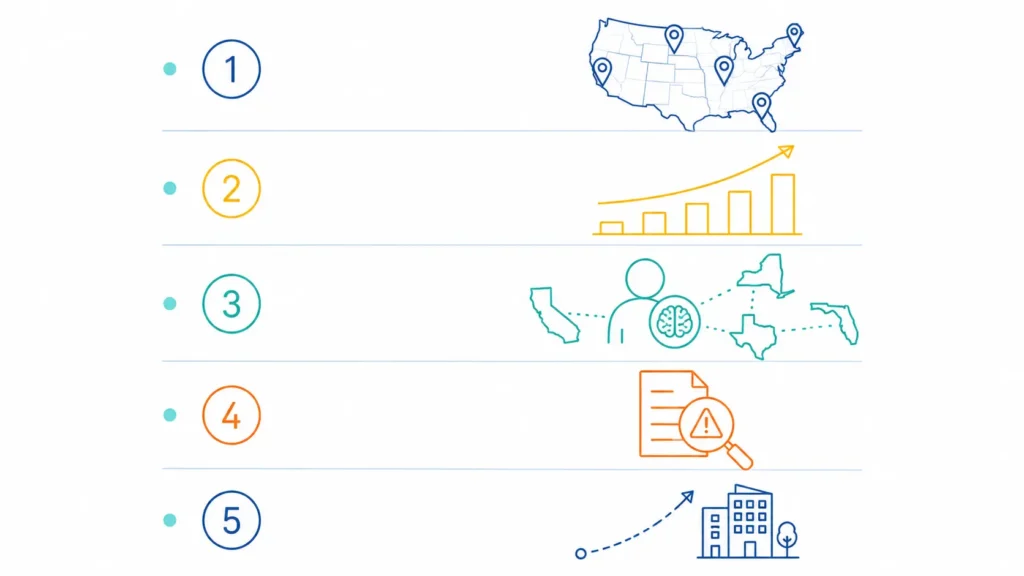
The Five Variables That Should Drive the In-House vs. Outsource Decision
Variable 1: Number of active filing jurisdictions
The complexity threshold matters more than almost any other factor. A company with nexus in 5 states and straightforward product taxability can reasonably manage compliance with a part-time internal resource and a good software tool. That same company at 25 states, with different rates, different filing frequencies, different product classifications, and different exemption certificate rules in each, is operating at a level of complexity where a single internal hire rarely has the breadth of expertise to get everything right.
The inflection point most tax advisors identify: when a company crosses 15 active filing jurisdictions with mixed product taxability, the expertise gap in an internal generalist hire begins to cost more in audit risk than the salary saves in vendor fees.
Variable 2: Rate of change in the compliance footprint
A stable company with established nexus and predictable revenue doesn’t need the same infrastructure as one that’s opening new markets, hiring remote employees in new states, acquiring businesses, or launching new product lines every year. Change is the hardest thing for an in-house compliance function to manage because it requires both operational execution and advisory expertise simultaneously.
Outsourced partners, particularly those with multi-client practices, see the same compliance changes across dozens of companies at once. A state that changes its SaaS taxability rule in October triggers an immediate update across every client in that provider’s book. An in-house analyst at a single company may not hear about the same change until a filing is wrong.
Variable 3: Internal tax expertise depth vs. state breadth
Sales tax compliance requires two different kinds of knowledge: operational knowledge (how to file, where to register, what forms to use) and advisory knowledge (what’s taxable, where nexus exists, how to structure a VDA, how to respond to an audit). Most internal hires are stronger in one area than the other.
A company that hires a strong operational hire gets accurate, timely filings, but may miss the advisory calls that prevent audit exposure. A company that hires a strong advisory resource gets good strategic guidance, but may find that day-to-day filing execution is underprioritized. The fully staffed in-house model, operational staff plus advisory expertise, is expensive. A senior sales tax manager with advisory capability in multiple states earns $180,000 to $220,000 in total compensation in most major markets. Adding an analyst brings the team cost to $280,000 or more annually, before software, training, and overhead.
Variable 4: Audit history and current exposure profile
A company that has never been audited and has a clean nexus footprint is a different risk profile from a company that has open audit periods in three states, unresolved VDA negotiations, and a history of exemption certificate gaps. Audit defense and remediation are specialized skills that most in-house generalists haven’t built and the cost of learning on the job during an active audit is measured in audit findings, not tuition.
For companies with active or recent audit activity, outsourced expertise is almost always the right call during the remediation period, even if the long-term model is internal.
Variable 5: Strategic trajectory of the business
A company planning a significant acquisition in the next 18 months, entering the EU market, or launching a new digital product line is about to face compliance complexity it doesn’t have yet. Building internal capacity for future complexity is expensive and slow, recruiting, hiring, and onboarding a qualified sales tax professional takes four to six months in the current market. Outsourcing provides immediate access to expertise the company needs now, with the ability to scale back when the complexity normalizes.
The Decision Matrix: Where Each Model Actually Wins
| Scenario | In-House Wins | Outsource Wins |
| Filing jurisdictions | Under 10, stable | 15+, or growing |
| Product taxability | Simple, single category | Mixed, digital+ physical, exempt categories |
| Compliance footprint change rate | Low (stable business) | High (growth, acquisition, new markets) |
| Internal expertise | Deep multi-state advisory | Operational only, or generalist |
| Audit history | Clean, no open periods | Active audits, VDA negotiations, remediation |
| Business trajectory | Stable, predictable | Acquisition, international expansion, new products |
| Annual compliance budget | Over $300K available | Under $200K, or cost-sensitive |
| Technology infrastructure | ERP with clean tax integration | Fragmented systems, integration gaps |
The matrix doesn’t produce a binary answer. Most enterprise companies land in the middle, where a hybrid model, combining an internal coordinator with an outsourced specialist partner, outperforms either extreme.
What the Hybrid Model Looks Like in Practice
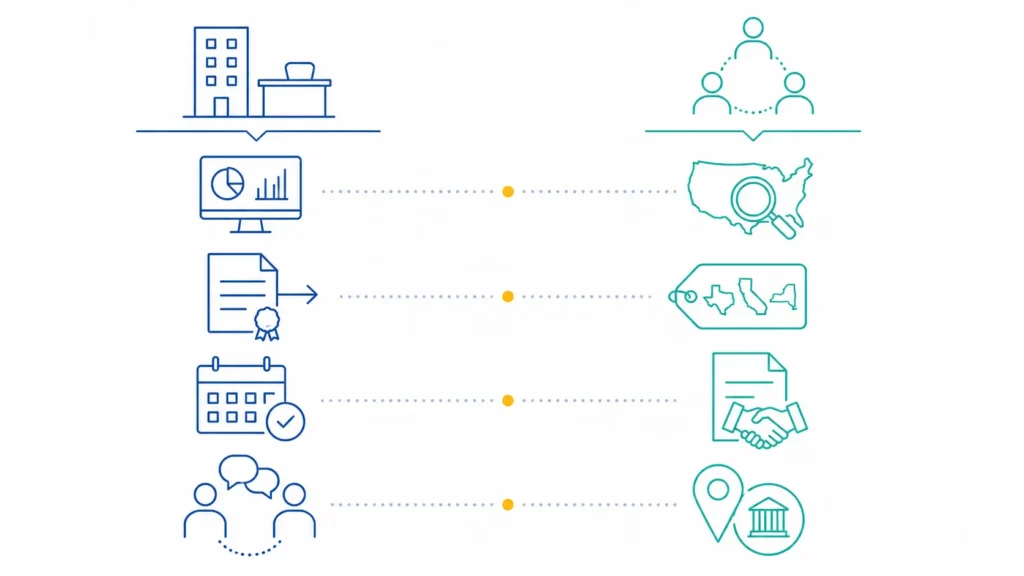
The hybrid model is the most common structure among mid-market and growth-stage enterprise companies, and for good reason. It assigns each function to whoever handles it most efficiently:
Internal team owns:
– Day-to-day relationship with ERP and billing systems
– Exemption certificate collection from customers
– Internal coordination between AP, procurement, and HR on nexus-triggering events
– First-line review of filing calendars and due dates
Outsourced partner owns:
– Nexus analysis and monitoring
– Product taxability determination and updates
– VDA negotiations and audit response
– State registration management
– Advisory on legislative changes and new market entry
– Actual return preparation and filing (in most hybrid arrangements)
The internal coordinator doesn’t need to be a sales tax expert. They need to be organized, connected to the right internal stakeholders, and disciplined about feeding information to the external partner on time. The expertise lives outside. The operational coordination lives inside.
The Hidden Costs In-House Teams Consistently Undercount
When enterprise finance teams build the in-house business case, they typically include salary, benefits, and software. They routinely omit four cost categories that materially change the comparison:
Turnover cost:
The average time to replace a specialized sales tax professional is four to six months, plus three to six months of onboarding before full productivity. During that gap, either filings slip or the workload falls on staff who aren’t qualified to handle it.
Training and currency:
Sales tax law changes constantly across 45 taxing states. Keeping an in-house professional current on rate changes, legislative updates, new nexus rules, and emerging digital taxability questions requires ongoing investment in conferences, publications, and continuing education, costs that rarely appear in the original hire budget.
Audit response capacity:
When an audit lands, it consumes the in-house team at full capacity for weeks or months. If the team is already fully utilized on routine compliance, something else falls behind. Outsourced providers handle audits as a separate engagement without disrupting ongoing filing operations.
The “single point of knowledge” risk:
When one person holds all institutional knowledge of the compliance function, which jurisdiction codes, which exemptions, which customers have which certificates and that person leaves, the knowledge leaves too. Outsourced providers maintain documented processes and institutional memory independent of any individual.
When to Make the Switch from In-House to Outsource (or Back)
Switch to outsource when:
– The company crosses 15 active filing jurisdictions
– A significant acquisition adds complex new nexus obligations
– An audit is initiated in a state where internal expertise is thin
– The internal team’s error rate in filings or exemptions is rising
– A key internal hire exits and the replacement timeline is uncertain
Switch back to in-house (or build internal capacity) when:
– The compliance footprint has stabilized at a manageable size
– The company has the budget and timeline to hire a qualified multi-state expert
– Internal coordination complexity justifies a dedicated internal resource
– The company’s audit profile is clean and the ongoing obligation is predictable
Final Words
The in-house vs. outsource question doesn’t have a universal answer, but it does have a structured one. The right model is determined by filing complexity, rate of change, internal expertise depth, audit history, and business trajectory. Most enterprise companies that evaluate these five variables honestly find they’re either underinvesting in outsourced expertise (running too lean on advisory capability) or overpaying for internal capacity that doesn’t match the actual complexity of their obligation.
The worst outcome is not choosing wrong. It’s not choosing deliberately, defaulting to whatever model exists through inertia while the compliance obligation quietly outgrows it.
This decision deserves the same rigor as any other enterprise operational choice. The audit exposure from getting it wrong is real. So is the salary cost from overbuilding internal capacity for a compliance function that an outsourced partner handles better, faster, and for less.
Not Sure Which Model Fits Where You Are Right Now?
Integral Sales Tax (IST) works with enterprise companies across every stage of this decision, from initial nexus analysis for companies evaluating their true compliance footprint, to full managed compliance for businesses that have outgrown their internal capacity, to hybrid advisory arrangements where IST provides expert oversight while the internal team handles day-to-day operations.
The starting point is a straightforward assessment: what does your compliance obligation actually look like today, and does your current model, in-house, outsourced, or hybrid, match it?
Talk to an IST advisor today
Find out which model fits your compliance complexity & what it would cost to get it right
Frequently Asked Questions
When should an enterprise company outsource sales tax compliance instead of hiring in-house?
An enterprise should consider outsourcing when it has nexus in 15 or more filing jurisdictions, when the compliance footprint is changing rapidly due to growth or acquisition, when the company has active audit exposure, or when replacing an internal hire would leave a critical gap for four to six months. Outsourcing provides immediate access to multi-state expertise that would take months to recruit and hire internally.
How much does it cost to build an in-house sales tax compliance team?
A senior sales tax manager with multi-state advisory capability earns $180,000 to $220,000 in total annual compensation in most major U.S. markets. Adding a sales tax analyst brings the team cost to $280,000 or more annually, before software licenses, training, conferences, and overhead. These costs are fixed regardless of compliance complexity, outsourced models typically scale with the actual compliance footprint.
What is a hybrid sales tax compliance model?
A hybrid model combines an internal coordinator who manages day-to-day operational tasks, exemption certificate collection, ERP coordination, filing calendars, with an outsourced specialist partner who handles nexus analysis, product taxability determinations, VDA negotiations, audit response, and return preparation. The internal resource does not need to be a sales tax expert; the expertise lives with the external partner.
What is the 15-jurisdiction inflection point in sales tax compliance?
Most tax advisors identify 15 active filing jurisdictions as the threshold where internal generalist expertise begins to cost more in audit risk than it saves in vendor fees. Below 15 jurisdictions with simple product taxability, an in-house resource plus software is manageable. Above 15, especially with mixed product types, exemption categories, and varying filing frequencies, the breadth of expertise required typically exceeds what a single internal hire can maintain.
What are the hidden costs of in-house sales tax compliance that most enterprises miss?
The four most commonly underestimated costs are: turnover replacement (four to six months of gap plus three to six months of onboarding at full salary cost); training and currency (ongoing investment in education, publications, and conferences to stay current across 45 states); audit response capacity (active audits consume the entire in-house team while routine filings continue); and single-point-of-knowledge risk (when the key hire leaves, institutional knowledge of exemptions, jurisdictions, and customer classifications leaves with them).
Does outsourcing sales tax compliance work for companies with complex ERP integrations?
Yes, but the outsourced partner must have demonstrated integration capability with the company’s ERP platform. When evaluating outsourcing providers, enterprises should confirm the provider can integrate with existing systems, NetSuite, SAP, Salesforce, or other platforms, to minimize disruption and enable accurate data exchange. A provider that requires manual data export and import creates operational risk that partially offsets the expertise benefit.
When should a company switch from outsourced back to in-house sales tax compliance?
A company should consider building internal capacity when: the compliance footprint has stabilized at a predictable and manageable size; the company has the budget and timeline to recruit a qualified multi-state expert (four to six months minimum); internal coordination complexity has grown to the point where a dedicated internal resource adds value beyond what an outsourced coordinator provides; and the ongoing audit profile is clean with no active remediation.
How do enterprise companies typically start the in-house vs. outsource evaluation?
The most effective starting point is a current-state compliance assessment: mapping every state where the company has nexus, calculating the current filing obligation by jurisdiction and frequency, identifying any gaps between the current compliance model and the actual obligation, and estimating the cost of those gaps in audit risk. That assessment, not a salary comparison, is what drives the right decision. IST conducts these assessments as the first step in any compliance model recommendation.
Leave a Reply