
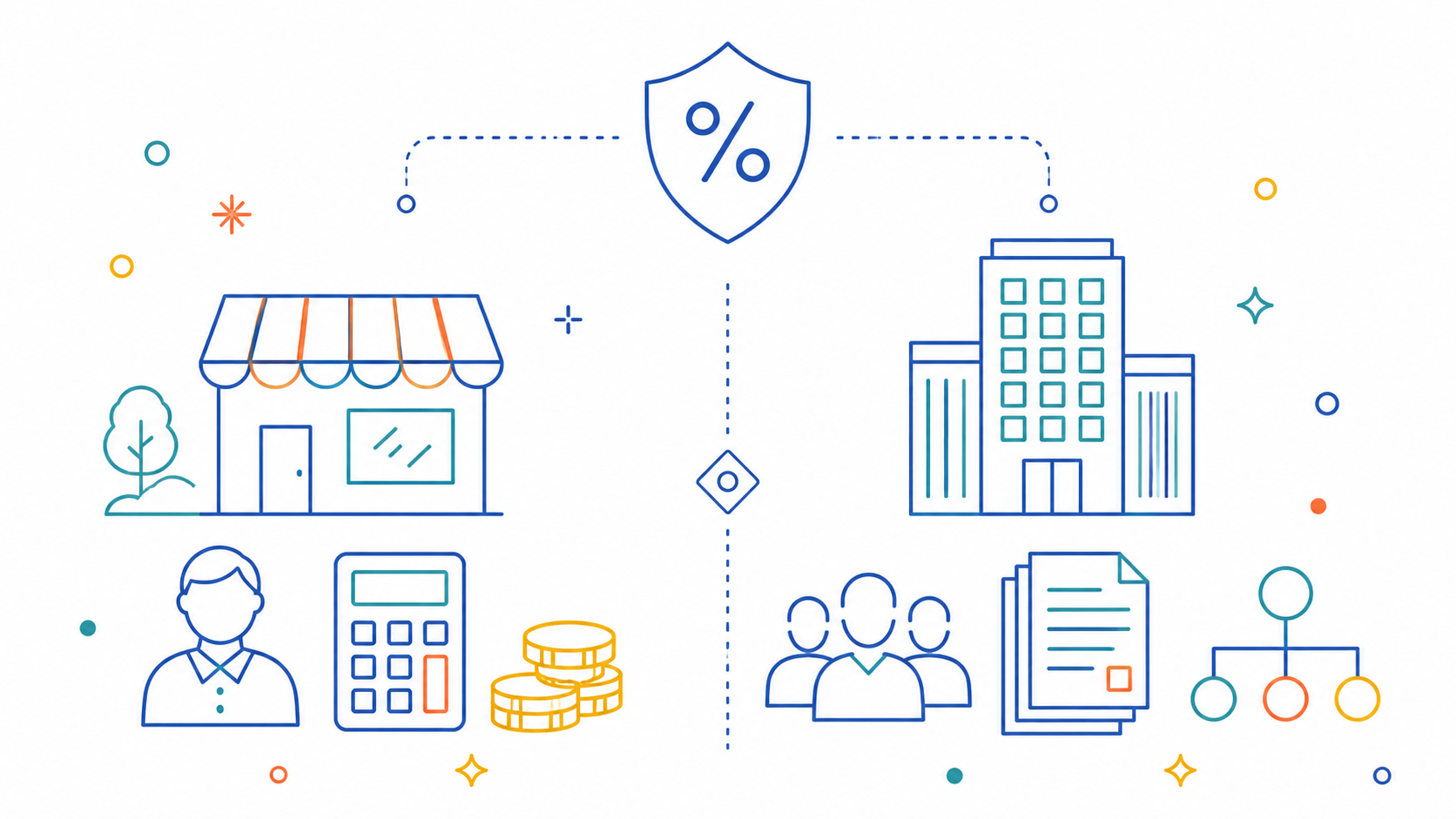
A $2 million ecommerce company and a $200 million distributor both need sales tax compliance. That’s where the similarity ends. The tools, processes, and risks that apply to each are so different that treating them the same way, which many software vendors still do, is one of the most expensive mistakes in tax management.
“Small business vs. enterprise sales tax compliance” is not a debate about which type of business matters more. It’s a practical question about which solutions actually fit the complexity, volume, and risk profile of a given organization. Getting that match wrong doesn’t just waste money. It leaves gaps that auditors find.
Small business and enterprise sales tax compliance differ in risk type, complexity, and required infrastructure. Small businesses most often face undetected nexus and back-tax liability. Enterprise businesses manage audit exposure, multi-state filing, and high-volume calculation accuracy. The right solution depends on accurately diagnosing which problem the business actually has, before selecting or deploying any software.
Small business vs. enterprise sales tax compliance is not just a matter of scale, it’s a difference in risk type and solution requirements. Small businesses typically face undetected economic nexus, back-tax exposure, and limited internal capacity to manage filings. Enterprise businesses face audit risk, product taxability complexity, exemption certificate management, and multi-entity filing across 20 or more states. Both groups make the same core mistake: deploying software before understanding their actual obligations. Compliance starts with a nexus analysis and product taxability review, not with automation.
What Small Business Tax Compliance Actually Looks Like
A small business typically defined as a company with under $10 million in annual revenue, usually sells in one or a handful of states. Its sales tax obligations are real, but narrow. The compliance stack is lean: maybe one accounting system, one sales channel, one person handling tax filings alongside five other responsibilities.
The defining challenge for small businesses isn’t complexity. It’s awareness. Most small business owners don’t know they’ve crossed an economic nexus threshold until long after it happened. A Shopify store that starts selling in 10 states during a strong Q4 can accumulate sales tax obligations in six or seven of them without a single flag going up internally.
The risk here is back liability. Uncollected sales tax from prior periods, plus interest, plus penalties, can become a serious cash problem for a business that’s still growing. And because small businesses rarely have dedicated tax staff, errors tend to compound quietly.
What Enterprise Tax Compliance Demands
Enterprise compliance is a different category entirely. A company with operations across 20 or more states, multiple legal entities, high transaction volumes, and diverse product lines isn’t asking whether it has nexus. It knows it does. The questions are about accuracy, speed, auditability, and integration.
At this scale, a one-basis-point tax calculation error on $100 million in sales is $100,000 in misallocated liability. That’s the kind of number that shows up in an audit finding. So enterprise tax compliance is less about understanding the rules and more about executing them correctly, consistently, and at volume, across ERP systems, billing platforms, and multiple jurisdictions simultaneously.
The risk shifts, too. Enterprise businesses are far more likely to face formal audits. They deal with nexus in nearly every state, complex product taxability questions, exemption certificate management at scale, and filing across dozens of jurisdictions with different deadlines. A controller at a national distributor isn’t worried about discovering nexus. She’s managing 47 state registrations, tracking exemption certificate expiration dates, and trying to get her ERP to stop miscoding bundled product sales.
How Sales Tax Compliance Needs Differ by Business Size
This table maps the key differences directly:
| Compliance Factor | Small Business | Enterprise |
| Number of states with nexus | 1–10 | 20–50+ |
| Primary risk | Undetected nexus, back liability | Audit exposure, calculation errors |
| Team structure | Owner or generalist accountant | Dedicated tax team, outside counsel |
| Software needs | Lightweight calculation tool or manual | ERP-integrated, multi-entity automation |
| Exemption certificate management | Minimal | High volume, expiration tracking |
| Filing frequency | Monthly or quarterly in a few states | Monthly in most states |
| Product taxability complexity | Low to moderate | High (bundles, digital, exempt categories) |
| Voluntary disclosure need | Common | Less common, but still relevant |
The table illustrates something important: the compliance problem for a small business is primarily diagnostic. For an enterprise, it’s operational.
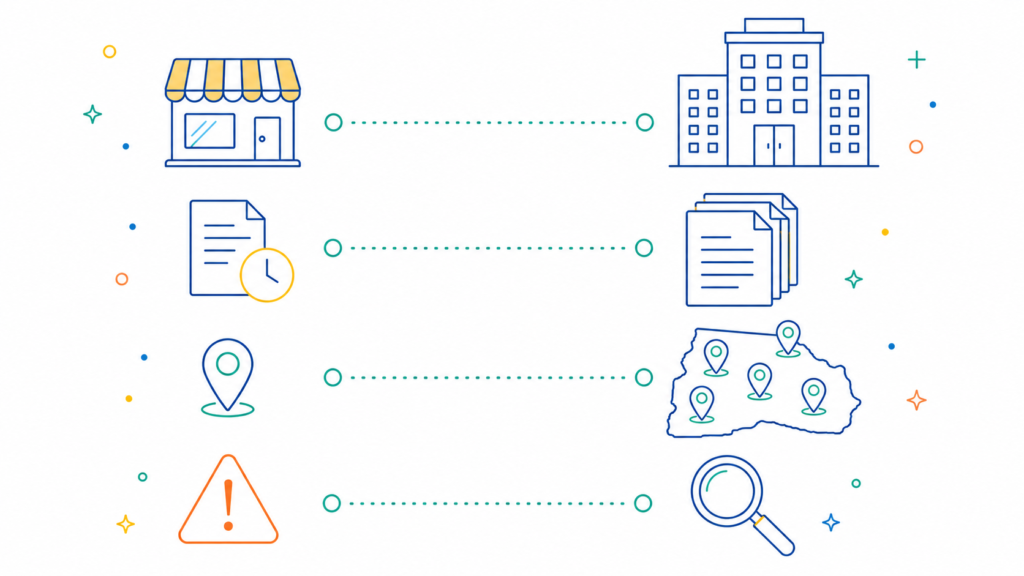
The Risks of Mismatching Solutions to Business Size
Small businesses that deploy enterprise-grade software often end up paying for capability they don’t need, while still getting the setup wrong because the software assumes a level of in-house expertise they don’t have. The software collects tax. But if the nexus analysis was never done, the software may be collecting in the wrong states, or missing states entirely.
Conversely, enterprise businesses that rely on lightweight tools or that let individual states fall through the cracks during rapid growth face audit risk that can exceed the cost of proper compliance infrastructure by a factor of ten.
But the most common mistake isn’t choosing the wrong software. It’s automating a broken process. An enterprise that has miscoded its product taxability in the ERP and then runs it through an automated tax engine gets wrong answers at scale. Speed without accuracy isn’t compliance. It’s high-volume error.
What the Right Solution Actually Looks Like at Each Stage
For small and growing businesses:
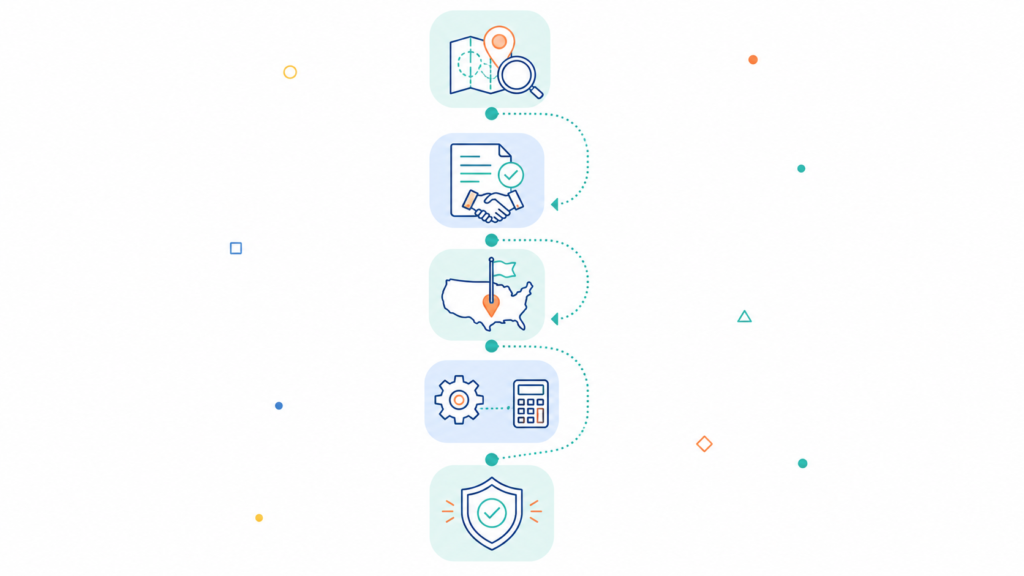
- Start with a nexus analysis to know where obligations already exist
- Use voluntary disclosure to address any past exposure before it becomes a liability
- Register in states where thresholds have been crossed
- Implement a calculation tool that matches the current transaction volume
- Set up monitoring so future nexus triggers are caught early
For mid-market and enterprise businesses:
- Conduct a full product taxability review across all SKUs and service lines
- Integrate tax calculation directly into the ERP or billing system
- Build exemption certificate management into the purchase order workflow
- Establish multi-entity filing infrastructure with jurisdiction-specific calendars
- Run periodic nexus reviews as the business grows, acquires, or changes its product mix
Neither list is about software first. Both lists start with understanding the actual obligation, because automation can only enforce rules correctly if the rules have been correctly identified.
Final Words
The gap between small business and enterprise sales tax compliance isn’t just a question of scale. It’s a question of risk type, team capacity, and what “getting it right” actually means at each level. Small businesses need to find their exposure before it compounds. Enterprise businesses need to execute correctly on obligations they already know they have.
Both groups share one problem: compliance solutions that aren’t designed for their specific situation will fail them, either by being too simple to catch everything or too complex to be implemented correctly without dedicated tax expertise. The right approach starts with an honest assessment of where the business stands today, not with purchasing software and hoping it fills the gaps.
Sales tax compliance isn’t a one-size-fits-all problem, and the businesses that treat it that way are the ones that end up with the largest back-tax assessments, audit findings, and remediation bills. Small businesses need to find and address their exposure. Enterprise businesses need to execute on known obligations without errors that compound at volume.
The common denominator is this: software doesn’t create compliance. Understanding your obligations does. Whether you’re a $3 million ecommerce company that just hit nexus in Texas or a $300 million distributor managing 40 state registrations, the first question is always the same, do you actually know what you owe?
If the answer is uncertain, that’s the starting point. Not the software selection.
Get a Compliance Assessment Designed for Your Business
Integral Sales Tax (IST) works with businesses at every size and stage, from first-time nexus discovery to enterprise-scale compliance automation. The starting point is always an honest assessment of where your business stands: what states require registration, what products are taxable, and whether past exposure needs to be addressed through voluntary disclosure.
If your current compliance setup was built around the business you were two years ago, it may not fit the business you are today.
Schedule a free consultation with IST → Get clarity on your actual obligations, then build the solution that fits.
What is the difference between small business and enterprise sales tax compliance?
Small businesses typically have nexus in fewer states, limited internal tax resources, and face the highest risk from undetected obligations and past-due liability. Enterprise businesses have known, multi-state obligations and face risk primarily from execution errors, inaccurate calculations, expired exemption certificates, and audit exposure at scale.
When does a small business need to start collecting sales tax in multiple states?
Once a small business crosses a state’s economic nexus threshold, generally $100,000 in annual sales or 200 transactions, it must register and begin collecting sales tax in that state. Thresholds vary slightly by state. Many small businesses cross these thresholds without realizing it, which is why periodic nexus reviews matter.
What sales tax compliance tools do enterprise businesses need?
Enterprise businesses typically need ERP-integrated tax calculation engines, automated exemption certificate management, multi-entity filing infrastructure, and jurisdiction-specific compliance calendars. The tools must handle high transaction volumes, multiple product lines with varying taxability, and filing across dozens of states with different deadlines and rates.
What is a voluntary disclosure agreement and when should a small business use one?
A Voluntary Disclosure Agreement (VDA) is a formal arrangement between a business and a state tax authority that limits back-tax liability and waives penalties in exchange for coming forward proactively. Small businesses with uncollected sales tax from prior periods should pursue a VDA before a state initiates an audit, when the cost of remediation is substantially lower.
Can a small business use the same sales tax software as an enterprise?
Technically yes, but it’s usually the wrong fit. Enterprise software assumes dedicated tax staff, ERP integration, and in-house expertise to configure correctly. A small business without that infrastructure often ends up with misconfigured software that collects tax incorrectly. A lightweight solution built on a proper nexus analysis is a more reliable starting point.
How often should a growing business review its sales tax nexus?
At minimum, annually, but a nexus review should also be triggered by any material change to the business: entering a new product category, crossing revenue milestones in specific states, hiring remote employees in new states, or acquiring another business. Growth accelerates nexus exposure faster than most internal teams track it.
What are the biggest sales tax compliance risks for enterprise companies?
The most significant risks for enterprise businesses are calculation errors at scale (a small percentage error across millions in revenue becomes a large dollar amount), expired or missing exemption certificates in an audit, product miscoding in an ERP or billing system, and failure to file in jurisdictions where nexus was triggered by a merger or acquisition.
Leave a Reply