
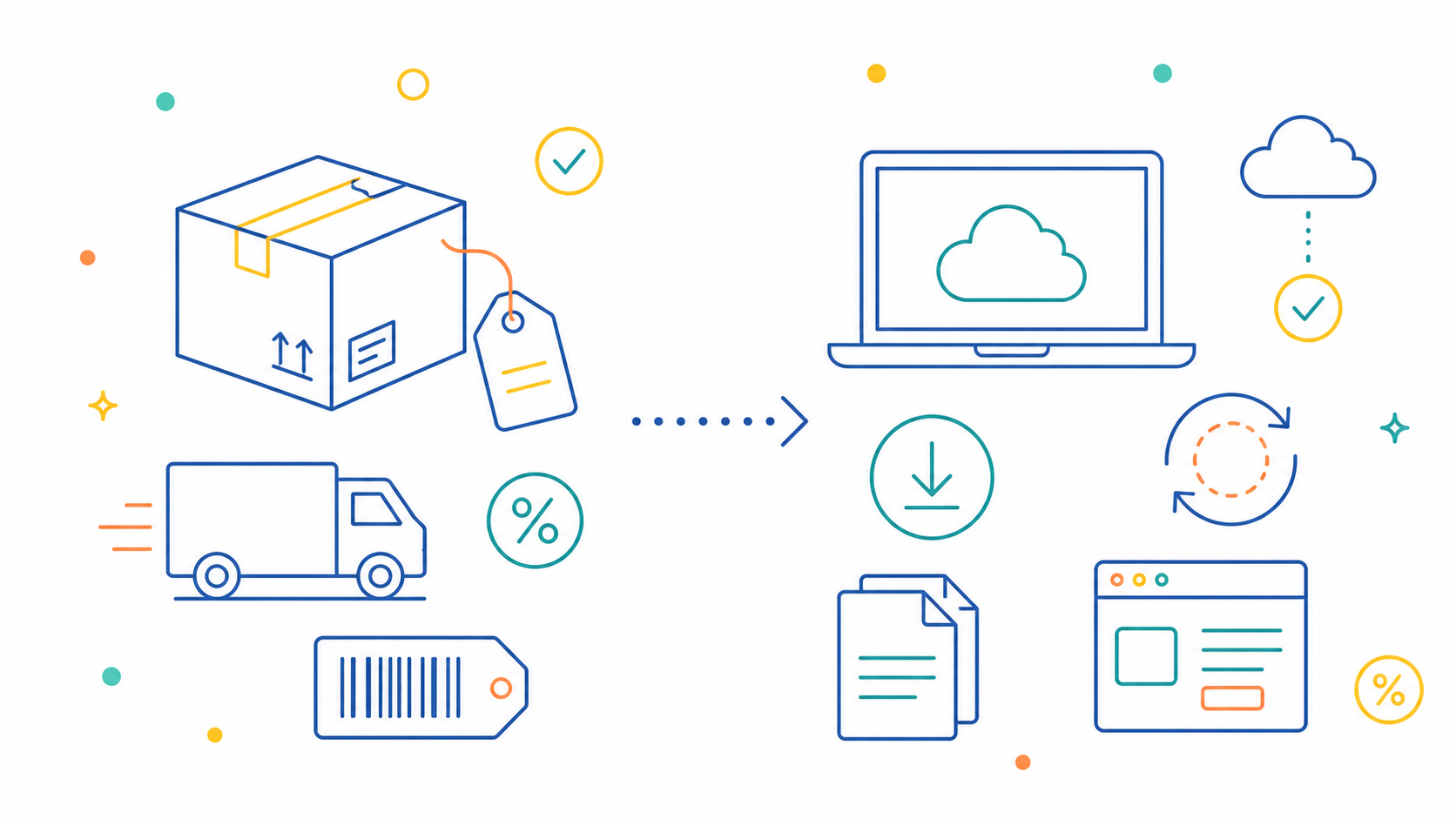
Sales tax rules differ significantly for digital goods vs. physical goods. Physical products (tangible personal property) are taxable in most U.S. states by default. Digital goods, including SaaS, downloads, and streaming services, follow no uniform rule; taxability varies by state, product type, and delivery method. Businesses must evaluate each jurisdiction separately to ensure compliance.
Selling a software subscription and shipping a physical product might feel like two sides of the same business coin but when it comes to sales tax, they operate in completely different worlds. If you’re a SaaS company, ecommerce seller, or multi-state business assuming the same rules apply to both, you could be sitting on a significant and growing tax liability right now.
The distinction between “sales tax on digital goods vs. physical goods” is one of the most misunderstood areas of tax compliance in the United States and globally. The rules vary dramatically by state, country, and product type and tax authorities are actively closing loopholes as digital revenue grows. Understanding how these rules differ isn’t optional. For businesses operating across multiple jurisdictions, it’s essential.
Sales tax treatment of digital goods vs. physical goods varies widely across U.S. states and international jurisdictions. Physical goods (tangible personal property) are generally taxable by default, with well-established exemption frameworks. Digital goods, including downloaded software, SaaS subscriptions, streaming content, and e-books, follow no federal standard in the U.S. Each state determines taxability independently. Globally, the EU, Canada, Australia, and the UK have expanded VAT/GST obligations to cover digital services sold by foreign sellers. Businesses must conduct product taxability reviews and nexus analyses to remain compliant across all jurisdictions.
What Are Digital Goods and Physical Goods for Sales Tax Purposes?
Before examining the rules, it’s important to define each category clearly because the definitions themselves drive taxability.
“Physical goods” (also called tangible personal property, or TPP) are items you can touch, ship, and hold. This includes retail merchandise, manufactured products, equipment, components, and anything delivered in a physical form. Most jurisdictions have taxed TPP for decades, and the rules are relatively well-established.
“Digital goods”, by contrast, are products and services delivered electronically. They include:
– Downloadable products: software, music, e-books, games, fonts, templates
– Streaming content: video, audio, and media accessed online without a permanent download
– SaaS (Software as a Service):cloud-based software accessed via subscription
– Digital subscriptions: news platforms, databases, professional tools
– Electronically delivered services: online courses, digital consulting, cloud storage
The challenge is that there is no single universal definition. What one state calls a “digital product,” another calls a “service” and the tax treatment changes accordingly.
Why Sales Tax Rules Differ for Digital vs. Physical Products
Physical goods have always been the foundation of sales tax. When a state imposes sales tax, it originally did so to capture revenue from the sale of tangible items within its borders. Digital goods didn’t exist in most tax codes until relatively recently, which means:
1. Many older state tax codes simply didn’t address them.
2. States have been retrofitting existing laws or writing new ones to capture digital revenue.
3. The result is a patchwork of rules that varies dramatically by jurisdiction.
Furthermore, digital goods complicate the concept of “nexus”, the connection a business must have with a state before that state can require it to collect sales tax. A company selling physical goods has clear nexus through warehouses, employees, or inventory. A SaaS company may have customers in 40 states without a single physical presence in any of them.
How Sales Tax Works on Physical Goods: The Established Framework
For tangible personal property, sales tax compliance follows a more predictable pattern. Here’s how it generally works in the United States:
– Taxability: Most physical goods are taxable by default. Exemptions exist for specific categories, groceries, prescription drugs, agricultural equipment, but the starting assumption is that TPP is taxable.
– Rate: The combined state and local rate applies based on the “destination” of the goods (where the buyer receives them).
– Nexus triggers: Physical presence (office, warehouse, employees, inventory) plus economic nexus thresholds ($100,000 in sales or 200 transactions in most states).
– Exemptions: Resale certificates, manufacturing exemptions, nonprofit exemptions, and industry-specific carve-outs are well-established and consistently applied.
Internationally, physical goods are subject to customs duties, VAT, or GST at import with well-established frameworks in the EU, Canada (GST/HST), Australia (GST), and the UK (VAT).
How Sales Tax Rules Differ for Digital Goods and Subscriptions
This is where compliance becomes genuinely complex. Sales tax rules for digital goods differ from physical goods in four critical ways.
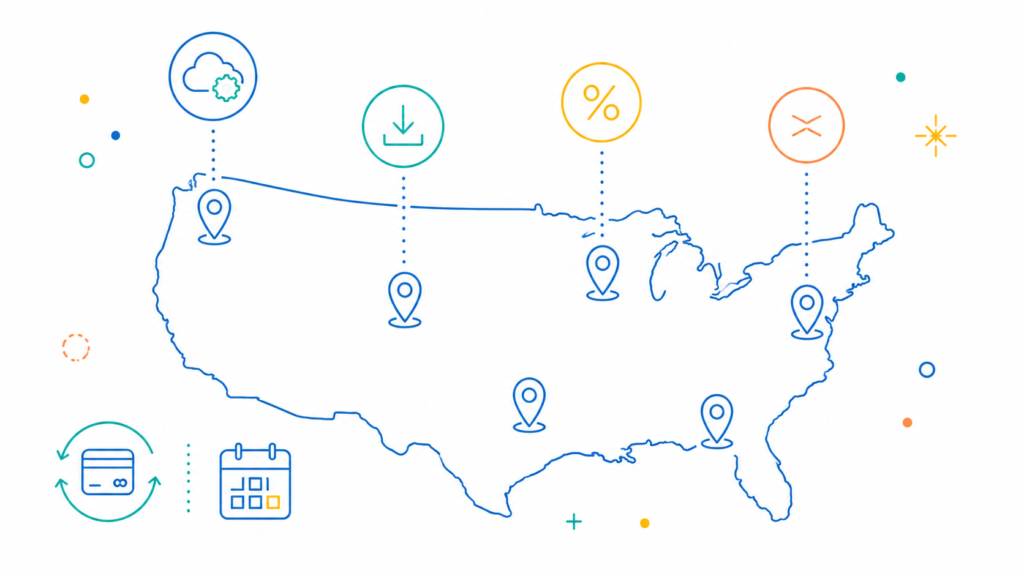
1. Taxability Varies Wildly by State
In the U.S., there is no federal standard for taxing digital goods. Each of the 45 states that impose a sales tax makes its own determination. As of 2025, the landscape looks like this:
| Category | Taxable in Most States | Taxable in Some States | Generally Exempt |
|---|---|---|---|
| Downloaded software (permanent) | ✓ | ||
| SaaS / cloud software | ✓ | ||
| Streaming video/audio | ✓ | ||
| Digital books (e-books) | ✓ | ||
| Online courses | ✓ | ||
| Digital news subscriptions | ✓ |
States like Texas, New York, and Pennsylvania broadly tax digital goods and SaaS. States like California do not impose sales tax on most SaaS products. Florida taxes some digital downloads but not others. Oregon, Montana, New Hampshire, and Delaware impose no general sales tax at all.
2. The “Delivered Electronically” Test
Many states use the method of delivery to determine taxability. If a product is delivered electronically, meaning no physical medium changes hands, it may be treated differently than if it comes on a DVD or USB drive. Some states explicitly exempt electronically delivered software while taxing the same software sold on a disc.
3. Subscription vs. One-Time Purchase
How a digital product is sold also affects its tax treatment. A one-time software download may be treated as a taxable sale of tangible property (if a physical copy exists), while the same software sold as a monthly SaaS subscription may be classified as a nontaxable service in several states. This distinction creates planning opportunities but also compliance risks if misapplied.
4. Bundled Digital and Physical Products
When businesses bundle digital and physical components, such as a hardware device sold with a software subscription, states apply different “bundling rules”. Some tax the entire bundle at the rate of the predominant item. Others require sellers to separate and tax each component individually. Getting this wrong is one of the most common and costly mistakes in multi-channel commerce.
Global Sales Tax Rules for Digital Goods: A Snapshot
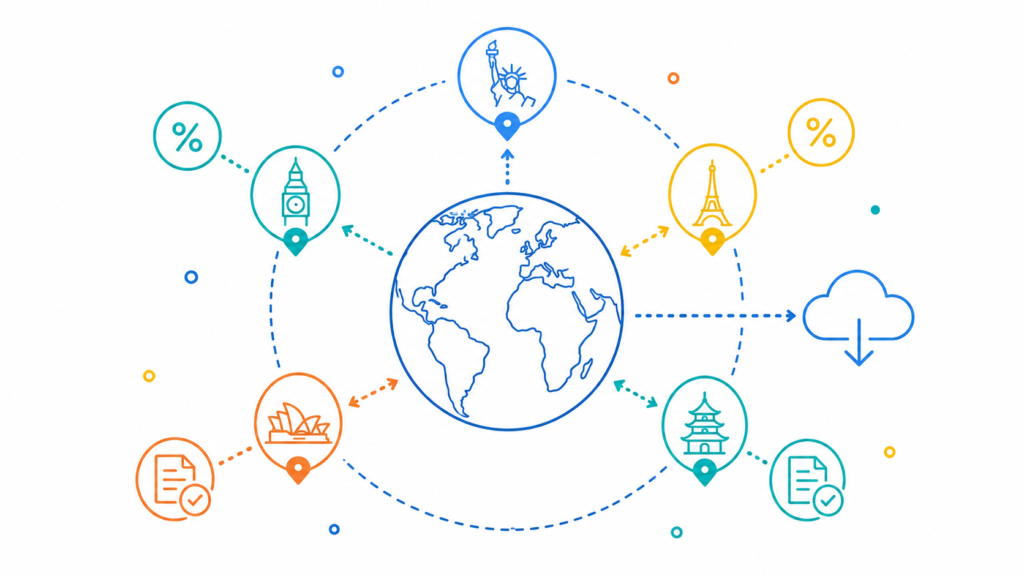
The U.S. isn’t alone in grappling with digital taxation. Around the world, tax authorities have moved aggressively to capture digital revenue:
– European Union: Under the “EU VAT on Digital Services” rules (effective 2015, expanded 2021), non-EU businesses selling digital goods to EU consumers must register for VAT, either in each member state or via the One-Stop Shop (OSS) system. Rates range from 17% to 27%.
– Canada: The federal GST/HST applies to digital services sold to Canadian consumers. Since 2021, foreign digital platforms have been required to register and collect GST/HST.
– Australia: The GST applies to digital goods and services supplied to Australian consumers by offshore suppliers, effective July 2017.
– United Kingdom: Post-Brexit, the UK maintains its own VAT framework for digital services, mirroring many EU rules.
– Asia: Countries including Japan, South Korea, Singapore, and India have introduced digital services taxes or GST requirements for foreign digital providers.
The common thread globally: “governments treat digital goods as taxable”, and the compliance obligation increasingly falls on the seller, not the buyer.
The Real Risks of Getting Digital vs. Physical Sales Tax Wrong
Misclassifying a product or misunderstanding which rules apply can lead to serious consequences, including:
– “Unpaid tax liability” with interest and penalties accumulating across multiple periods
– “Audit exposure” in states where economic nexus thresholds have been exceeded
– “Back filing obligations” covering years of uncollected tax
– “Reputational damage” with business partners, investors, or acquirers during due diligence
The risk is amplified for digital businesses because revenue can scale rapidly across dozens of jurisdictions simultaneously, long before a compliance infrastructure is in place. A SaaS company that grows from $500,000 to $5 million in revenue may suddenly owe sales tax in 15 or 20 states, retroactively.
This is why nexus analysis and proactive compliance are far less costly than reactive remediation. Understanding “how sales tax rules differ for digital and physical goods” is the first step to avoiding these exposures.
What Businesses Should Do Next
Whether you sell physical products, digital subscriptions, or both, here is a practical compliance roadmap:
1. Conduct a product taxability review.
Map every product and service you sell to the taxability rules in each jurisdiction where you have customers.
2. Perform a nexus analysis.
Identify every state or country where you have crossed an economic nexus threshold for both physical and digital sales.
3. Review your bundling practices.
If you sell products that combine physical and digital components, ensure your invoicing and tax treatment align with each jurisdiction’s bundling rules.
4. Evaluate voluntary disclosure.
If you have past exposure, especially for digital goods that were previously undertaxed, a Voluntary Disclosure Agreement (VDA) can limit your back-tax liability and eliminate penalties.
5. Automate with the right foundation.
Sales tax software is powerful, but it only works correctly if your product classifications and nexus determinations are accurate first.
Final Words
The gap between sales tax rules for digital goods and physical goods is wide and it’s still changing. States continue to revise their laws, expand digital taxability, and tighten economic nexus thresholds. Globally, digital services taxes are becoming standard. Businesses that operate as if the old rules still apply are accumulating risk with every transaction.
The good news is that getting compliant is entirely achievable with the right expertise and the right tools. Understanding how sales tax on digital goods differs from physical goods is not a one-time exercise. It’s an ongoing obligation that deserves the same attention you give to revenue, margins, and growth.
Ready to Know Exactly Where You Stand?
At “Integral Sales Tax (IST)”, we help businesses untangle the complexity of digital and physical goods taxation, across every state and jurisdiction where you operate. From nexus analysis and product taxability reviews to voluntary disclosure and ongoing compliance automation, we provide the full solution that tax software alone cannot.
Sales tax compliance for digital and physical goods doesn’t have to be a guessing game. Integral Sales Tax (IST) helps businesses of all sizes understand exactly what they owe, where they owe it, and how to get and stay compliant.
From nexus analysis and state registrations to voluntary disclosure, back filings, and AI-powered tax calculation software, IST provides the full compliance solution not just the software.
Schedule your free consultation with IST today → Find out exactly where your business stands before an auditor does.
-
Is sales tax charged on digital downloads in the United States?
It depends on the state. Most states tax permanent software downloads. Some states, including California, do not impose sales tax on SaaS or cloud-based software. There is no federal rule, each state determines digital product taxability independently.
-
Do SaaS companies have to collect sales tax?
Yes, in many U.S. states. States including Texas, New York, Pennsylvania, and others require SaaS providers to collect sales tax. Other states, like California, generally exempt SaaS from sales tax. SaaS companies must evaluate taxability state by state and monitor economic nexus thresholds.
-
How is sales tax different for subscriptions vs. one-time purchases?
A subscription-based digital product may be treated as a service (often nontaxable) in some states, while the same product sold as a one-time download may be treated as a taxable sale of digital property. The structure of how a product is sold directly affects how it is taxed.
-
What is economic nexus and how does it affect digital sellers?
Economic nexus is the obligation to collect sales tax in a state based solely on revenue or transaction volume, without any physical presence. Most states set thresholds at $100,000 in annual sales or 200 transactions. Digital sellers who meet these thresholds must register and collect sales tax in those states.
-
Are digital goods subject to VAT in the European Union?
Yes. Since 2015, digital services sold to EU consumers are subject to VAT in the buyer’s country of residence. Non-EU businesses must register for VAT, either in each member state individually or through the EU’s One-Stop Shop (OSS) system. Rates vary from 17% to 27% depending on the member state.
-
What is the risk of not collecting sales tax on digital products?
Businesses that fail to collect and remit sales tax on taxable digital goods can face back-tax assessments, interest, and penalties across multiple periods and jurisdictions. Audit risk increases as state revenue departments expand digital compliance enforcement. Voluntary Disclosure Agreements (VDAs) are available to help businesses with past exposure limit their liability.
-
How do bundled physical and digital products get taxed?
Bundling rules vary by state. Some states tax the entire bundle at the rate of the dominant item. Others require line-item separation and tax each component according to its own taxability rules. Sellers must understand each jurisdiction’s bundling rules to avoid over- or under-collecting tax.
-
Do I need to collect sales tax on digital goods sold internationally?
Generally, yes, many countries now require foreign digital sellers to register and collect VAT or GST. The EU, UK, Canada, Australia, Japan, Singapore, and India all have digital services tax frameworks. The obligation typically applies when selling to consumers (B2C) and may not apply to B2B transactions where the buyer self-assesses.
The rules governing sales tax on digital goods vs. physical goods are among the most dynamic and consequential in modern tax compliance. Physical goods operate within a mature, predictable framework. Digital goods, subscriptions, SaaS, downloads, and streaming content, exist in a fragmented landscape where the rules differ by state, by product type, by delivery method, and by how the sale is structured.
Tax authorities in the U.S. and around the world are not standing still. They are actively expanding digital taxability, lowering nexus thresholds, and increasing audit activity against businesses, especially in the software and ecommerce sectors. Every month a business operates without clarity on its digital tax obligations is another month of compounding exposure.
The path forward is not complicated, but it does require action: conduct a nexus analysis, map your product taxability, assess your past exposure, and build an automated compliance foundation on accurate data. The cost of getting it right is a fraction of the cost of getting it wrong.
Sales tax compliance for digital and physical goods doesn’t have to be a guessing game. Integral Sales Tax (IST) helps businesses of all sizes understand exactly what they owe, where they owe it, and how to get and sta compliant.
From nexus analysis and state registrations to voluntary disclosure, back filings, and AI-powered tax calculation software, IST provides the full compliance solution not just the software.
Schedule your free consultation with IST today →
Find out exactly where your business stands before an auditor does.
Leave a Reply