
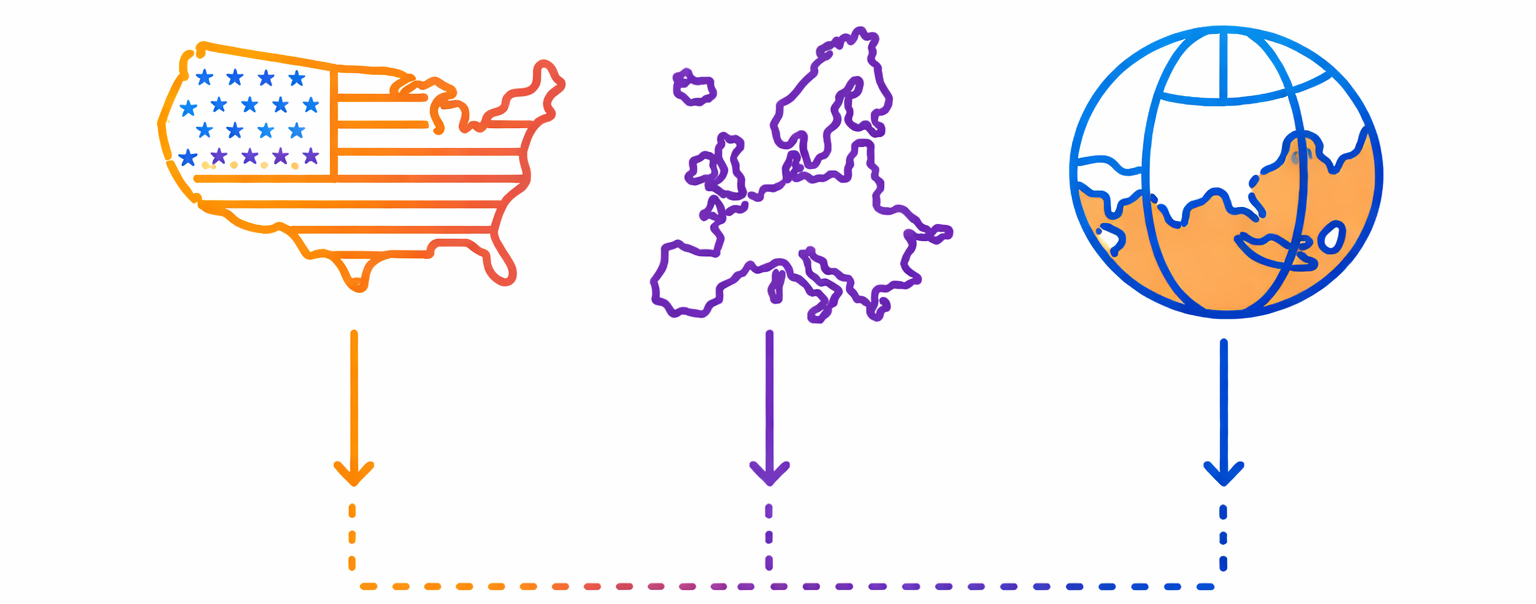
If you sell across borders, one question comes up fast: Why does tax work completely differently depending on where your customer is?
The answer lies in how regions design their tax systems. Understanding sales tax vs VAT vs GST isn’t just academic, it directly affects pricing, compliance, cash flow, and risk.
In this guide, we break down how these three tax systems work, where each applies, and why the differences matter for businesses operating across the U.S., Europe, Asia, and beyond.
Understanding Sales Tax vs VAT vs GST
At a high level, all three are consumption taxes. However, how they’re collected, who pays them, and when they apply are very different.
- Sales tax is primarily used in the United States.
- VAT (Value-Added Tax) is common in Europe and many other regions.
- GST (Goods and Services Tax) is used in countries such as Canada, Australia, and parts of Asia.
Therefore, a business selling internationally may be subject to multiple tax systems at the same time.
Sales Tax vs VAT vs GST in the United States
In the U.S., sales tax is collected only at the final point of sale. Businesses charge customers sales tax and then remit it to state or local authorities.
Key characteristics:
- No federal sales tax
- Rates vary by state, county, and city
- Over 11,000 tax jurisdictions
- Economic nexus rules apply to remote sellers
As a result, compliance becomes complex quickly, especially for ecommerce businesses selling into multiple states.
Sales Tax vs VAT vs GST in Europe
VAT operates very differently. Instead of being charged once, VAT is applied at every stage of the supply chain, from production to final sale.
Key VAT features:
- Businesses collect VAT on sales
- Businesses reclaim VAT paid on expenses
- Net VAT is remitted to tax authorities
- Rates vary by country (standard and reduced rates)
For example, a U.S. business selling digital services to EU customers may be required to register for VAT even without a physical presence. Consequently, VAT compliance often starts earlier than U.S. sales tax obligations.
Sales Tax vs VAT vs GST in Asia and Other Regions
GST is similar to VAT in structure but differs in administration.
Countries using GST include:
- Canada (GST / HST)
- Australia
- New Zealand
- India
- Singapore
GST is usually:
- Applied at multiple stages
- Credit-based (like VAT)
- Centralized or semi-centralized
However, thresholds, filing frequency, and tax rates differ widely. Therefore, businesses expanding into Asia-Pacific markets must evaluate each country independently.
Why Sales Tax vs VAT vs GST Differences Matter for Businesses
The differences between sales tax, VAT, and GST affect businesses in several critical ways:
- Cash flow: VAT/GST credits delay refunds
- Pricing strategy: Tax-inclusive vs tax-exclusive pricing
- Registration thresholds: Often lower outside the U.S.
- Compliance risk: Incorrect registration can trigger audits
- Technology requirements: Invoicing rules vary by region
Moreover, businesses that assume “tax works the same everywhere” often overpay or under-collect, both costly mistakes.
Cross-Border Selling and Multi-Tax Exposure
A single transaction may involve:
- U.S. sales tax (origin or destination)
- EU VAT (customer location)
- GST at import or checkout
For example, a U.S. ecommerce company selling software to Germany may owe EU VAT, not U.S. sales tax. Meanwhile, the same company selling physical goods into Canada may trigger GST or HST obligations.
As a result, manual compliance becomes unsustainable at scale.
How IST Simplifies Sales Tax vs VAT vs GST Compliance
Integral Sales Tax (IST) helps businesses manage sales tax vs VAT vs GST from one unified platform.
IST enables businesses to:
- Identify which tax system applies to each transaction
- Track registration thresholds by region
- Apply correct rates automatically
- Generate compliant reports and filings
- Reduce audit risk across borders
Therefore, businesses gain clarity instead of complexity, even as they expand internationally.
Final Words
Sales tax, VAT, and GST may serve similar purposes, but they operate in fundamentally different ways. Understanding sales tax vs VAT vs GST is essential for businesses selling across regions, platforms, and borders.
With the right technology, compliance doesn’t have to slow growth. IST helps businesses stay accurate, compliant, and confident, no matter where they sell.
Selling across regions? Don’t guess which tax applies.
Start simplifying global tax compliance with Integral Sales Tax today.
Leave a Reply