
Most ecommerce sellers discover the difference between US sales tax and EU VAT the hard way, after their first European order gets flagged, their goods are held at customs, or they receive a registration notice from a country they’d never thought twice about. By then, the damage is already in motion.
These are not two versions of the same system. US sales tax and EU VAT operate on fundamentally different logic, affect cash flow differently, and demand different compliance infrastructure. Understanding how they diverge is not optional for any business that sells across the Atlantic or plans to.
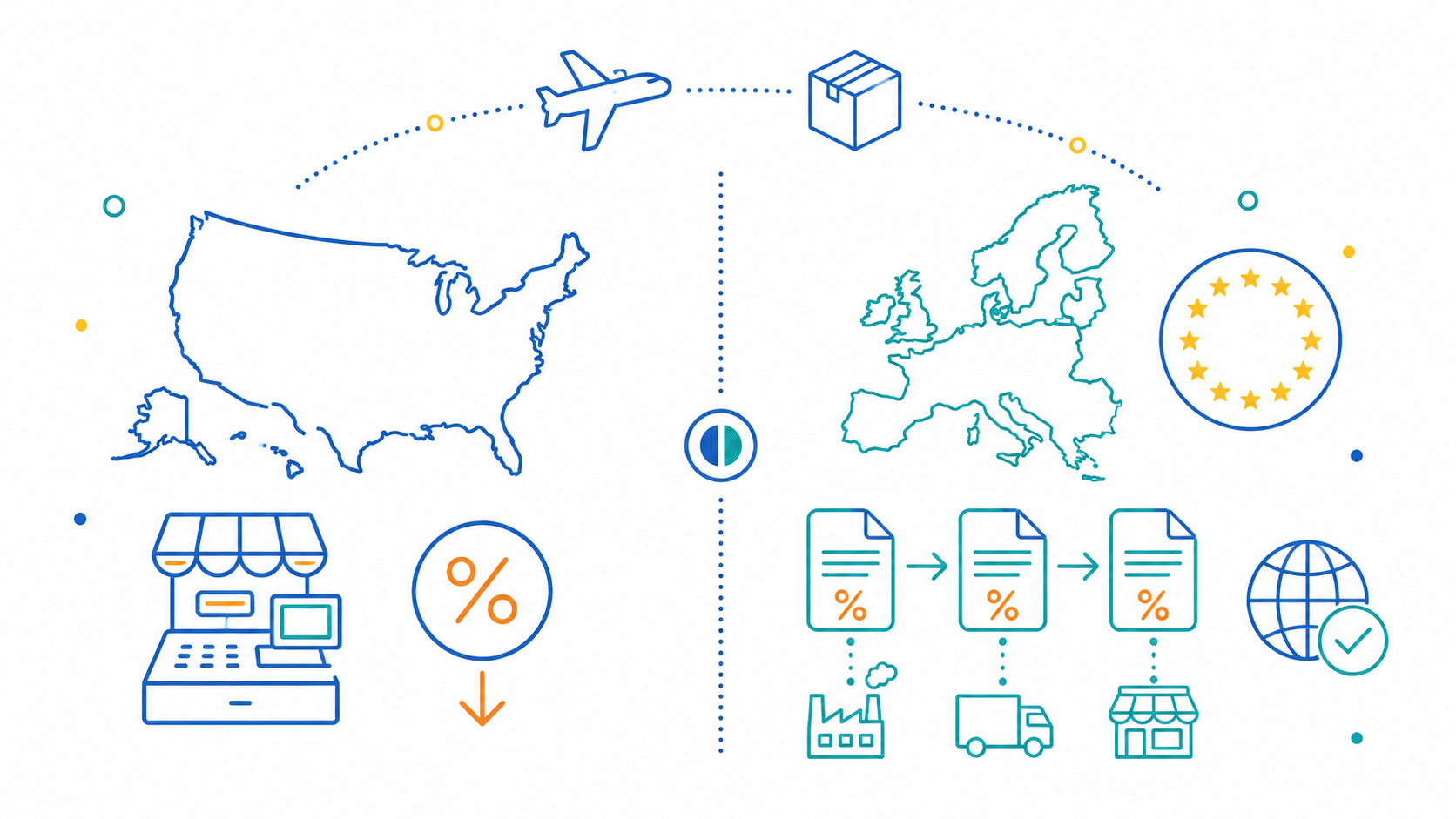
US sales tax vs. EU VAT represents two structurally different international tax systems that cross-border ecommerce sellers must understand separately. US sales tax is a state-level retail tax triggered by economic nexus thresholds, typically $100,000 in annual sales per state. EU VAT is a multi-stage tax applied across the entire supply chain, with rates ranging from 17% to 27% depending on the member state. Non-EU sellers must register for VAT from their first B2C sale, with no de minimis exemption for goods since July 2021. Compliance requirements, registration paths, and B2B treatment differ significantly between the two systems.
What US Sales Tax Actually Is
US sales tax is a state-level consumption tax imposed at the final point of sale. The federal government collects no sales tax. Each of the 45 states that impose it sets its own rate, rules, and exemptions independently. Add county and city taxes on top, and you’re looking at over 11,000 individual tax jurisdictions nationwide.
The seller collects tax from the buyer at checkout and remits it to the relevant state. The buyer bears the economic cost. The seller acts as a collection agent.
Critically, US sales tax applies only once, at the retail stage. A manufacturer sells components to a distributor: no sales tax. That distributor sells to a retailer: no sales tax. The retailer sells to an end consumer: sales tax applies. Everything upstream is covered by resale certificates and exemptions.
For cross-border sellers entering the US market, the trigger is economic nexus, the threshold at which a state can require you to collect and remit sales tax even without physical presence. Most states set this at $100,000 in annual sales or 200 transactions. Cross that line in California, Texas, or New York, and you owe registration, collection, and filing in that state. Miss it, and you’re accumulating back liability.
What EU VAT Actually Is and Why It Works Completely Differently
EU VAT, Value Added Tax, is not a retail tax. It’s a multi-stage tax applied at every step in the supply chain. Each business in the chain charges VAT on what it sells, then deducts the VAT it paid on what it bought. The net difference goes to the government. In theory, only the end consumer bears the full burden. In practice, every business in the chain is responsible for tracking, reporting, and remitting their portion.
VAT rates across EU member states range from 17% (Luxembourg) to 27% (Hungary). There is a standard rate and reduced rates for specific categories (food, books, medical goods) that vary by country. Unlike US sales tax, VAT is embedded in the displayed price in most EU markets. Consumers see a single price inclusive of tax; the seller backs out the VAT component.
For non-EU sellers shipping goods to European buyers, VAT applies from the first euro. There is no de minimis exemption for goods as of July 2021, the previous EUR 22 threshold was eliminated. Every shipment to an EU consumer triggers a VAT obligation.
US sales tax and EU VAT are fundamentally different systems. US sales tax applies only at the final sale, varies by state, and triggers based on economic nexus thresholds. EU VAT applies at every supply chain stage, ranges from 17% to 27% by country, and applies from the first sale to a European consumer with no minimum threshold for goods.
The Registration Problem: Where Most Cross-Border Sellers Get Stuck
This is the part that catches most sellers off guard.
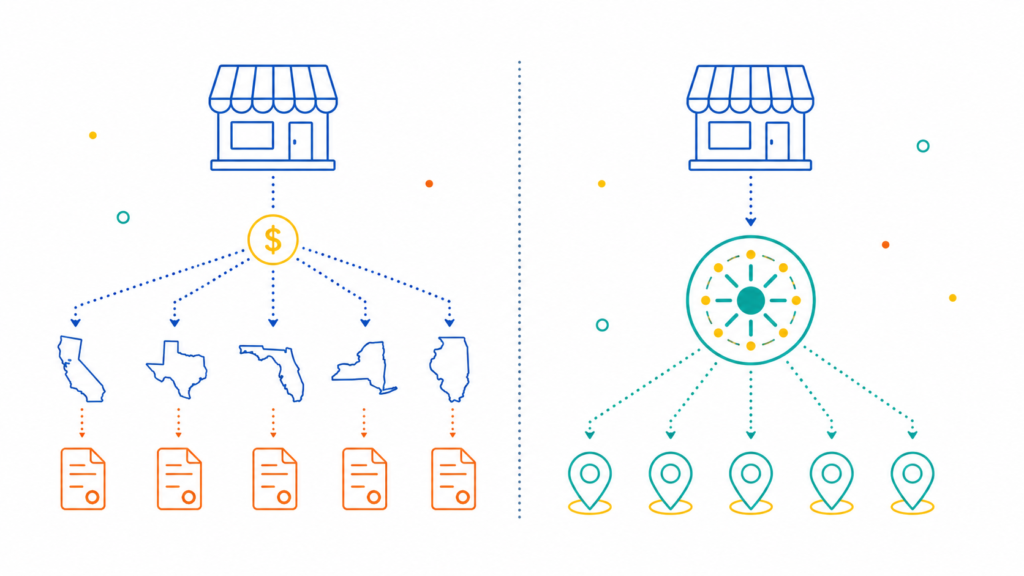
In the US, registration is state-by-state. Hit the economic nexus threshold in Illinois, register in Illinois. Hit it in Florida, register in Florida. You manage multiple state accounts, but you only register where you’ve actually crossed a threshold.
In the EU, you have two options and choosing the wrong one creates real operational pain:
Option 1: Register in each EU member state individually. If you store inventory in Germany and have customers in France, Italy, and Spain, you may need separate VAT registrations in all three countries. Each has its own filing calendar, language requirements, and rate structure.
Option 2: Use the EU One-Stop Shop (OSS). Since July 2021, non-EU sellers can register for OSS in a single EU member state and use that single registration to declare and pay VAT for all B2C sales across the EU. This is a significant simplification, but it only applies to sales to consumers, not to B2B transactions, and not to goods stored in EU warehouses (which trigger separate local VAT registrations).
If you use Amazon’s Fulfilled by Amazon (FBA) program and store inventory in multiple EU fulfillment centers, OSS does not eliminate your need for country-specific registrations. That’s a detail Amazon’s setup flow doesn’t always make obvious.
How the Two Systems Handle B2B Sales Differently
This distinction has real cash flow implications.
In the US, a business buyer provides a resale certificate or exemption certificate. The seller doesn’t collect tax. The obligation ends there for the seller.
In the EU, B2B transactions between VAT-registered businesses in different member states are generally zero-rated, meaning VAT is charged at 0% by the seller, and the buyer self-assesses VAT under the reverse charge mechanism. To qualify, both parties must have valid VAT registration numbers, and the seller must verify and record the buyer’s VAT ID. If that verification fails, the seller can become liable for the VAT that should have been zero-rated.
This is an audit risk that US-trained accounting teams routinely underestimate when expanding into Europe.
What the Compliance Risk Looks Like in Practice
A US-based seller generating $2 million a year in EU B2C sales and operating without VAT registration is not just non-compliant. That seller is potentially liable for VAT on every transaction from the point their EU sales became material, plus interest and penalties that compound by country. EU tax authorities have become aggressive about chasing non-EU sellers, particularly those selling through digital channels or marketplaces.
The US side carries its own exposure. A seller hitting $150,000 in annual sales to Texas customers from an offshore base has crossed Texas’s economic nexus threshold. Texas imposes a 6.25% state rate plus local rates. Without registration, every uncollected dollar of tax is a liability that accrues with interest.
Both exposures are fixable. But the fix is substantially cheaper before an audit than after one.
US Sales Tax vs. EU VAT: A Direct Comparison
| Factor | US Sales Tax | EU VAT |
| Who imposes it | State and local governments | EU member states (harmonized framework) |
| Stage of collection | Retail/final sale only | Every stage of supply chain |
| Rate range | 0% to 10.25% combined | 17% to 27% standard rate |
| Registration trigger | Economic nexus threshold per state | First B2C sale to EU consumer |
| B2B treatment | Exempt via resale/exemption certificate | Zero-rated with reverse charge |
| Pricing display | Tax added at checkout | Tax embedded in displayed price |
| Multi-jurisdiction filing | Separate return per state | OSS allows single EU-wide return (B2C only) |
| Marketplace liability | Varies by state | Marketplace liable in most EU cases |
What Cross-Border Sellers Should Do Before Entering Either Market
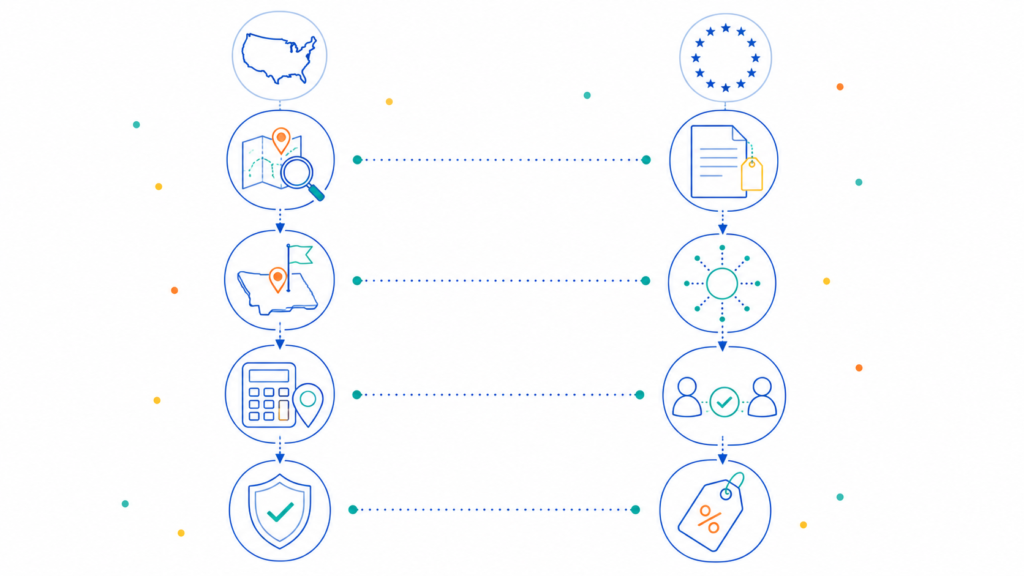
Before selling into the US:
- Conduct a nexus analysis to identify which states require registration based on current and projected revenue
- Register in threshold-crossed states before the next filing period
- Implement destination-based tax calculation at checkout
- Evaluate whether a marketplace facilitator is remitting on your behalf and in which states
Before selling into the EU:
- Determine whether you’re selling B2C, B2B, or both, the compliance path differs significantly
- Evaluate OSS registration vs. country-specific registrations based on where inventory is stored
- Ensure your product classifications align with each country’s VAT rate categories
- Verify buyer VAT IDs for all B2B transactions before zero-rating them
- Build VAT-inclusive pricing into your EU market pricing from day one
Final Words
US sales tax and EU VAT are not minor variations of the same concept. They are structurally different systems with different triggers, different cash flow implications, and different compliance paths. A seller who understands one has not automatically understood the other.
Cross-border ecommerce makes it easier than ever to sell globally. It does not make the tax obligations any simpler. And the businesses that scale without addressing both systems are not avoiding the problem, they’re deferring it, with interest.
Getting this right starts with a clear picture of where you actually have obligations. Not where you think you might. Where you actually do.
Know Where Your Cross-Border Tax Obligations Actually Stand
Integral Sales Tax (IST) works with ecommerce sellers, SaaS companies, and multi-market distributors who are expanding across borders and need to know, specifically, what they owe, where they owe it, and how to get compliant without disrupting operations.
That includes US nexus analysis, state registrations, EU VAT assessment, voluntary disclosure for past exposure, and the automated calculation infrastructure to keep everything accurate as you grow.
Talk to an IST advisor today Get a clear compliance picture before your next market expansion not after your first audit notice.
What is the main difference between US sales tax and EU VAT?
US sales tax is a single-stage retail tax collected only at the final point of sale and varies by state. EU VAT is a multi-stage tax applied at every level of the supply chain, from manufacturer to end consumer. Registration requirements, pricing structure, and B2B treatment are fundamentally different under each system.
Do I need to register for EU VAT if I sell from the US to European customers?
Yes. Since July 2021, there is no de minimis exemption for goods sold to EU consumers. Non-EU sellers must register for VAT either in each EU member state where they sell, or through the EU One-Stop Shop (OSS) for a single consolidated B2C registration. OSS does not cover B2B sales or goods stored in EU warehouses.
What is economic nexus and when does it apply to cross-border sellers entering the US?
Economic nexus is the obligation to collect and remit US state sales tax based on revenue or transaction volume alone, without physical presence. Most states set the threshold at $100,000 in annual sales or 200 transactions. A foreign seller crossing this threshold in any US state must register and collect sales tax in that state.
How does the EU One-Stop Shop (OSS) work for non-EU ecommerce sellers?
OSS allows non-EU sellers to register for VAT in a single EU member state and use that registration to declare and pay VAT on all B2C sales across the EU. Instead of registering separately in each country, sellers file one consolidated return. OSS does not apply to B2B transactions or goods stored in EU fulfillment centers.
Is VAT included in the price shown to EU customers?
Yes. In the EU, prices are displayed inclusive of VAT. The seller backs out the VAT component when reporting. This is the opposite of US practice, where sales tax is added at checkout on top of the displayed price. EU pricing strategies must account for VAT inclusion from the outset.
What happens if I sell B2B in the EU without verifying the buyer’s VAT ID?
B2B sales between VAT-registered businesses in different EU member states are generally zero-rated under the reverse charge mechanism. But the seller must verify and document the buyer’s valid VAT registration number. If that verification fails, the seller can become liable for the VAT that should have been zero-rated. This is one of the most underestimated audit risks for US sellers in Europe.
Can Amazon or other marketplaces handle my EU VAT obligations?
For B2C sales made through major marketplace platforms, the marketplace is generally liable for collecting and remitting VAT in most EU countries. But this only covers sales made through the marketplace itself. Sales through your own website or inventory stored in EU warehouses create separate obligations the marketplace does not cover.
What is the penalty for failing to register for US sales tax after crossing a nexus threshold?
Penalties vary by state but typically include the full uncollected tax amount plus interest (often 5%–12% annually) plus penalties ranging from 5% to 25% of the unpaid tax. States can audit 3 to 7 years back. Voluntary disclosure before a state initiates contact can significantly reduce or eliminate penalty exposure.
Leave a Reply