

A remote employee working in another state creates sales tax nexus for their employer in that state, regardless of how much revenue the company generates there. Unlike economic nexus, which requires $100,000 in annual sales, employment nexus has no minimum threshold. One W-2 employee in a new state creates immediate physical nexus and may require sales tax registration before the employee’s first day.
The offer letter goes out on a Thursday. The candidate accepts on Friday. By Monday, your company has a sales tax nexus problem in a state it has never registered in and nobody in the tax department knows yet.
This is not a hypothetical. It happens every time an enterprise company approves a remote hire in a new state without routing the decision through a tax compliance review. HR processes the new employee. Payroll registers in the state for withholding. And the sales tax team, which nobody told, continues not collecting in a jurisdiction where the company now has an undeniable physical presence.
“Remote employee sales tax nexus” is one of the fastest-growing categories of enterprise tax exposure, not because the rules are new, but because the workforce model that triggers them is. Companies that shifted to distributed hiring in 2020 and 2021 created nexus obligations in states they had never considered. Many still haven’t reconciled the gap.
Remote employees create sales tax nexus for their employers in the states where they physically work, regardless of sales volume. Unlike economic nexus, which requires $100,000 in annual in-state revenue in most states, employment nexus has no minimum threshold. A single remote hire triggers physical presence in the new state, which may require immediate sales tax registration. California, New York, New Jersey, Pennsylvania, and Texas enforce this rule consistently. Most enterprise companies create nexus gaps because HR and payroll process remote hires without notifying the tax team, and payroll registration in a state does not satisfy sales tax registration.
Why One Remote Employee Is Enough
Here is the rule that surprises most finance teams: employment nexus has no minimum threshold. A single employee working from a home office in a new state creates physical presence there, regardless of how much revenue the company generates in that state.
This is the opposite of economic nexus, which requires $100,000 in annual sales before most states demand registration. With a remote employee, the trigger is immediate and unconditional. Your company could have zero customers in that state and still owe sales tax registration, because a W-2 employee physically working there creates the connection.
California makes this explicit. The state’s physical nexus rules include any employee or contractor working in California, even remotely, even if the company’s only California presence is that one person’s apartment. The moment that employee starts working, the company has nexus. Full stop.
And it doesn’t matter what the employee does. A developer writing code in Denver creates the same nexus as a sales representative closing deals in Denver. A customer success manager working from Charlotte creates nexus in North Carolina. The job function is irrelevant. The physical location is everything.
The Contractor Assumption That Creates Real Liability
Many HR teams believe there’s an easy workaround: classify the worker as an independent contractor instead of an employee, and the nexus problem disappears. It doesn’t.
States increasingly look at behavior, not job title, when determining whether a relationship creates nexus. A contractor who works exclusively for one company, follows that company’s processes, uses company equipment, and works set hours is functionally an employee in the eyes of most state tax authorities, regardless of what the contract says. If that person creates nexus as an employee, they likely create it as a contractor too.
This matters for enterprise companies that rely heavily on fractional workers, embedded contractors, or “consultant” arrangements that operate identically to full-time employment. The label on the engagement letter doesn’t determine the tax outcome. The nature of the work and the physical location of the person does.
What Enterprise HR Teams Typically Miss
The gap is structural, not intentional. In most enterprise organizations, HR operates one process and tax operates another and remote hire decisions flow entirely through HR without triggering any tax review.
Here is what that looks like in practice: an engineering manager gets approval to hire a senior developer in North Carolina. The recruiter sources a candidate, HR extends an offer, the candidate relocates from Texas during onboarding. HR updates the HRIS system. Payroll registers the employee for state withholding in North Carolina. The tax team never receives a notification. Six months later, when someone does a nexus analysis, the company discovers it has been selling taxable software into North Carolina, without a sales tax registration, for the entire period since that hire.
That six-month gap is a filing obligation. It accrues with interest. And depending on the state’s audit posture, it may invite scrutiny across all periods the employee has been in-state.
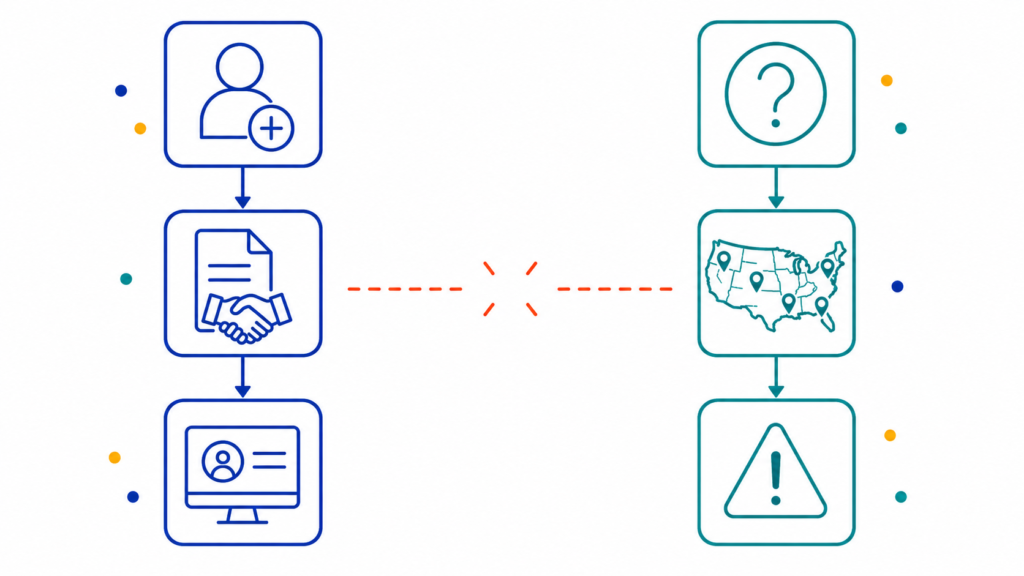
The specific HR gaps that create this problem, consistently, are:
– No tax review step in the remote hire approval workflow
– No systematic notification from HR to tax when an employee changes work location
– No monitoring of home-office location changes that employees self-report to payroll without routing to compliance
– No process for tracking contractors by physical work location, only by payment entity
– Assumption that payroll registration in a state means sales tax registration is covered, it does not
Payroll nexus and sales tax nexus are registered with entirely different state agencies, on different schedules, with different consequences for non-compliance. A company that correctly registers for payroll withholding in a new state has not automatically satisfied its sales tax obligation there.
The States Where This Comes Up Most Often
Not every state applies remote employee nexus aggressively, but several enforce it in ways that consistently catch enterprise companies off guard.
“California” creates nexus immediately upon hire. No revenue threshold. No grace period. The company must register for sales tax before the employee’s first day if they will be collecting taxable revenue from California customers.
“New York” adds a complication: the convenience-of-employer doctrine. If a New York-based company allows an employee to work remotely from another state for the employee’s own convenience rather than because the business requires it, New York may still assert income tax nexus as if the employee were in New York. The state upheld this position as recently as May 2025. For sales tax, New York applies physical nexus rules, but the convenience doctrine signals how aggressively the state monitors remote work arrangements.
“New Jersey and Pennsylvania” both have well-established precedent for creating nexus through remote employees, including cases going back more than a decade. Companies headquartered in New York or Delaware with employees in either state should assume nexus exists.
“Texas” has no income tax, which makes it a popular destination for remote workers, but Texas does impose sales tax, and a remote employee there creates physical nexus. Enterprise companies that approve Texas remote hires without a sales tax review are routinely surprised when they realize they owe registration.
How to Fix the Process, Not Just the Symptom
The individual nexus exposure is addressable through registration and, where prior periods are affected, voluntary disclosure. But the structural problem, HR making hiring decisions that create compliance obligations nobody else knows about, requires a process fix, not just a one-time filing.
Specifically:
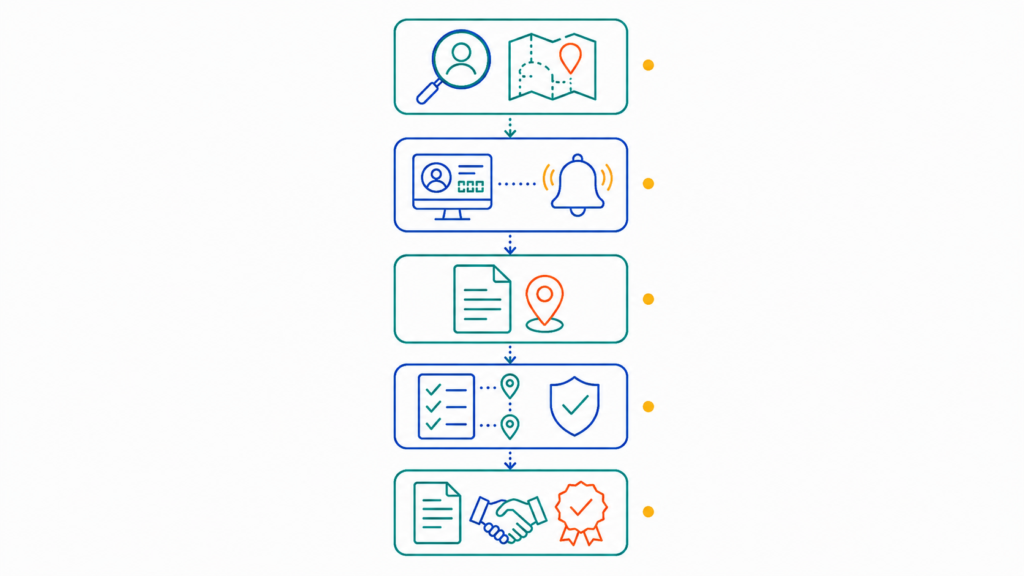
1. “Insert a tax review gate into the remote hire approval workflow.” Before any offer is extended to a candidate in a new state, the tax team should confirm whether the company already has nexus there, whether the hire would create new nexus, and whether registration needs to happen before the first day.
2. “Build a location-change notification from HRIS to tax.” When an employee updates their work location, including informal moves and “I’ll be working from my parents’ house for a few months” situations, that change should route to the compliance team automatically, not just to payroll.
3. “Map contractors by physical work location, not payment entity.” If your accounts payable system tracks contractor payments by legal entity but not by physical work location, you have a blind spot. That blind spot creates nexus.
4. “Conduct an annual nexus reconciliation against your full employee and contractor list.” Every state where you have a W-2 employee or a behavioral employee should be cross-referenced against your sales tax registration list. Gaps are filing obligations.
5. “Address any prior-period exposure through voluntary disclosure before a state finds it first.” If the reconciliation reveals states where you should have been registered and weren’t, a VDA is almost always the right path, limited lookback, waived penalties, and the process is done on your terms.
Final Words
Remote work didn’t create new sales tax rules. It created a new operational reality that existing rules were already designed to address and that most enterprise compliance processes were not built to track.
A single remote hire in a new state is a compliance event. So is a location change. So is a contractor whose working arrangement looks like employment. Each of these decisions, made in isolation by HR without a tax review, can accumulate into a multi-state nexus exposure that is entirely invisible until a nexus analysis or an audit surfaces it.
The fix is not complicated. But it does require HR and tax to share information that most enterprise organizations currently keep in separate systems, on separate workflows, with separate assumptions about who is responsible for what.
That coordination is worth building before an auditor makes it urgent.
Find Out Which States Your Remote Workforce Has Already Put You In
IST conducts nexus analyses for enterprise companies with distributed teams, cross-referencing employee and contractor locations against current registration lists to identify gaps, estimate exposure, and determine whether voluntary disclosure is the right path for prior periods.
If your company has added remote employees in new states over the past three years and hasn’t done a formal nexus review in that time, the gap is almost certainly real.
Talk to an IST advisor today
Find out exactly where your remote workforce has created sales tax obligations, before a state does.
Frequently Asked Questions
Does a remote employee create sales tax nexus for their employer?
Yes, in nearly every state. When an employee physically works from a state, including from a home office, their employer is considered to have physical presence in that state. This creates sales tax nexus regardless of the company’s revenue in that state. There is no minimum threshold for employment-based physical nexus. The obligation begins when the employee starts working, not when the company reaches a revenue target.
Does the employee’s job function matter for sales tax nexus?
No. A remote developer, a customer success manager, a recruiter, and a sales representative all create the same nexus in the state where they work. The job function is irrelevant. What matters is that the company has a person on its payroll physically located in that state. States do not distinguish between client-facing and back-office roles when determining physical nexus from employment.
Does using a contractor instead of an employee avoid sales tax nexus?
Not reliably. States look at the nature of the working relationship, not just the contract classification. A contractor who works exclusively for one company, follows company processes, and operates like an employee may be treated as creating physical nexus in the same way an employee would. Enterprise companies that use embedded contractors or long-term “consultant” arrangements should evaluate nexus risk on the actual working relationship, not the contract title.
Does registering for payroll withholding in a state satisfy sales tax registration?
No. Payroll withholding registration and sales tax registration are separate obligations with separate state agencies, separate filing schedules, and separate consequences for non-compliance. A company that correctly registers with the state’s department of labor or revenue for payroll purposes has not satisfied its obligation to collect and remit sales tax. These registrations must be done independently.
Which states are most aggressive about remote employee sales tax nexus?
California creates nexus immediately upon hire, with no revenue threshold. New York applies its nexus rules strictly and also enforces the convenience-of-employer doctrine, which can create income tax complications for remote arrangements. New Jersey and Pennsylvania have well-established nexus rules from remote employee presence. Texas has no income tax but imposes sales tax, and remote hires there create physical nexus. Massachusetts has maintained rules from the pandemic period that continue to affect remote arrangements.
What should an enterprise company do if it discovers remote employees have created nexus in unregistered states?
The first step is a nexus analysis to confirm which states have created obligations and for how long. If the company has been selling taxable goods or services into those states during the period of unregistered nexus, it has a back-tax liability. Voluntary disclosure, initiated before the state makes contact, caps the lookback period and waives penalties. After the historical exposure is resolved, the company should register in each affected state and set up ongoing compliance.
How far back can a state go if it discovers a company had an unregistered remote employee creating nexus?
If a company has never filed sales tax returns in a state, most states face no statute of limitations on how far back they can audit. In practice, auditors typically focus on the most recent three to seven years, but the legal exposure can extend to the date nexus was created. A voluntary disclosure agreement limits this lookback to three to four years in most states and waives penalties, making it substantially less costly than a state-initiated audit.
How should an enterprise company change its HR process to prevent future nexus gaps?
The most effective fix is inserting a tax review step into the remote hire approval workflow before any offer is extended in a new state. The tax team should confirm whether registration is required and whether it needs to happen before the employee’s start date. Additionally, the HRIS system should route location-change notifications to the compliance team automatically, not just to payroll, so that mid-employment moves and temporary relocations are captured before they accumulate into undetected nexus.
Leave a Reply