
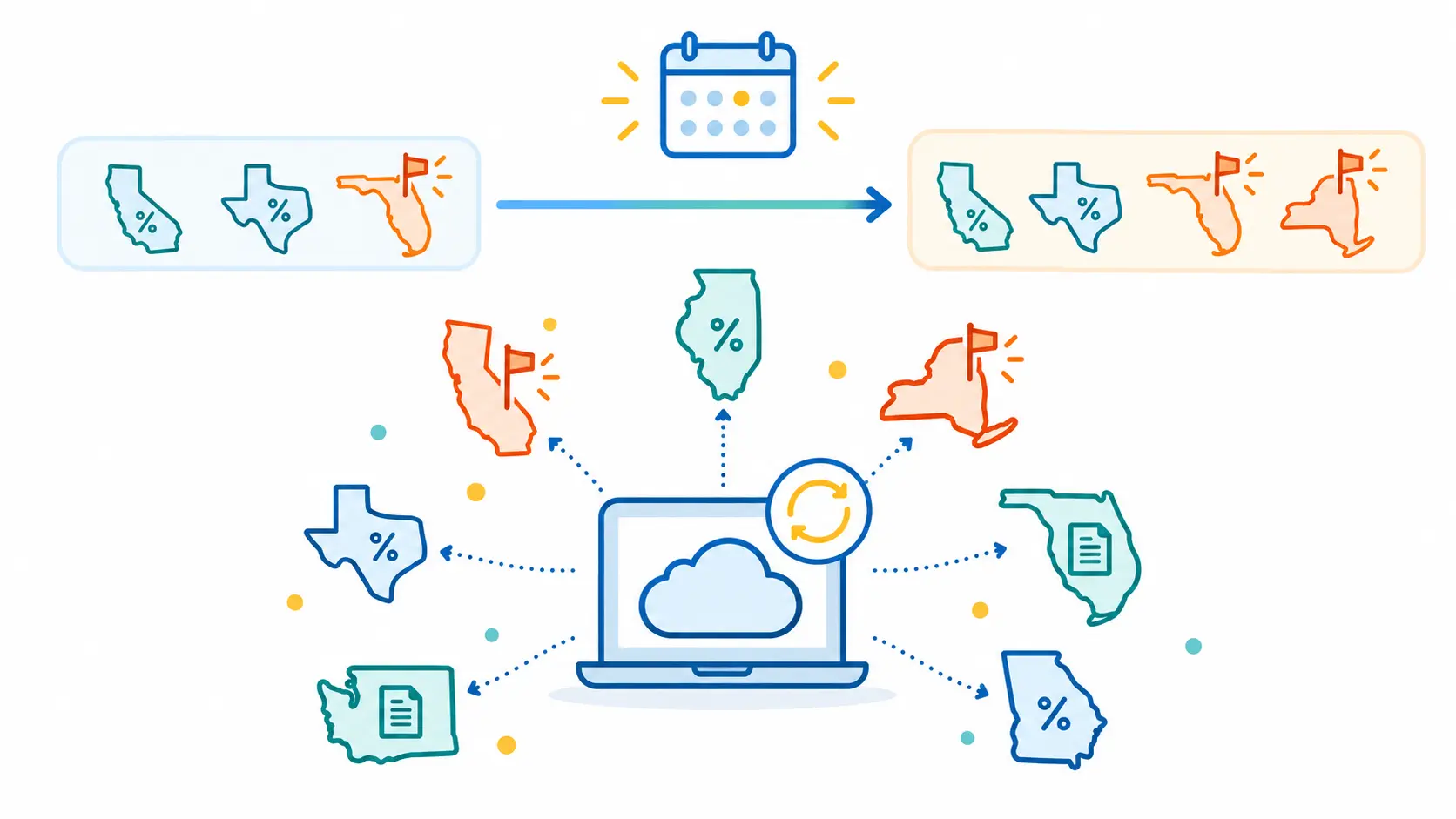
On June 29, 2026, California Governor Gavin Newsom signed Senate Bill 122. Starting January 1, 2027, SaaS and electronically delivered software become subject to California sales and use tax for the first time in the state’s history.
That sentence will restructure the compliance obligations of every enterprise SaaS company with California customers. And California is not the only state that moved in the past 18 months.
Digital product taxability rules moved in one direction across all state activity in 2025 and 2026: toward broader coverage. No state reduced digital goods taxation during this period.
For enterprise companies that set their product taxability codes at ERP implementation and have not reviewed them since, that sentence is an audit in waiting. The question is not whether “sales tax on SaaS and digital goods” applies to your company. At this point, the question is which states, which products, and starting when.
Sales tax on SaaS and digital goods expanded dramatically across U.S. states in 2025 and 2026. Louisiana added SaaS to its tax base January 1, 2025, with its state rate rising to 5%. Maryland imposed a 3% technology services tax July 1, 2025. Washington expanded retail sales tax to IT services and custom software October 1, 2025. Utah codified SaaS as taxable prewritten software July 1, 2026. California signed SB 122 on June 29, 2026, making SaaS taxable beginning January 1, 2027. Washington D.C. increased its digital goods rate from 6% to 7% effective October 1, 2026. No state reduced digital goods taxation during this period.
Sales tax on SaaS and digital goods expanded significantly in 2025–2026. Louisiana taxed SaaS from January 1, 2025. Maryland imposed a 3% tech services tax from July 1, 2025. Washington expanded digital services taxation from October 1, 2025. California signed SB 122 on June 29, 2026, making SaaS taxable from January 1, 2027. As of 2025, SaaS is taxable in 25 U.S. states.
What Changed in 2025 and 2026 and Why the Pace Accelerated
State sales tax systems were originally built around tangible goods. Digital products didn’t fit the existing definitions, and states were slow to update their codes. That period ended.
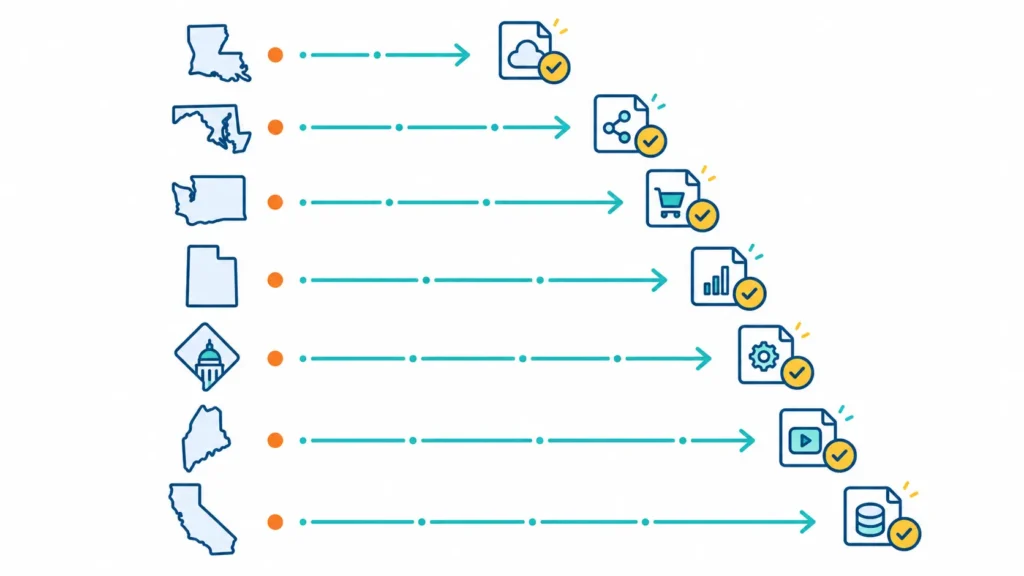
The two-year period from 2025 to 2026 produced more consequential changes to digital goods taxation than any comparable period in recent history. Here is what changed, state by state:
| State | What Changed | Effective Date |
| Louisiana | SaaS, digital products, and information services added to sales tax base; state rate rose from 4.45% to 5.0% | January 1, 2025 |
| Maryland | 3% sales tax on technology services including SaaS (commercial use), web hosting, and data processing | July 1, 2025 |
| Washington | Retail sales tax expanded to custom software, IT services, digital advertising, and custom website development | October 1, 2025 |
| Utah | SB 162 codified SaaS as taxable prewritten software | July 1, 2026 |
| Washington D.C. | Digital goods and services rate increases from 6% to 7% | October 1, 2026 |
| Maine | Digital audiovisual and audio services added to taxable categories | 2026 |
| California | SB 122 subjects SaaS and electronically delivered software to sales and use tax | January 1, 2027 |
The pattern is not a coincidence. The rise of the service and subscription economy, SaaS, cloud hosting, digital advertising, and remote consulting, means these categories now represent a much larger share of commerce than when most state tax codes were drafted, and legislators increasingly see them as an obvious, underused tax base.
States that previously had no digital goods tax are enacting one. States that had partial coverage are expanding it. And the companies most exposed are the ones that assumed their taxability configuration from three years ago still reflects the current law.
Where SaaS and Digital Goods Stand State by State in 2026
As of August 2026, SaaS and digital goods taxability falls into three tiers:
| Tier | Description | Representative States |
| Broadly taxable | SaaS explicitly included in sales tax base | Texas, New York, Pennsylvania, Washington, Connecticut, Tennessee, Minnesota, Louisiana (post-2025), Utah (post-July 2026), Maryland (post-July 2025) |
| Exempt or largely excluded | SaaS generally not subject to sales tax | Florida, New Hampshire (no sales tax), Oregon (no sales tax), Delaware (no sales tax) |
| Recently changed or unsettled | New legislation or active review; prior exemption no longer reliable | California (taxable Jan 1, 2027), Washington D.C. (rate increase Oct 1, 2026), Maine (expanded 2026), Maryland (unsettled patchwork on enterprise carve-outs) |
As of 2025, SaaS services are taxable in 25 U.S. states. California’s SB 122 will make that at least 26 effective January 1, 2027. The states that remain in the exempt or excluded tier are doing so by choice, but no state reduced digital goods taxation during this period</cite), which means the direction of movement is entirely one way.
One geographic complexity deserves specific attention. Chicago applies its approximately 9% personal property lease transaction tax to cloud software even though Illinois doesn’t tax SaaS at the state level. A company with Chicago-based customers may owe Chicago’s local tax on SaaS subscriptions even while correctly treating Illinois as a non-taxing state. The product, the customer, and the state all require separate analysis.
Why Enterprise ERP Configurations Are Now Wrong in Multiple States
Most enterprise companies set their SaaS product taxability codes when they implemented their ERP or billing system. That implementation may have happened in 2021 or 2022. Every change in the table above postdates that configuration.
The Louisiana expansion took effect January 1, 2025. The Maryland tech services tax took effect July 1, 2025. The Washington expansion took effect October 1, 2025. A company whose taxability codes were configured in 2022 and last reviewed in 2023 has been applying incorrect taxability determinations to every Louisiana, Maryland, and Washington invoice it has generated since those dates.
That’s not a small number. For an enterprise SaaS company generating $2 million annually in Louisiana subscription revenue at a 5% state rate, the base tax exposure from January 2025 forward is $100,000 per year before penalties. For a company with $5 million in Washington state revenue being incorrectly classified as non-taxable since October 2025, the exposure compounds at 10.5% per quarter in Washington’s combined rate.
Changes like this illustrate that a company’s sales tax obligations may shift even when its products, customers, and business model have not changed. The law changed. The ERP didn’t.
The Five-Step Reassessment Framework for Enterprise SaaS and Digital Goods
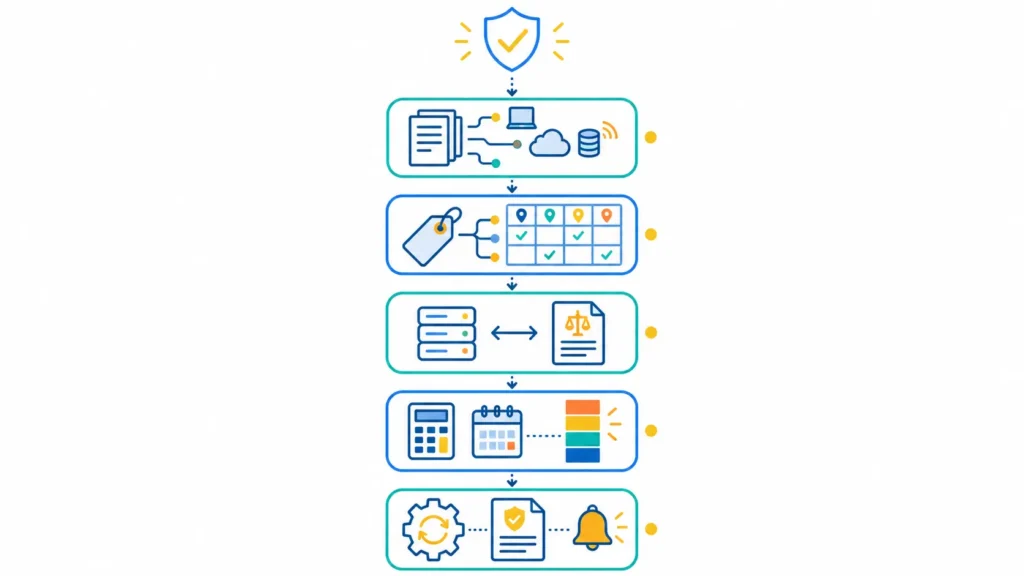
For enterprise companies that have not reviewed their digital goods taxability configuration in the past 12 months, the reassessment has five steps:
Step 1: List every digital product and service the company sells
This includes SaaS subscriptions, downloaded software, software updates and upgrades, data services, API access, digital content, streaming services, AI tools, and any bundled offering that combines a digital service with a physical component. Each category may be treated differently within the same state.
Step 2: Map the current taxability determination for each product in each nexus state
Pull the current taxability configuration from the ERP or billing system for each product type in each state where the company has nexus. This is the baseline against which the current law will be compared.
Step 3: Compare baseline configurations against current state law
For each state where the company has nexus, verify whether the current taxability rule matches the ERP configuration. Use the specific legislation and effective dates, not a summary or a blog post, as the reference. Louisiana’s January 1, 2025 expansion, Maryland’s July 1, 2025 implementation, Washington’s October 1, 2025 expansion, and California’s January 1, 2027 effective date must all be verified against the company’s actual configuration and transaction history.
Step 4: Identify configuration gaps and calculate retroactive exposure
Any state where the current law has changed since the last configuration review and where the company has been under-collecting represents a retroactive exposure. Calculate the base tax using actual revenue data and the applicable rate from the effective date of the law change. Then apply the state’s actual penalty and interest structure to produce a maximum exposure figure.
Step 5: Update configurations, address exposure, and build a monitoring trigger
Update ERP and billing system configurations to reflect current law. Address retroactive exposure through voluntary disclosure where material liability exists. And build a process, not a calendar reminder, but an actual workflow, that triggers a taxability review any time a state enacts new digital goods legislation affecting states where the company has nexus.
The last step is the one most companies skip. Taxability reviews happen reactively, after an audit surfaces the gap, rather than proactively, as part of ongoing compliance monitoring. That sequencing always costs more than the alternative.
California’s SB 122: What Enterprise Companies Should Do Before January 2027
California’s SB 122 is the single most consequential change in digital goods taxation in 2026, both because of the size of California’s economy and because it reverses a longstanding exemption that most enterprise SaaS companies have relied on without question.
California SB 122, signed June 29, 2026, will subject prewritten software delivered electronically or accessed remotely, including SaaS, to sales and use tax beginning January 1, 2027, while retaining exclusions for custom software and certain digital infrastructure.
Enterprise companies with California customers have roughly five months to:
– Determine whether their products fall within the taxable definition or a named exclusion (custom software is excluded; prewritten or subscription software is not)
– Verify California economic nexus status, the threshold is $500,000 in annual revenue
– Register for California sales tax if not already registered for the obligation that existed before SB 122
– Update billing systems to calculate and collect California sales tax on affected products starting January 1, 2027
– Communicate the rate change to customers, particularly in B2B relationships where contracts may specify tax treatment
The company that completes these five steps before December 31, 2026 will begin the new compliance period cleanly. The company that doesn’t will spend Q1 2027 in retroactive correction mode.
Final Words
Sales tax on SaaS and digital goods is no longer an emerging issue or a compliance edge case. It is the current enforcement environment for every enterprise company selling software, subscriptions, or digital services to customers in the United States.
The states that moved in 2025 and 2026 were not acting in isolation. They were responding to a structural shift, digital revenue now represents a material share of state tax bases, and the exemptions that governed the early years of cloud computing are being systematically eliminated. California’s SB 122 is not the end of that process. It is the most visible signal that the process is accelerating.
Every enterprise company whose taxability configurations haven’t been reviewed since 2023 is operating on outdated law in at least several states. The reassessment is not optional. The only question is whether the company does it before the next audit or during it.
Reassess Your SaaS and Digital Goods Tax Configuration Before the Law Catches Up
IST conducts digital goods and SaaS taxability reviews for enterprise companies, mapping every product type against current state law in every nexus state, identifying configuration gaps, calculating retroactive exposure, and managing voluntary disclosure for any prior periods where under-collection created liability.
The five-step framework in this article is the starting point. The specific analysis for your company requires your product catalog, your nexus footprint, and a current review of the law in every state where you operate.
Talk to an IST advisor today & Find out which states have changed the taxability rules for your products since your last compliance review.
Frequently Asked Questions
Is SaaS subject to sales tax in 2026?
Yes, in at least 25 states as of 2025, with more being added. SaaS is broadly taxable in Texas, New York, Pennsylvania, Washington, Connecticut, Tennessee, Minnesota, Louisiana (since January 1, 2025), Utah (since July 1, 2026), and Maryland (since July 1, 2025). California signed SB 122 on June 29, 2026, making SaaS taxable there starting January 1, 2027. Florida and most states without income tax still generally exempt SaaS. No state reduced digital goods taxation in 2025 or 2026.
What does California SB 122 mean for enterprise SaaS companies?
California SB 122, signed by Governor Newsom on June 29, 2026, subjects SaaS and electronically delivered prewritten software to California sales and use tax beginning January 1, 2027. Custom software remains excluded. Enterprise SaaS companies with California customers must verify California economic nexus status, register if not already registered, update billing system configurations to calculate and collect California sales tax, and communicate rate changes to affected customers before December 31, 2026.
When did Louisiana change its sales tax rules for SaaS?
Louisiana enacted HB 8, effective January 1, 2025, which brought SaaS, digital products, and information services into the state’s sales tax base for the first time. The state rate also increased from 4.45% to 5.0% as part of the same legislative package. Any enterprise company with Louisiana customers that treated SaaS as non-taxable before January 1, 2025 and has not updated its configuration has been under-collecting Louisiana sales tax since that date.
What did Washington State change for digital goods taxation in 2025?
Washington enacted ESSB 5814, effective October 1, 2025, which extended retail sales tax to a broader range of digital and technology services including custom software, customization of prewritten software, IT services, digital advertising, and custom website development. Washington already taxed many digital goods before 2025; this expansion specifically captured previously excluded service categories. Enterprise companies providing technology services or custom software development to Washington customers must have updated their taxability configurations by October 1, 2025.
Does Chicago tax SaaS even though Illinois doesn’t?
Yes. Chicago applies its personal property lease transaction tax, which reaches approximately 9%, to cloud software and SaaS subscriptions even though Illinois does not impose state sales tax on SaaS. A company with Chicago-based customers may owe Chicago’s local tax on SaaS revenue while correctly treating the same product as non-taxable for Illinois state purposes. This requires separate analysis at the city level, not just the state level.
How should enterprise companies update their ERP configurations for the 2025–2026 digital goods changes?
Enterprise companies should follow a five-step process:
(1) List every digital product and service sold.
(2) Map the current taxability determination for each product in each nexus state.
(3) Compare baseline ERP configurations against current state law using specific legislation and effective dates.
(4) Calculate retroactive exposure for any state where the law changed and the configuration was not updated.
(5) Update configurations, address prior exposure through voluntary disclosure where material liability exists, and build a monitoring trigger for future legislative changes.
What enterprise companies are most affected by the 2025–2026 digital goods tax changes?
Enterprise SaaS providers, cloud software companies, digital advertising platforms, IT services companies, data services firms, and companies with bundled physical-digital products are most directly affected. Companies with significant revenue in Louisiana, Maryland, Washington, Utah, or California face the most urgent reassessment need. California’s SB 122 will affect every SaaS company with California customers, the largest state economy in the U.S. starting January 1, 2027.
What is the retroactive exposure risk if an enterprise company hasn’t updated its SaaS taxability configurations?
For each state where the law changed and the company was under-collecting, the retroactive exposure equals: taxable revenue since the effective date of the law change, multiplied by the applicable state and local rate, plus state penalties (typically 10%–25%) and interest (3%–18% annually depending on the state). For a company with $2 million in annual Louisiana SaaS revenue that didn’t update configurations after January 1, 2025, the base tax exposure is $100,000 per year before penalties and interest. Voluntary disclosure limits lookback periods and waives penalties, significantly reducing total liability.
Leave a Reply