
Why Sales Tax Automation is Critical for Freight Companies
A freight broker in Dallas invoices a client for a shipment from Texas to Florida. She separately states the freight charge on the invoice. Florida exempts separately stated shipping when the buyer has the option to arrange their own carrier. Texas does not have that same condition. Two states, one load, two different answers and that’s before accounting for the taxability of the goods being moved.
This is not an edge case. It’s a Tuesday in freight.
Sales tax automation for freight is not a nice-to-have feature that simplifies accounting. For carriers, brokers, 3PLs, and distributors operating across state lines, it’s the difference between accurate billing and compounding audit exposure that builds invisibly over months of shipments.
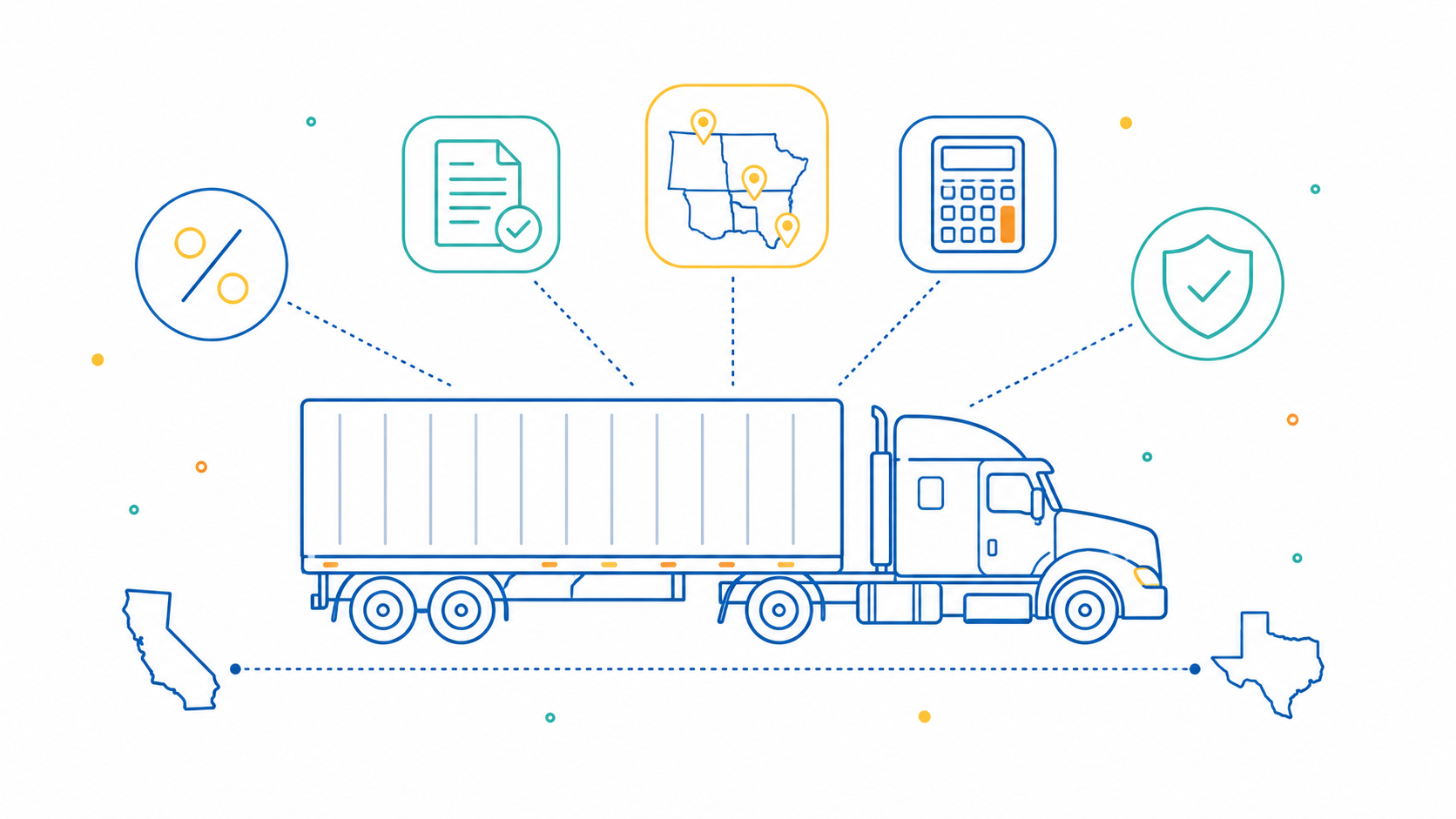
Sales tax on freight charges depends on five variables: whether the charge is separately stated or bundled, the taxability of goods being transported, who arranges the carrier, and the rules of both origin and destination states. Most states exempt separately stated freight charges, but rules vary significantly. Freight companies operating across multiple states require automated tax calculation to apply these rules accurately and consistently.
Sales tax automation is critical for freight companies because freight tax rules vary by state across at least five simultaneous variables: charge classification, goods taxability, billing structure, carrier arrangement, and jurisdiction-specific rules. States including California, Florida, New York, and Texas each apply different conditions to whether freight and handling charges are taxable. Manual tax determination fails at high transaction volumes and creates audit exposure. Freight companies also face broad nexus obligations from physical presence in multiple states and economic nexus thresholds. Automation integrated with a transportation management system (TMS) enables accurate, real-time tax determination at invoice level.
Why Freight Tax is Harder Than Almost Any Other Industry
Most businesses deal with one or two taxability variables: what they’re selling and where the buyer is located. Freight companies deal with at least five simultaneously.
Taxability of freight charges depends on:
– Whether the freight charge is separately stated or bundled with the product price
– Whether the goods being transported are themselves taxable or exempt
– Whether the seller or buyer arranges the transportation
– The origin and destination states, both of which may have a claim
– Whether the charge is labeled “freight,” “shipping,” “handling,” or “delivery” because some states tax these differently
That last point is not a technicality. Florida taxes handling but may exempt separately stated shipping. New York taxes shipping when it’s part of a taxable sale. California exempts shipping only when it’s separately stated and reflects actual cost. Louisiana distinguishes between third-party carriers arranged by the seller versus the buyer. These are not minor distinctions, they change whether a line item on an invoice is taxable or not.
A freight company running 500 loads a week across 20 states is making thousands of individual taxability determinations per month. Manual processes don’t survive that volume without error.
What “Getting It Wrong” Actually Costs in Freight
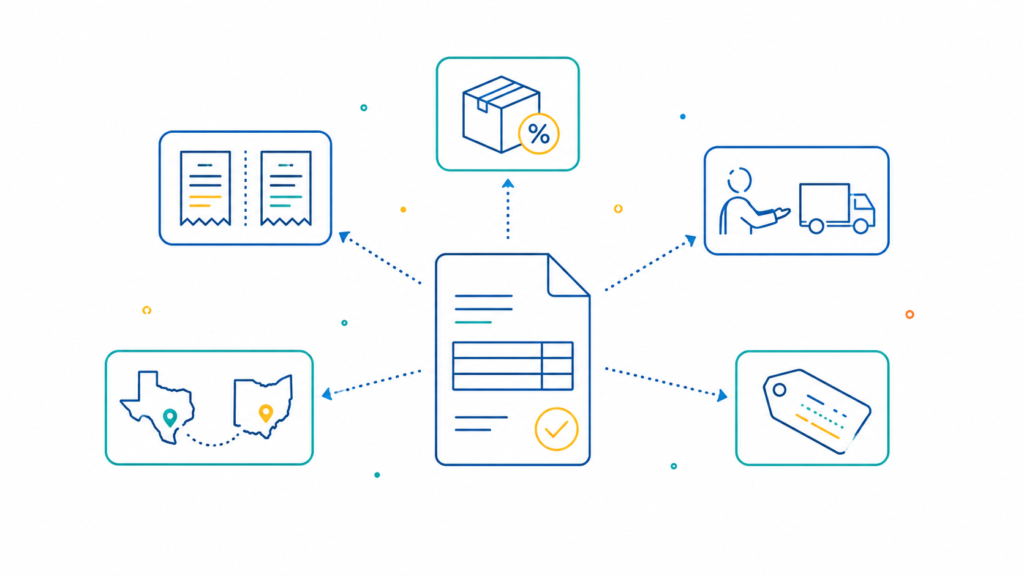
The exposure accumulates fast. Consider a national LTL carrier that has been bundling freight and handling charges on a single invoice line “freight & handling” for customers in states where that combined billing makes the entire charge taxable. If those charges were not being taxed, and the carrier has operated this way for three years in a state with a seven-year audit lookback, the uncollected tax becomes the carrier’s liability, not the customer’s.
That’s not a compliance problem. That’s a cash problem.
The IRS and state revenue departments have become significantly more aggressive about freight and logistics companies in recent years, in part because the industry’s multi-state nature makes it easy to underestimate nexus exposure and easy to miscalculate charge taxability. A carrier with drivers, terminals, or drop lots in a state almost certainly has physical nexus there. Add economic nexus thresholds crossed in states where it only has customers, and the registration obligations can span 30 or more states.
Audits in freight also tend to be broader than in retail because auditors look at both the transportation service and the nature of the goods being moved. A carrier that regularly hauls a mix of taxable and exempt goods needs airtight documentation to support every exemption claimed.
How Sales Tax Automation Changes the Equation for Freight
Manual tax determination in freight looks like this: a billing clerk looks up the destination state, checks whether freight is taxable there, tries to remember whether the goods on this particular load are taxable, and enters a rate. If they get any one of those inputs wrong, every invoice for that lane gets the same error until someone catches it.
Automated sales tax calculation fixes the input problem at the source. When the transportation management system (TMS) or billing platform is integrated with a tax calculation engine, each invoice is evaluated against:
– Origin and destination state rules
– Freight charge classification (separately stated vs. bundled)
– Goods type and taxability
– Customer exemption certificate status
– Current rate for the applicable jurisdiction
The result is applied in real time, consistently, across every transaction. No clerk making judgment calls. No stale rate table. No missed exemption certificate that leaves a taxable charge uncollected.
But automation is only as reliable as the data going into it. A TMS that miscodes freight charges or doesn’t distinguish shipping from handling will produce wrong answers at scale. This is why implementation matters as much as the software itself.
The Exemption Certificate Problem in Freight
Carriers and 3PLs frequently haul goods for customers who are themselves exempt, manufacturers taking delivery of raw materials, distributors moving inventory between their own locations, nonprofits. Each of these exemptions requires a valid, current exemption certificate on file.
In a high-volume freight operation, certificate management is its own compliance function. Certificates expire. Customers change their business type. New customers onboard without submitting documentation. And when an auditor asks for the certificate that justified a tax-exempt transaction from 18 months ago, “we think they sent one” is not a defensible answer.
Automated exemption certificate management solves this by tracking certificate validity by customer, triggering renewal requests before expiration, and blocking tax-exempt billing when documentation isn’t current. Without it, the audit risk from exemption failures alone can be significant.
Nexus in Freight: More Exposure Than Most Companies Realize
Physical nexus in freight is almost unavoidable. Drivers who cross state lines and stop in a state, even temporarily, can create nexus in some jurisdictions. Terminals, drop yards, and cross-dock facilities are physical presence by definition. And any state where a freight company has employees, whether drivers, dispatchers, or sales staff, is a state that can require sales tax registration.
Beyond physical nexus, economic nexus thresholds apply to freight revenues just as they do to product sales. A regional carrier that hauls into a state regularly may be crossing that state’s $100,000 threshold without tracking it.
The result: freight companies often have nexus in far more states than they’ve registered in and they often discover this during an audit rather than proactively.
What Freight Companies Should Do Right Now
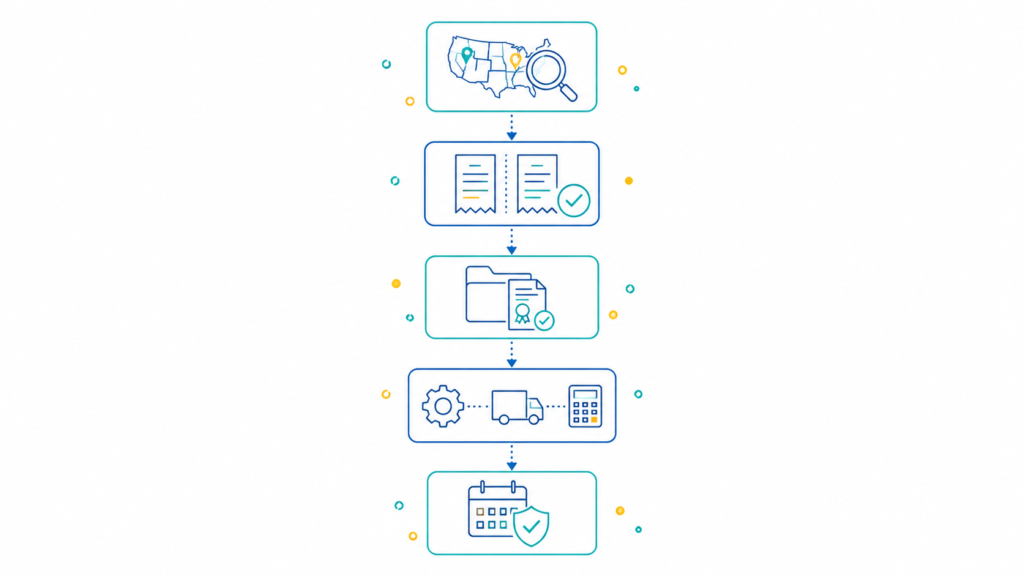
If your company hasn’t done a formal nexus review in the past 12 months, start there. Map every state where you have terminals, drivers, customers, or revenue. Then compare that footprint against your current registration list.
From there:
1. Audit your invoice structure. Are freight and handling charges separated? Is the language on your invoices consistent with the exemption rules of each state you serve?
2. Review your exemption certificate file. Are certificates current? Are there customers billed as exempt without valid documentation?
3. Evaluate your TMS integration. Is your billing system feeding accurate charge classification and goods type data to your tax calculation engine?
4. Address past exposure. If you’ve identified states where you should have been registered or collecting, voluntary disclosure is available and substantially reduces penalty exposure.
5. Build monitoring into your compliance calendar. Nexus obligations change as your lanes, customers, and revenue change. A one-time review is not a compliance program.
Final Words
Freight tax is genuinely complicated. It’s not complicated because the rules are arbitrary, it’s complicated because the industry’s operational reality, multi-state lanes, mixed goods types, variable billing structures, and high transaction volume, creates more taxability variables per invoice than almost any other sector.
Manual processes fail at that volume. Automation handles it, but only if it’s implemented on a foundation of accurate nexus analysis, correct invoice structure, and current exemption documentation. The companies that get audited aren’t always the ones that were trying to avoid tax. They’re often the ones that were trying to handle it manually.
That’s fixable. But it’s easier to fix before an auditor makes the timeline.
Freight tax compliance fails quietly. A billing structure that’s been in place for years, a rate table that hasn’t been updated since the last state rule change, an exemption certificate file that no one has audited, these are not dramatic failures. They’re the kind of slow accumulation of exposure that only becomes visible when an auditor starts pulling invoices.
Sales tax automation for freight companies doesn’t eliminate the need to understand the rules. It enforces the rules at volume, consistently, across every invoice and every lane, but only if it’s built on accurate nexus analysis, correct invoice structure, and clean exemption documentation.
The good news is that most freight tax exposure is addressable before it becomes a crisis. The window for that is open now. It closes when the audit letter arrives.
Find Out Where Your Freight Tax Exposure Actually Stands
IST works with freight carriers, brokers, 3PLs, and distributors to identify nexus exposure across every operating state, structure invoice compliance, manage exemption certificates, and implement automated tax calculation that integrates with existing TMS and billing systems.
The starting point is always a nexus analysis, understanding where your operation has created tax obligations, not where you’ve assumed it hasn’t.
Freight tax rules are state-specific, invoice-specific, and change without notice. Integral Sales Tax (IST) helps freight carriers, brokers, and 3PLs understand exactly where their tax obligations stand and build the automated infrastructure to handle them accurately at scale.
Start with a nexus analysis. Know which states require registration, where past exposure exists, and whether voluntary disclosure is the right path. Then build compliance that runs without manual intervention.
Talk to an IST advisor today.
Get clarity on your freight tax exposure before your next audit notice arrives.
Is sales tax charged on freight charges?
It depends on the state and how the charge is billed. Most states exempt separately stated freight charges, but many tax freight when it’s bundled with handling charges or included in the product price. Some states, such as Alabama and Kentucky, tax freight regardless of billing structure when the underlying transaction is taxable.
Why is sales tax compliance more complex for freight companies than other businesses?
Freight companies must simultaneously evaluate the taxability of the goods being transported, the billing structure of their charges, who arranged the transportation, and the rules in both origin and destination states, for every shipment. This creates more taxability variables per transaction than most industries, making manual compliance unreliable at scale.
What creates sales tax nexus for a freight company?
Physical nexus is created by terminals, drop yards, cross-dock facilities, drivers who stop in a state, and employees including drivers, dispatchers, and sales staff located in a state. Economic nexus thresholds, typically $100,000 in annual revenue or 200 transactions, also apply to freight revenues in most states. Freight carriers commonly have nexus in more states than they’ve registered in.
What is the difference between shipping, handling, and freight for sales tax purposes?
States may tax these charges differently depending on how they’re defined and billed. “Shipping” or “freight” typically refers to the transportation cost. “Handling” covers packaging and order preparation. Florida taxes handling but may exempt separately stated shipping. Combined “shipping and handling” charges are fully taxable in most states, even if part of the charge would otherwise be exempt.
What is an exemption certificate and why do freight companies need to manage them carefully?
An exemption certificate is a document provided by a buyer claiming exemption from sales tax, for example, a manufacturer receiving raw materials or a distributor moving inventory between its own locations. Freight companies that bill exempt customers without a current, valid certificate on file can be held liable for the uncollected tax during an audit. Certificate management requires tracking expiration dates and renewal for every exempt customer relationship.
What happens if a freight company has been operating in a state without sales tax registration?
The company may owe back taxes for the period it was required to collect but did not, plus interest and penalties. Most states can audit 3 to 7 years back. A Voluntary Disclosure Agreement (VDA) allows companies to come forward proactively, typically limiting the lookback period and eliminating penalties, making it substantially less costly than waiting for a state-initiated audit.
How does sales tax automation integrate with a transportation management system (TMS)?
A tax calculation engine integrates with the TMS via API, receiving transaction data including origin, destination, freight charge classification, goods type, and customer exemption status. The engine applies current jurisdiction rules to each transaction and returns the correct tax amount in real time, which populates the invoice before it’s issued. This eliminates manual rate lookups and ensures consistent application across high transaction volumes.
What should a freight company do if it discovers it has nexus in states where it hasn’t been collecting sales tax?
The first step is a formal nexus analysis to confirm where obligations exist and for how long. The next step is evaluating voluntary disclosure in each affected state to limit back liability. Registration and ongoing compliance setup should follow. Waiting for a state to initiate contact removes the voluntary disclosure option and increases penalty exposure significantly.
Leave a Reply