
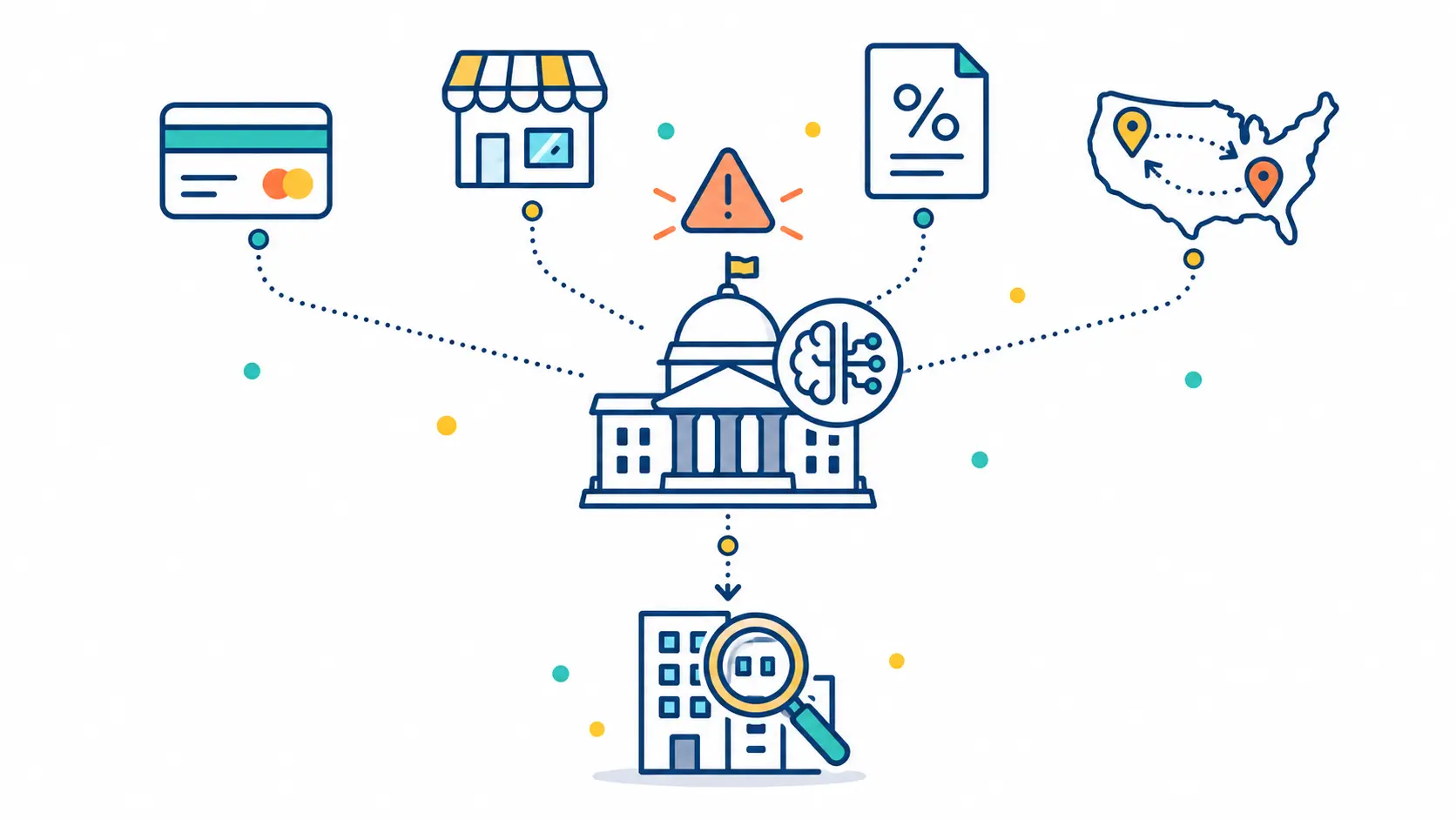
State AI audit systems in 2026 detect sales tax non-compliance by cross-referencing filed returns against payment processor data, marketplace facilitator reports, and transaction records across state lines. They score businesses for audit risk using predictive models that run multiple times per year. Triggers include revenue discrepancies between filed returns and visible transaction data, unusual exemption ratios, and nexus violations from unregistered states with active customer transactions.
Three years ago, a company with unregistered nexus in eight states had a reasonable chance of flying under the radar. State audit selection was largely manual, underfunded, and slow. A mid-sized distributor generating $4 million in a state where it hadn’t registered might never appear on a revenue department’s radar at all.
That window has closed.
State tax authorities have deployed machine learning systems that cross-reference filed returns against payment processor data, marketplace facilitator reports, 1099 filings, and third-party transaction records, simultaneously, continuously, at scale. California’s AI audit selection system helped the state collect an estimated $477 million in net deficiencies in a single recent fiscal year. New York’s Department of Taxation and Finance uses an algorithmic flagging system with no third-party oversight. South Carolina formally launched AI-based audit selection in 2026, joining a growing list of states that have moved from human-selected to algorithm-selected targets.
”AI-powered state audits” are not a future concern. They are the current enforcement environment and enterprise companies whose compliance infrastructure was built for the old one are being caught.
AI-powered state sales tax audits are actively catching enterprise companies in 2026 by cross-referencing transaction data from multiple sources, payment processors, marketplace facilitators, 1099-K filings, and shipping records, against filed returns and registration footprints. California, New York, Texas, and South Carolina have deployed machine learning audit selection systems. The IRS expanded from 10 documented AI use cases in 2022 to 129 by mid-2025. Common enterprise audit triggers include exemption ratio anomalies, revenue discrepancies across state data sources, and nexus in unregistered states visible through transaction patterns. Companies whose compliance data is internally consistent score lower and are less likely to be selected.
How State AI Audit Systems Actually Work
The mechanics matter, because understanding them shows exactly which compliance gaps get surfaced and which don’t.
State AI audit systems generally operate as predictive scoring models. They ingest multiple data streams simultaneously and score each registered business and many unregistered ones, on audit risk. These systems can detect underreporting by comparing filed returns with data from payment processors and marketplace facilitators, identify nexus violations by analyzing transaction patterns across state lines, and flag suspicious exemption claims by cross-referencing certificate data with business activity records.
The data sources states are drawing on in 2026 include:
Marketplace facilitator reports
Amazon, eBay, Walmart Marketplace, and other platforms file reports with state tax authorities showing sales made through their platforms by sellers. If a company’s marketplace sales in a state exceed the economic nexus threshold but the company has no registration, that discrepancy is visible to the scoring model before any human auditor reviews it.
Payment processor 1099-K data
The IRS receives 1099-K filings from payment processors for transactions above reporting thresholds. States access this data through data-sharing agreements. A company processing $2 million in credit card sales in Texas that files $800,000 in taxable Texas revenue creates a discrepancy that an algorithm flags immediately.
Prior return pattern analysis
AI systems run scoring cycles multiple times per year, learning with each iteration. Common triggers include year-over-year revenue discrepancies, sudden changes in exemption ratios, and round numbers that suggest estimates rather than actual transaction data.
Cross-state transaction mapping
AI models can map transaction flows across state lines, identifying companies that are consistently shipping into or billing customers in states where they have no registered presence.
The IRS expanded from 10 documented AI use cases in 2022 to 129 by mid-2025. These AI systems now run six times per tax year, learning with each iteration. State systems are operating on a parallel track, and the data sharing between federal and state authorities means a flag at the federal level can trigger a state review.
What Enterprise Companies Are Getting Flagged For
Enterprise compliance teams often assume their size and sophistication provide some protection against audit selection. The data suggests the opposite. Advanced data analytics and AI drive highly targeted audits, moving away from random selection and large corporations with assets over $250 million face projected audit rates up to 22.6% in 2026. Scale creates more data, more discrepancies, and more exposure to algorithmic detection.
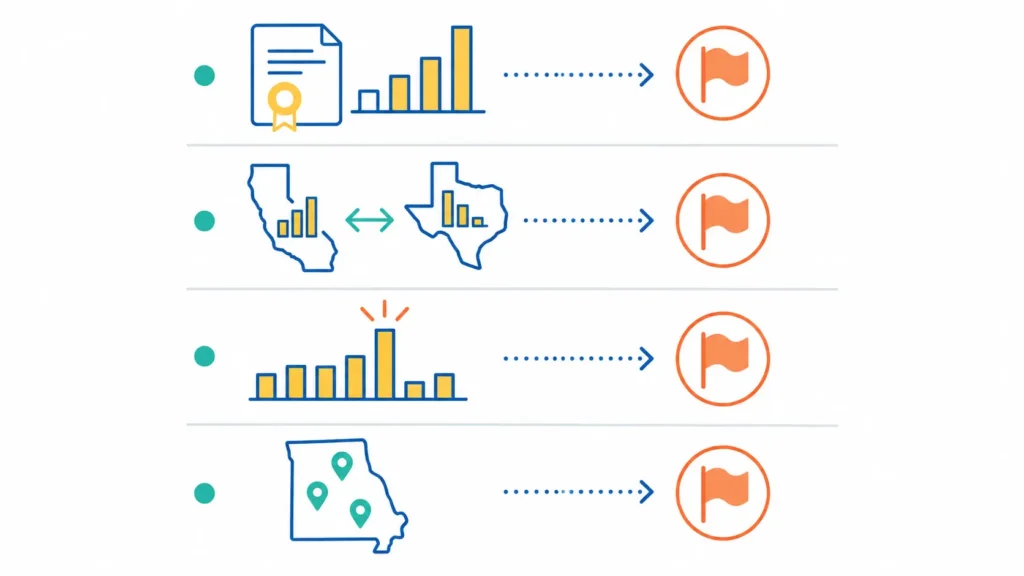
The specific patterns that AI audit systems are catching most consistently in enterprise companies are:
Exemption certificate discrepancies at scale
A company that applies tax-exempt status to 30% of its transactions but has verifiable certificate documentation for only a fraction of those exemptions creates a statistical anomaly. The AI doesn’t need to review each certificate, it flags the ratio. A human auditor then requests all of them, and the gaps become the assessment.
Revenue reported to one state that conflicts with revenue visible in another state’s data
A company that ships from a Texas warehouse to Florida customers, reporting it all as Texas-sourced revenue, creates a discrepancy when Florida’s system sees the shipping data and destination addresses. This particular pattern is one of the most common triggers for multi-state audit cascades, where one state’s AI flag leads to coordinated review by neighboring revenue departments.
Sudden exemption ratio changes without a corresponding change in business model
If a company’s proportion of exempt sales jumps from 15% to 35% in a single year without an acquisition or a significant new product category, the scoring model treats it as suspicious. It may reflect a legitimate change, a major new wholesale customer, a new product line. But it flags for review, and the company then has to document the legitimate explanation under audit conditions rather than in the normal course of business.
Nexus in states with no registration
This is the most straightforward detection pattern. State AI systems can identify nexus violations by analyzing transaction patterns across state lines. A company with employees in North Carolina, consistent shipments to North Carolina addresses, and payment processor data showing North Carolina customer transactions, but no North Carolina sales tax registration, is a clear algorithmic target.
The Compliance Gap AI Exposes Better Than Any Human Auditor
Human auditors select targets based on industry knowledge, tips, and pattern recognition built from years of reviewing returns. They’re good at finding what they know to look for.
AI systems find what no human would have the bandwidth to find: the small, consistent, systematic discrepancy that runs across thousands of transactions over multiple years. A human auditor reviews a sample. An AI model reviews everything.
This is why the nature of enterprise audit risk has changed. The question used to be: does this company have an obvious compliance problem that might come to a human auditor’s attention? The question now is: does this company’s transaction data contain patterns that conflict with its filed returns or its registration footprint? Those are different questions with different answers and the second one is much harder to pass.
The companies that survive AI-powered audit selection are not necessarily the most sophisticated. They are the ones whose compliance data is internally consistent. Filed returns that match actual taxable revenue. Exemption ratios supported by documented certificates. Nexus registrations that cover every state where transaction data shows customer activity. When an AI model scores a company’s data and finds no discrepancies, it moves to the next target.
What Enterprise Companies Should Do Before the Next Scoring Cycle
AI audit systems run continuously, but companies still have the ability to get ahead of them by addressing exposure before a flag becomes an audit notice.
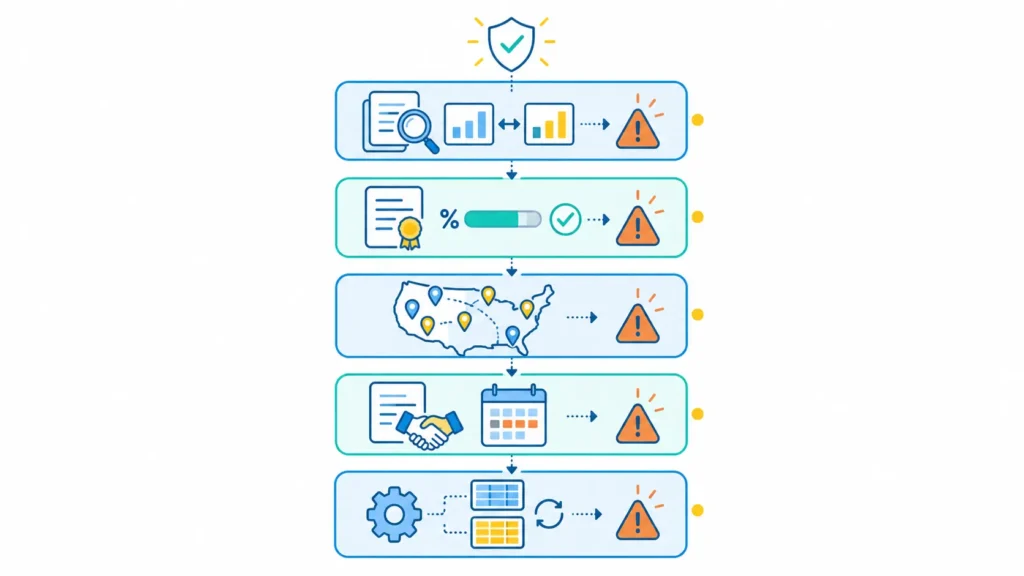
The most urgent steps for enterprise companies in 2026:
Conduct a data reconciliation audit
Compare your filed returns in every state against your actual transaction data, what your payment processors, marketplace platforms, and shipping records show. If those numbers don’t align with what you filed, an AI system has already seen the discrepancy.
Review your exemption certificate file against your exemption ratio
If your tax-exempt transactions represent a material percentage of your revenue, confirm that valid, current certificates exist for every exempt customer relationship. An exemption ratio the AI flags will be followed by a certificate request from an auditor.
Cross-reference your registration list against your nexus footprint
Map every state where you have employees, warehouse locations, marketplace inventory, or revenue above the economic nexus threshold, then compare it against your current registration list. Unregistered states with visible transaction data are the highest-priority AI targets.
Address past exposure through voluntary disclosure before a state selects you
If the reconciliation reveals states where you should have been registered and weren’t, a voluntary disclosure agreement caps your lookback period and waives penalties. Once the AI flags your account and the state initiates contact, VDA eligibility ends.
Ensure your compliance data is internally consistent going forward
Your filed returns, your exemption documentation, your nexus registrations, and your transaction records should tell the same story. When they don’t, the AI finds it. When they do, you’re not the most interesting target in the dataset.
Final Words
State tax authorities in 2026 have better data, better tools, and more efficient ways to find compliance gaps than at any previous point in the history of sales tax enforcement. The companies being audited are not necessarily the ones with the largest gaps. They’re the ones whose data patterns create discrepancies that an algorithm can detect and that distinction matters.
Enterprise companies that built their compliance infrastructure before AI-powered audit selection became standard are operating in a different enforcement environment than the one they designed for. The right response is not panic. It’s a structured review of whether the compliance data the company generates, returns, exemption ratios, transaction records, registration footprint, is internally consistent and accurate.
If it is, the AI scores you low and moves on. If it isn’t, it already has.
Find Out What Your Compliance Data Looks Like to a State AI System
IST works with enterprise companies to conduct the pre-audit reconciliation that identifies data discrepancies before an algorithm does, cross-referencing filed returns against actual transaction data, reviewing exemption certificate coverage, mapping the nexus footprint against current registrations, and addressing any gaps through voluntary disclosure before state contact occurs.
The companies that come through AI-powered audits cleanly are the ones that did this work before the audit notice arrived.
Talk to an IST advisor today. Find out what your compliance data looks like to a state AI audit system, before the state does.
Frequently Asked Questions
How do state AI audit systems select companies for sales tax audits?
State AI systems use predictive scoring models that ingest data from multiple sources simultaneously, payment processor reports, marketplace facilitator filings, prior year returns, and cross-state transaction data. Each business is scored for audit risk based on discrepancies between filed returns and externally visible transaction data. Companies with consistent, documented compliance score lower and are less likely to be selected. Companies with exemption ratio anomalies, revenue discrepancies, or nexus in unregistered states score higher.
What data sources do states use for AI-powered sales tax enforcement?
States cross-reference multiple data streams: marketplace facilitator reports (from Amazon, eBay, Walmart), payment processor 1099-K filings shared through IRS data agreements, prior sales tax return history, shipping and destination address records, and cross-state transaction pattern analysis. The combination of these sources allows AI systems to identify companies that have revenue or transactions in a state but no corresponding sales tax registration or collection.
Which states are using AI for sales tax audit selection in 2026?
California’s CDTFA has used machine learning for audit selection for several years, collecting an estimated $477 million in net deficiencies in a recent fiscal year. New York’s Department of Taxation and Finance uses an algorithmic flagging system. South Carolina formally launched AI-based audit selection in 2026. Texas, Florida, and other high-revenue states have also invested in data analytics capabilities. The IRS is separately deploying AI across 129 use cases, including audit prioritization for large corporations.
What triggers a sales tax audit from an AI system?
The most common AI audit triggers for enterprise companies are: exemption ratios that are statistically anomalous or not supported by verifiable certificate data; revenue reported to one state that conflicts with transaction data visible in another state; marketplace or payment processor data showing activity in states where the company has no registration; sudden changes in filing patterns without a corresponding business explanation; and year-over-year discrepancies in taxable revenue relative to third-party data sources.
Does a voluntary disclosure agreement still work after an AI system flags a company?
No. VDA eligibility ends the moment a state makes contact, including when contact results from an AI-generated audit flag. Once the state’s system has identified the company as a target and initiated the process, the business is in the audit stream on the state’s terms. VDA is only available to businesses that come forward proactively before state contact. The practical implication: companies with unregistered nexus or compliance gaps need to address them before the AI scoring cycle identifies them, not after.
How many times per year do state and IRS AI systems score businesses for audit risk?
IRS AI audit scoring systems run six times per year, updating their risk assessments with each iteration based on new data. State systems vary in frequency, but most run scoring cycles at least quarterly, with some running continuously as new data sources are integrated. The practical effect is that a company’s compliance exposure is evaluated multiple times per year, not just at filing time and a compliance gap that develops mid-year can trigger audit selection before the annual return is even filed.
What is a “data reconciliation audit” and why does it matter for AI audit defense?
A data reconciliation audit compares a company’s filed sales tax returns against the transaction data visible to state AI systems, including payment processor records, marketplace reports, and shipping data. The goal is to identify discrepancies before a state AI system does. If filed returns understate taxable revenue in a state, or if the company has marketplace or payment data visible in states where it hasn’t registered, those discrepancies are exactly what AI scoring models flag. Finding them internally first allows the company to address them through voluntary disclosure rather than audit response.
Can a company appeal an audit that was triggered by an AI system?
Yes, audit rights remain the same regardless of how the audit was selected. A company retains the right to dispute findings, present documentation, and contest assessments through the state’s normal appeals process. However, the fact that AI-triggered audits tend to focus on specific, data-identified discrepancies means the documentation burden is often higher, the auditor arrives with specific transaction data in hand, and the company must explain or refute it. Strong exemption certificate files, reconciled returns, and accurate nexus registrations are more important in AI-triggered audits than in traditional random selections.
Leave a Reply