

Sales tax filing frequency, monthly, quarterly, or annual, is assigned by each state based on a business’s sales volume or estimated tax liability. Monthly filing typically applies when annual liability exceeds $10,000 in a state. Quarterly applies for mid-range liability. Annual filing is reserved for businesses remitting under approximately $1,200 per year to that state.
Sales Tax Filing Frequency: Monthly, Quarterly, or Annual
Which One Applies to You?
Miss a filing deadline in Texas and you’re looking at a 5% penalty on the first 30 days, then another 10% after that. File monthly in a state where you only owe $200 a year and you’ve wasted twelve hours of administrative time for no compliance benefit. Sales tax filing frequency isn’t just a bureaucratic detail, it directly affects your cash flow, your penalty exposure, and how much time your team spends on compliance every month.
Understanding sales tax filing frequency, whether monthly, quarterly, or annual, is one of the foundational decisions in multi-state compliance. And unlike most tax decisions, this one isn’t entirely up to you.
Sales tax filing frequency determines how often a business must remit collected tax and submit returns to a state. States assign filing schedules, monthly, quarterly, or annual, based on revenue thresholds or estimated tax liability, not business preference. Monthly filing is standard for high-volume sellers, quarterly for mid-volume, and annual for low-liability accounts. Filing on the wrong schedule, less frequently than required, generates penalty and interest charges from the original due date. Businesses registered in multiple states must track each jurisdiction’s assigned frequency separately, as states can change schedules without prominent notification.
What Sales Tax Filing Frequency Actually Means
Filing frequency refers to how often a business is required to remit collected sales tax to a state and submit a return. Every state that imposes a sales tax sets its own schedule and most states assign your filing frequency based on your sales volume or your expected tax liability, not your preference.
The three standard schedules are:
- Monthly: required in most states once a business exceeds a certain revenue or liability threshold. Common for businesses with $10,000+ in monthly tax liability.
- Quarterly: assigned to mid-volume sellers. Often triggered when annual tax liability falls between roughly $1,200 and $10,000, though thresholds vary widely by state.
- Annual: reserved for the smallest tax liability accounts, typically businesses remitting under $1,200 per year to that state.
Some states also use semi-annual or semi-monthly schedules for specific liability brackets. California, for example, uses a prepayment system for very high-volume filers.
States Decide Your Schedule Not You
This is the part most business owners get wrong. When you register for a sales tax permit in a new state, the state assigns your initial filing frequency based on your estimated liability. As your revenue grows, the state can and often does, move you to a more frequent schedule automatically.
A wholesale distributor that registers in Illinois expecting quarterly filings may find, after a strong year, that the state has reclassified the account to monthly. If no one on the team noticed the notification, the business is now filing on the wrong schedule, technically delinquent on eleven months of returns.
That scenario isn’t hypothetical. It happens regularly to growing businesses that registered in multiple states during a period of rapid expansion and then never revisited their filing assignments.
How Monthly, Quarterly, and Annual Filing Actually Differ in Practice
| Filing Frequency | Typical Liability Threshold | Due Date (Most States) | Best For |
|---|---|---|---|
| Monthly | $10,000+ per year in that state | 20th of the following month | High-volume multi-state sellers |
| Quarterly | $1,200–$10,000 per year | End of month after quarter close | Mid-volume ecommerce, regional distributors |
| Annual | Under $1,200 per year | January 31 or state-specific | Small sellers, low-volume remote nexus |
| Semi-monthly | Very high volume (varies) | Twice monthly | Large retailers, enterprise-level filers |
Due dates vary. New York’s monthly return is due on the 20th. Florida gives filers until the 19th. Some states penalize late filing even when no tax is owed, meaning a zero-return filed one day late still generates a penalty notice.
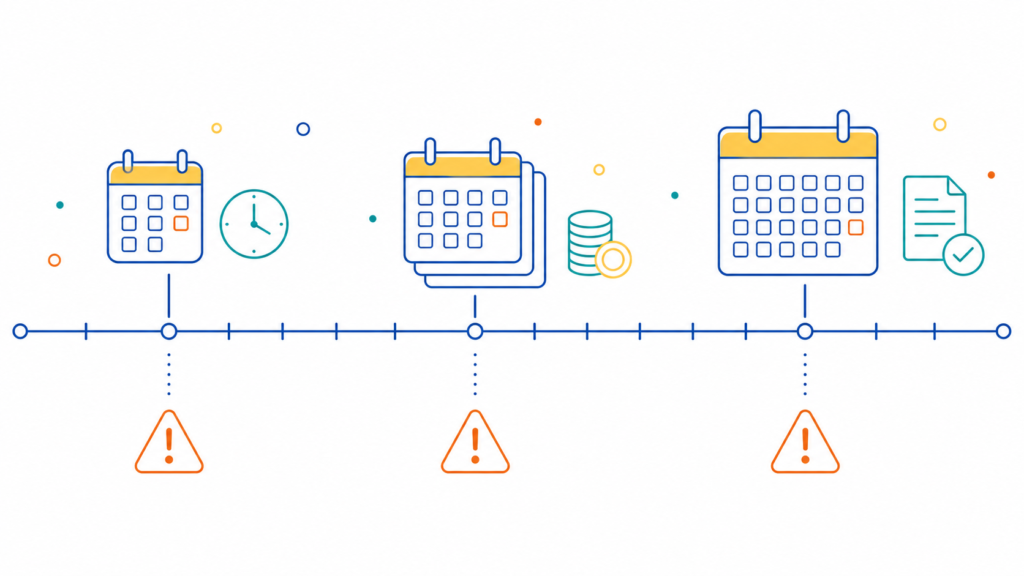
The Real Risk of Filing on the Wrong Schedule
Filing less frequently than required is the more common error and the more expensive one. If a state assigned you monthly filing and you’ve been filing quarterly, you have eleven delinquent returns per year accumulating interest from the original due date. Across three or four states, that exposure compounds fast.
But over-filing creates its own problems. A SaaS company with $800 in annual liability in Vermont doesn’t need to file monthly returns. Doing so voluntarily wastes administrative resources and increases the likelihood of a filing error, each return is another opportunity to enter the wrong figure.
The right filing frequency is the one the state assigned to your account. The problem is that most businesses don’t check this after initial registration.
How Filing Frequency Affects Cash Flow
Monthly filers remit tax within 20 days of the period close, which means collected tax stays on the books for a shorter window. For a business collecting $50,000 in sales tax per month across multiple states, that’s a meaningful cash flow constraint, the money can’t sit in an operating account for 90 days the way it might for a quarterly filer.
Quarterly filing gives businesses a longer float on collected tax. That’s not a reason to prefer quarterly filing, the state sets the schedule, not the business, but it’s a real operational difference that CFOs in high-growth companies should factor into working capital planning.
Annual filers, by definition, hold collected tax for up to twelve months before remitting. In states where this is permitted, it’s essentially an interest-free short-term loan from the state. But it only applies when liability is genuinely low. Using it as a cash management strategy in a state where you should be filing monthly is how businesses end up with five-figure penalty assessments.
What Businesses Should Do to Get This Right
- Pull your current filing frequency for every state where you’re registered. Log into each state’s taxpayer portal or contact the state directly. Do not assume the frequency hasn’t changed since you registered.
- Check your liability thresholds annually. If your revenue in a state has grown, your assigned frequency may have changed, with or without a notification you noticed.
- Set calendar reminders for every due date across every jurisdiction. A multi-state compliance calendar is not optional for businesses registered in more than five states.
- If you’ve been filing on the wrong schedule, address it proactively. A voluntary disclosure or amended return process is almost always less costly than waiting for the state to audit the discrepancy.
- Use automation that tracks frequency changes, not just calculates tax. Most lightweight sales tax tools calculate the correct amount but don’t flag when a state has reclassified your filing schedule.

Final Words
Sales tax filing frequency sounds like a minor administrative detail. It isn’t. The wrong schedule, in either direction, creates penalty exposure, cash flow miscalculation, and audit risk that compounds quietly across multiple periods. States set the schedule, states change the schedule, and states will assess penalties regardless of whether you knew the schedule had changed.
The businesses that manage this well are the ones that treat filing frequency as a living compliance variable, not a one-time setup decision. Check it annually. Automate the reminders. And if you have any doubt about what schedule applies to your account in a given state, verify it directly, not through your accounting software, which may not reflect a state-initiated change.
Not Sure What Filing Schedule You’re Actually On in Every State?
IST conducts full compliance reviews that include verifying your assigned filing frequency, identifying any delinquent returns, and building a jurisdiction-specific filing calendar across every state where you have a registration. If your filing schedule hasn’t been reviewed since you registered, there’s a reasonable chance it no longer matches what the state expects.
Contact IST for a compliance review → Know exactly what you owe, when it’s due, and whether you’re already behind.
Sales tax filing frequency isn’t complicated in concept, but it’s easy to get wrong in practice, especially for businesses registered in multiple states. The schedule was set when you registered. Your revenue has probably changed since then. And most state notification systems aren’t designed to make sure you noticed when your frequency was reclassified.
Check your current assigned frequency in every state. Build a filing calendar that reflects the actual due dates, not the ones you remember from when you first registered. And if the audit math on a delinquent filing period looks manageable now, it will look considerably worse after two more years of interest and penalties have compounded on top of it.
The cost of getting this right proactively is almost always lower than the cost of cleaning it up reactively.
How is sales tax filing frequency determined?
Each state assigns a filing frequency, monthly, quarterly, or annual, based on your estimated or actual tax liability in that state. High-revenue businesses are typically assigned monthly filing. States can change your assigned frequency as your sales grow, sometimes without a clear notification through your existing accounting system.
What happens if I file sales tax less frequently than required?
Filing less frequently than your assigned schedule means missing return deadlines. States assess penalties from the original due date, plus interest on the unpaid amount. In most states, penalties begin at 5–10% of the tax due and increase the longer the return remains unfiled. A zero-dollar return filed late can still generate a penalty notice in many states.
Can a business choose its own sales tax filing frequency?
Generally, no. States assign filing frequency based on liability thresholds. Some states allow businesses to request a less-frequent schedule if their liability drops below the threshold for their current assignment, but this requires a formal request, it does not happen automatically.
What is the sales tax filing due date for monthly filers?
Due dates vary by state. Most states require monthly returns by the 20th of the following month. Some states, including Florida, use the 19th. A few states offer a discount for early filing or electronic payment. Businesses registered in multiple states must track each state’s specific deadline separately.
How does sales tax filing frequency affect cash flow?
Monthly filers must remit collected tax within roughly 20 days of period close, limiting how long the funds sit in an operating account. Quarterly filers hold collected tax for up to 90 days before remitting. Annual filers hold it for up to 12 months. For high-volume businesses, the difference between monthly and quarterly filing represents a meaningful working capital consideration.
What should I do if my sales tax filing frequency has changed but I didn’t know?
If a state has reclassified your account to a more frequent schedule and you’ve been filing on the old schedule, you have delinquent returns. The most cost-effective path is usually to file the missing returns proactively, with a voluntary disclosure or amended return process, before the state identifies the gap in an audit.
Do multi-state businesses have different filing frequencies in each state?
Yes. A business registered in 15 states may be assigned monthly filing in California and Texas (high revenue states), quarterly filing in six others, and annual filing in the remaining states where liability is low. Each state’s assigned frequency and due date must be tracked independently.
Is annual sales tax filing ever a risk for growing businesses?
Yes. A business that qualified for annual filing when it registered in a state may no longer qualify once revenue grows, but if the state doesn’t proactively change the account and the business doesn’t check, it can continue filing annually when monthly filing is now required. This creates a backlog of delinquent returns that grows by 11 per year, per affected state.
Leave a Reply