
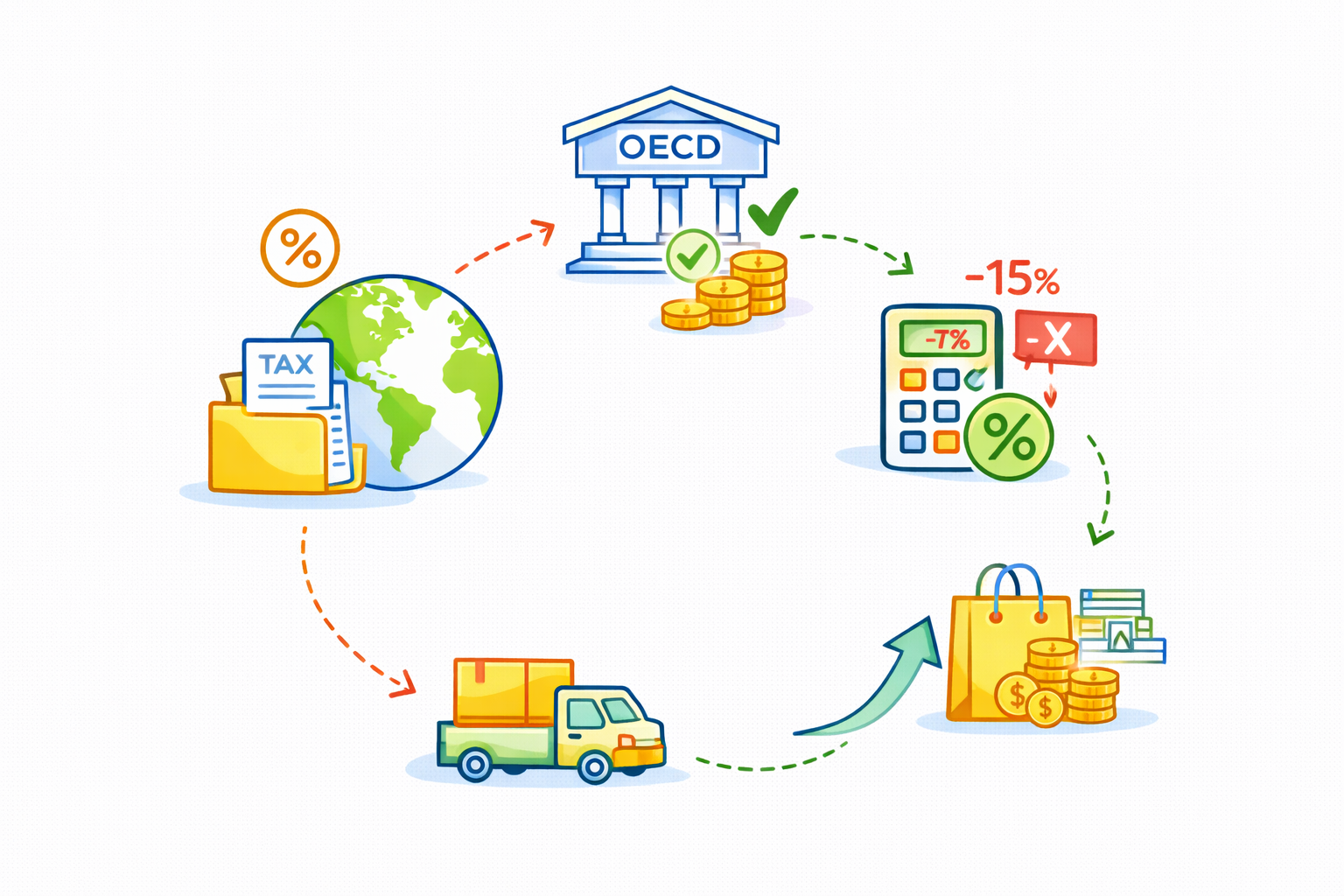
International tax law is undergoing one of the most significant transformations in decades. Governments worldwide are redesigning tax frameworks to address the digital economy, cross-border eCommerce, and multinational profit shifting. From digital services taxes (DSTs) to the OECD’s global minimum tax initiative, these changes are reshaping how businesses calculate, collect, and remit sales tax across borders.
For companies selling internationally, these developments are not just regulatory updates, they directly affect pricing strategies, compliance costs, reporting obligations, and long-term growth plans.
In this article, we break down recent and upcoming changes in international tax law, examine their impact on sales tax and global trade, and outline practical compliance strategies for global businesses.
The Shift Toward Digital Taxation
Traditional tax systems were designed for physical businesses operating within national borders. Today, companies can sell digital products, SaaS subscriptions, and services globally without a physical presence.
To address this gap, many countries have introduced Digital Services Taxes (DSTs) or expanded VAT/GST rules to cover foreign digital suppliers. These measures typically require businesses to:
- Register for VAT/GST in customer jurisdictions
- Collect and remit taxes based on customer location
- Comply with local reporting requirements
For example, the EU VAT eCommerce Package introduced the One-Stop Shop (OSS) system to simplify VAT reporting for cross-border sales within the EU. Meanwhile, countries like Canada, the UK, Australia, and many Asian economies have implemented similar marketplace and remote seller rules.
The result? Businesses that once operated under a single domestic tax framework now face multi-jurisdictional sales tax obligations.
OECD Global Tax Reform: BEPS 2.0 and Its Implications
The OECD’s Base Erosion and Profit Shifting (BEPS) 2.0 initiative represents a landmark shift in international corporate taxation.
It consists of two pillars:
Pillar One: Reallocates taxing rights so that large multinational enterprises pay taxes in countries where their customers are located, even without physical presence.
Pillar Two: Introduces a global minimum corporate tax rate of 15% to prevent profit shifting to low-tax jurisdictions.
While Pillar Two primarily targets large multinational groups, its ripple effects impact supply chains, transfer pricing, and cross-border pricing strategies, all of which influence indirect tax structures.
As governments align domestic rules with OECD standards, businesses must reassess:
- Where revenue is recognized
- How cross-border transactions are structured
- The interaction between corporate tax and indirect tax
Failure to align tax strategy across departments can result in double taxation, penalties, or reputational risk.
Expanding Sales Tax Nexus Rules
Another major development is the expansion of economic nexus rules.
Following the U.S. Supreme Court’s South Dakota v. Wayfair decision, many countries and states adopted similar economic nexus thresholds. Businesses no longer need physical presence to trigger sales tax obligations, revenue thresholds alone may require registration.
Common triggers include:
- Revenue exceeding a set amount (e.g., $100,000 or equivalent)
- Transaction volume thresholds
- Marketplace facilitator rules
For international sellers, this means even modest cross-border activity can create tax obligations in multiple jurisdictions.
As more countries digitize tax administration and share information internationally, enforcement has become more sophisticated.
Implications for Global Trade
Changes in international tax law affect global trade in several key ways:
1. Increased Compliance Complexity
Companies must monitor tax rules in every country where they sell. Regulations change frequently, and non-compliance can lead to fines, audits, and market restrictions.
2. Pricing and Margin Pressure
New digital taxes and VAT obligations may increase total tax costs. Businesses must decide whether to absorb these costs or pass them on to customers.
3. Supply Chain Restructuring
Global minimum tax rules and new reporting standards may require restructuring entities, distribution hubs, or fulfillment centers.
4. Technology and Reporting Demands
Governments are moving toward real-time reporting, e-invoicing, and digital tax submissions. Businesses need scalable systems capable of automated tax calculation and reporting.
5. Competitive Landscape Shifts
Larger multinational corporations may absorb compliance costs more easily, while smaller international sellers face proportionally higher administrative burdens.
Recent and Upcoming Global Changes to Watch
Several global trends are shaping the future of international tax:
- Expansion of digital VAT/GST rules in emerging markets
- Implementation phases of OECD Pillar Two rules
- Increased cooperation between tax authorities
- Mandatory e-invoicing systems (e.g., in Latin America and Europe)
- Enhanced transparency and data sharing
Businesses that treat compliance as a reactive function risk falling behind. Proactive tax planning is becoming a strategic advantage.
Compliance Strategies for International Businesses

To navigate the evolving landscape, businesses selling internationally should consider the following strategies:
1. Conduct a Global Tax Exposure Assessment
Identify all jurisdictions where your company may have economic nexus. Map revenue streams, digital sales, and marketplace activity.
2. Centralize Tax Data
Fragmented systems create risk. Implement centralized platforms that track VAT, GST, and sales tax obligations globally.
3. Automate Sales Tax Calculations
Manual processes increase error risk. Automated tax engines help ensure accurate, location-based tax calculation in real time.
4. Monitor Regulatory Updates
Assign responsibility for monitoring international tax law changes or partner with specialists who provide continuous updates.
5. Align Corporate and Indirect Tax Planning
Ensure that transfer pricing, corporate tax planning, and sales tax compliance are aligned to avoid unintended exposure.
6. Prepare for Audits
Maintain clear documentation of tax registrations, remittances, and customer location data.
Why This Matters Now
International tax law changes are accelerating, not slowing down. Governments need revenue, digital commerce continues to expand, and global coordination through the OECD is increasing.
For businesses engaged in cross-border trade, compliance is no longer optional or simple. It is strategic.
Companies that invest in proactive compliance frameworks will gain:
- Reduced risk exposure
- Greater operational clarity
- Stronger global scalability
- Enhanced credibility with partners and regulators
Those that delay may face financial penalties, operational disruption, or loss of market access.
Turning Tax Complexity Into Competitive Advantage
International tax reform is reshaping global commerce. Digital tax policies, OECD initiatives, and expanded nexus rules are fundamentally changing how businesses manage sales tax and cross-border trade.
While the regulatory environment may seem overwhelming, it also presents an opportunity. Businesses that embrace structured compliance, leverage technology, and align tax strategy with growth objectives can turn complexity into competitive advantage.
The global marketplace rewards companies that are agile, informed, and compliant.
At IST, we help businesses navigate evolving international tax regulations with confidence. From sales tax automation to strategic advisory, our experts ensure your global operations remain compliant, efficient, and future-ready.
Ready to protect your business and scale internationally with confidence?
Contact IST today and let our specialists build a smarter global tax strategy for you.
Leave a Reply