
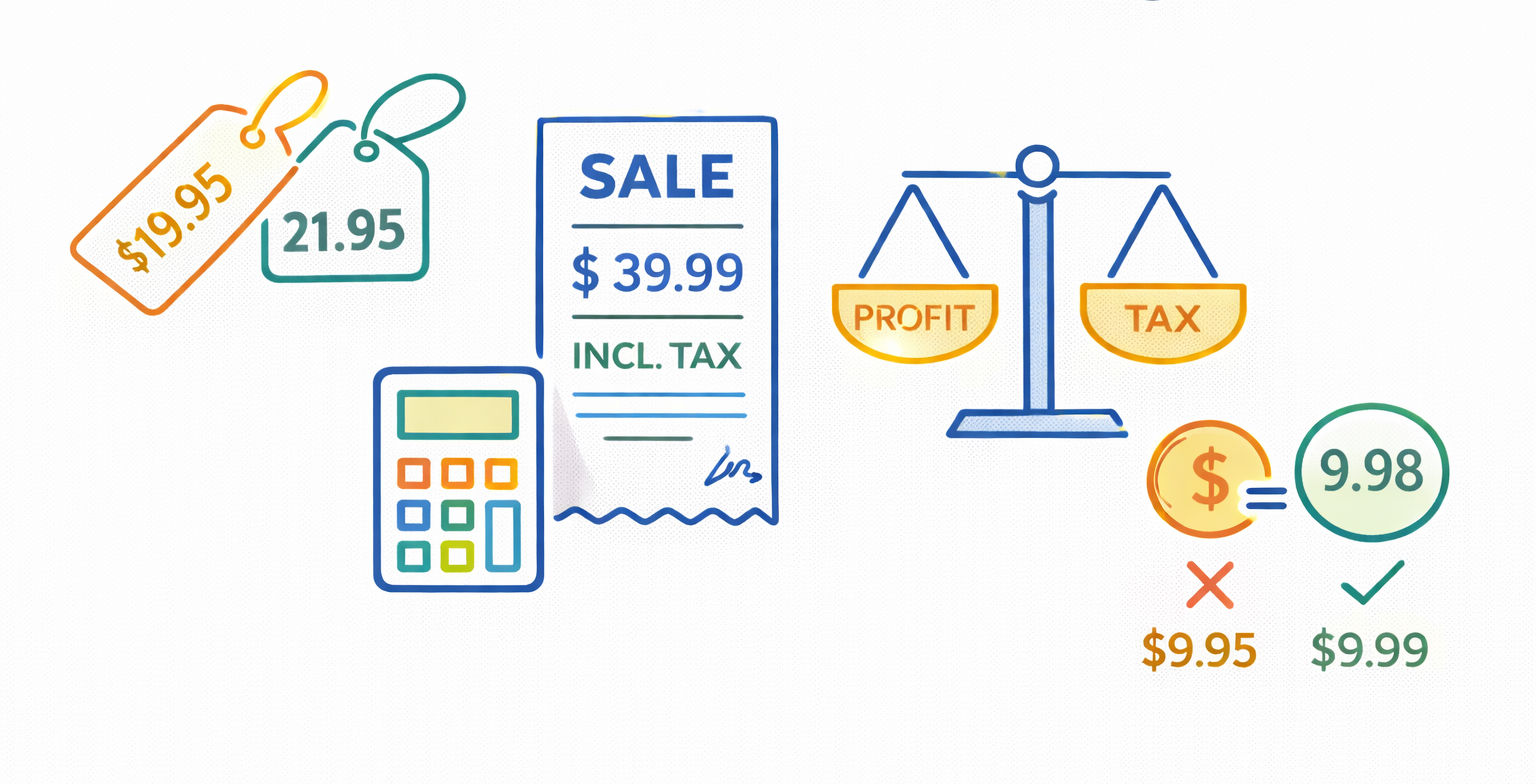
Pricing is already complex. Add sales tax into the equation and suddenly your profit margin starts playing hide and seek. Many businesses either underprice and absorb tax unintentionally or overcomplicate pricing in ways that confuse customers.
The goal is simple. Include sales tax intelligently, protect margins, and maintain customer trust. The execution is where strategy matters.
Understand the True Tax Impact on Your Margins
Before adjusting pricing, you need to know exactly how tax affects profitability.
Sales tax is typically added on top of the sale price in many jurisdictions, while VAT systems are often embedded in the advertised price. The structure alone changes how customers perceive value and how businesses calculate margins.
If you absorb tax without recalculating markup, your profit shrinks instantly. For example, if your product costs 70 and you sell it for 100 with a 10 percent tax absorbed into that 100, your effective revenue is 90.91, not 100. That difference compounds quickly at scale.
Accurate margin modeling must account for:
- Tax rates by jurisdiction
- Product or service taxability differences
- Marketplace facilitator impacts
- Discounts and promotional pricing
Without precise modeling, pricing becomes guesswork disguised as optimism.
Decide: Absorb the Tax or Pass It On
This is the central pricing decision.
Passing Tax to Customers
This is the most straightforward approach. The product price remains intact, and tax is calculated at checkout. Your margins remain stable, and transparency is high.
However, in competitive markets, higher checkout totals can cause friction, especially in ecommerce where comparison shopping is easy.
Absorbing Tax
Absorbing tax can simplify messaging. Customers see a single all inclusive price. This works particularly well in VAT jurisdictions where tax inclusive pricing is expected.
But absorbing tax without adjusting base pricing reduces margin. If absorption is strategic, prices must be recalibrated upward to maintain profitability.
The decision depends on market norms, competitive positioning, and customer expectations. What it should never depend on is habit.
Build Tax Into Pricing Formulas, Not Afterthoughts
One common mistake is calculating tax after pricing decisions are finalized.
Instead, tax should be integrated into pricing models from the beginning. That means:
- Modeling gross and net revenue simultaneously
- Testing pricing at different tax rates
- Simulating multi state or multi country expansion
- Factoring economic nexus exposure
When expansion triggers new tax collection obligations, margins should not collapse overnight. Strategic pricing accounts for future compliance thresholds before they are crossed.
Businesses that scale without this foresight often discover profitability gaps only after filing their first return in a new jurisdiction.
Strategic Rounding to Protect Margins
Rounding sounds minor. It is not.
Small rounding differences multiplied across thousands of transactions materially impact revenue.
If a tax inclusive price calculates to 19.87, rounding down to 19.85 feels customer friendly but erodes margin. Rounding up strategically while maintaining psychological pricing thresholds can offset tax absorption.
Consider:
- Ending prices in .99 or .95 after tax modeling
- Aligning rounding rules across channels
- Ensuring automated systems apply consistent rounding logic
Inconsistent rounding creates reconciliation issues and audit risk.

Communicating Pricing Clearly to Customers
Tax strategy is not only financial. It is also reputational.
Customers dislike surprises at checkout. If tax is added separately, make it visible early in the buying journey. If pricing is tax inclusive, clarify that taxes are included.
Transparent communication reduces abandoned carts and improves trust.
For service businesses, contracts and proposals should clearly state whether quoted fees are tax exclusive or inclusive. Ambiguity leads to disputes and margin leakage.
Clear language protects both revenue and relationships.
Adjust Pricing for Multi Jurisdiction Operations
Operating in multiple states or countries introduces variable tax rates. A uniform national price can distort margins when tax rates differ significantly.
Options include:
- Region specific pricing
- Weighted average pricing models
- Margin buffers built into national pricing
Each approach carries trade offs between simplicity and precision.
Technology plays a crucial role here. Without automated rate determination and tax calculation, pricing strategy becomes reactive instead of proactive.
Monitor Tax Law Changes Proactively
Economic nexus thresholds shift. Digital services become taxable. Marketplace laws evolve.
When tax obligations expand, pricing models must adapt quickly. Businesses that delay adjustments often absorb costs unintentionally for months.
Regular tax exposure reviews should be part of pricing strategy meetings, not an afterthought handled during annual compliance reviews.
Tax is dynamic. Pricing must be equally dynamic.
Align Finance, Sales, and Compliance Teams
Pricing decisions often sit with sales or marketing, while tax compliance sits with finance. That separation creates risk.
Cross functional collaboration ensures:
- Promotions are tax modeled before launch
- Bundled products are evaluated for mixed taxability
- Discounts do not create unexpected margin compression
A pricing strategy that ignores tax complexity eventually becomes expensive.
How IST Supports Smarter Pricing Decisions
IST helps businesses integrate tax compliance directly into pricing and operational strategy. By combining regulatory insight with automated calculation tools, IST enables accurate margin modeling across jurisdictions.
When tax rules change, systems adjust. When businesses expand, pricing remains aligned with compliance obligations.
Smart pricing is not about guessing how much customers will tolerate. It is about structuring revenue intelligently in a changing regulatory environment.
Final Words
Pricing products and services without accounting for sales tax is like building a house without measuring the foundation. It may look stable at first, but pressure reveals the cracks.
Whether you choose to absorb tax or pass it through, margins must be modeled precisely. Rounding must be strategic. Communication must be transparent. And expansion plans must anticipate new tax obligations before they impact profitability.
Sales tax does not have to erode margins. Poor planning does.
If your pricing strategy has not been reviewed through a tax lens, it is time. IST helps businesses model margins accurately, adapt to multi jurisdiction tax rules, and protect profitability as regulations evolve.
Connect with IST to build a pricing strategy that works with tax, not against it.
Leave a Reply