
Sales tax compliance is one of the most demanding responsibilities for modern businesses. As companies expand into new states, adopt multiple sales channels, or increase transaction volume, keeping up with rate changes, nexus rules, and filing deadlines becomes harder. The key decision most organizations face is whether to rely on manual processes or invest in automated sales tax calculation.
This guide breaks down the differences, benefits, challenges, and decision criteria to help you choose the best method for your business.
Why Sales Tax Compliance Has Become More Complex
Sales tax is not a single rate or rule set. In the United States, tax requirements vary across thousands of jurisdictions including states, counties, cities, and special tax districts. Laws change frequently, and factors like economic nexus, marketplace facilitator rules, and product taxability make the process even more complicated.
When compliance becomes too time consuming or too risky to manage manually, automation enters the conversation. But automation is not the right fit for every business. Understanding both options helps you make a strategic choice.
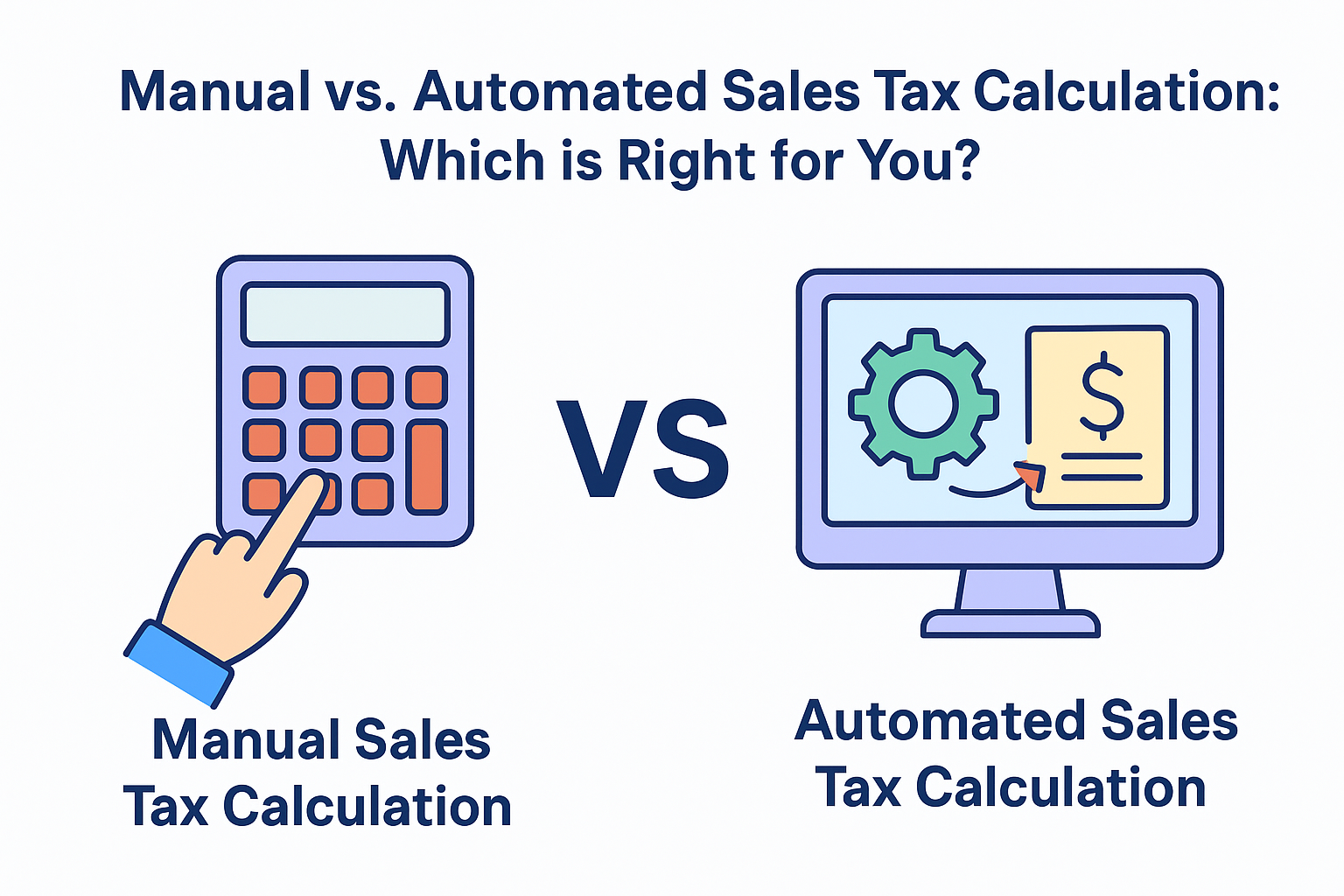
Manual Sales Tax Calculation
Manual calculation is the traditional approach. Businesses typically track rates using spreadsheets, basic accounting systems, or internal documents, applying tax themselves during checkout or invoicing.
Advantages of Manual Calculation
Full control over your process
Smaller businesses often appreciate being hands-on. When operating within one or two states, staying updated is still manageable.
Low upfront cost
Manual methods require no subscription fees. For new or low-budget operations, this is appealing.
Suitable for simple tax environments
If you only sell in a single state with stable rates, manual calculations can work without overwhelming your team.
Disadvantages of Manual Calculation
Higher risk of human error
Frequent legislative changes mean outdated rates can cause underpayment, penalties, or audit exposure.
Administrative burden
Researching rate updates, monitoring nexus thresholds, tracking exemptions, and filing returns all require significant time.
Poor scalability
As soon as a business expands into multiple states, the workload increases dramatically. Manual tracking rarely keeps up with long-term growth.
Manual calculation is most effective for very small businesses with simple, predictable tax requirements.
Automated Sales Tax Calculation
Automated sales tax calculation uses cloud-based software integrated with ecommerce platforms, POS systems, ERPs, or invoicing tools. It applies the correct tax rate in real time and often supports automated reporting and filing.
Advantages of Automated Calculation
Real-time accuracy
Automated tools update tax rates and rules constantly, ensuring accurate calculations for every transaction.
Scalability
Expanding into new states or launching new sales channels becomes simple. The system handles the increased complexity without additional manual work.
Reduced compliance risk
Automatic updates and consistent application of rules reduce errors, penalties, and audit exposure.
Streamlined filings
Many systems can auto-prepare and even file returns, improving accuracy and preventing missed deadlines.
Disadvantages of Automated Calculation
Software cost
Automation requires a recurring subscription. For microbusinesses, this may feel like an unnecessary expense.
Setup and configuration
Mapping products, defining nexus settings, and integrating platforms can take initial time and technical effort.
Less manual control
Automation limits the need for hands-on oversight. While many businesses prefer this, others may find it unfamiliar.
Automation is usually ideal for growing businesses with multi-state presence, high transaction volume, or complex tax obligations.
How to Choose the Right Method
1. Evaluate your geographic footprint
If you operate in only one or two low-complexity states, manual calculation can still work. If you sell in multiple states or plan to, automation prevents errors and saves time.
2. Consider your transaction volume
A small number of invoices per month may not justify automation. However, hundreds or thousands of transactions across different locations almost always require automated tools.
3. Assess your risk tolerance
Even minor calculation errors can trigger penalties, interest, and audits. Businesses in regulated industries or fast-growth environments benefit most from automation’s accuracy.
4. Factor in long-term scalability
If you expect growth in the next 12 to 24 months, adopting automated sales tax calculation early helps you avoid disruption and rebuilds later.
Final Words
Manual sales tax calculation is viable for small, simple, cost-sensitive businesses with limited geographic reach. However, as soon as operations expand, tax obligations become more complex, and the risk of human error grows.
Automated sales tax calculation offers real-time accuracy, scalability, lower long-term risk, and significantly reduced administrative work. For most businesses aiming to grow, automation delivers a smoother, safer, and more efficient path to compliance.
Making the right choice today helps protect your company from penalties, improves your financial accuracy, and gives your team more time to focus on revenue and customer growth rather than tax regulations.
Leave a Reply