
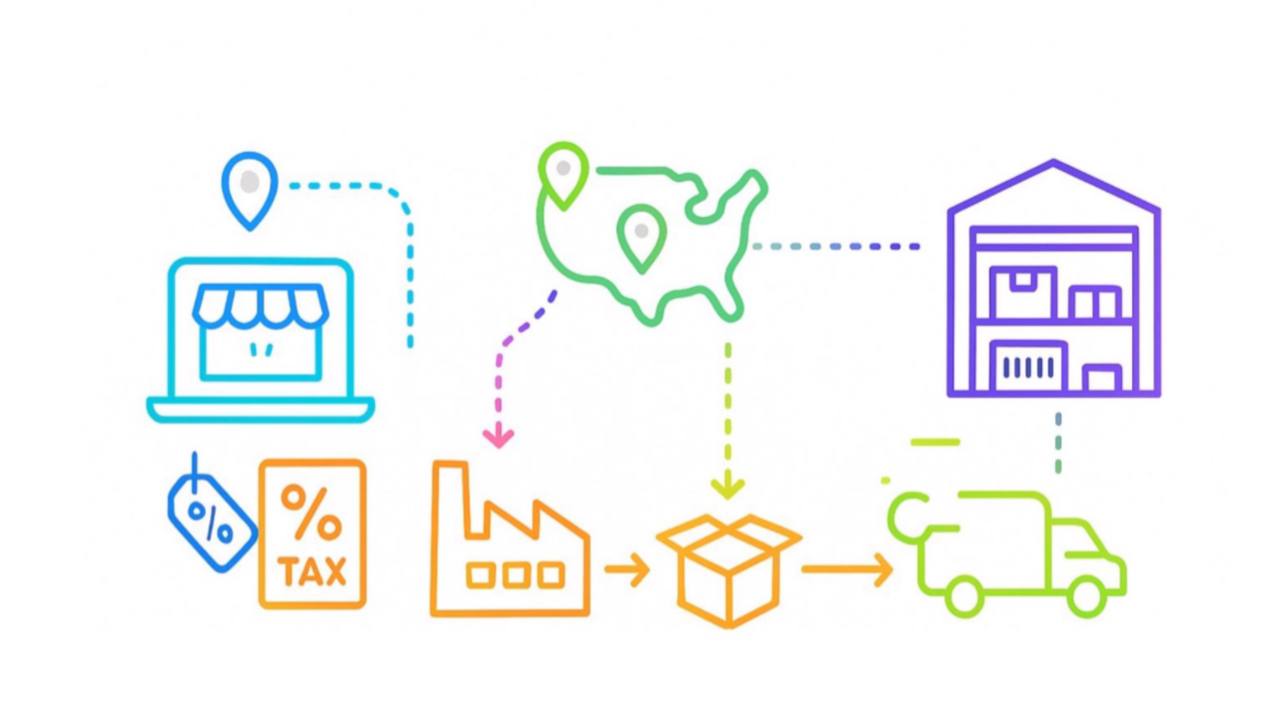
Running an online business today often means your products live in multiple places your store, a dropshipper’s warehouse, or an Amazon fulfillment center. But what many sellers don’t realize is this: every location your inventory touches could trigger a sales tax obligation.
In this guide, we’ll break down how sales tax for remote sellers, dropshipping, and third-party fulfillment works in the U.S., what risks come with distributed inventory, and how automation through Integral Sales Tax (IST) keeps you compliant no matter where your products ship from.
Understanding Sales Tax for Remote Sellers
After the 2018 Wayfair decision, “economic nexus” became the new standard for U.S. sales tax.
That means even if your business has no physical office or employees in a state, you may still owe sales tax if you exceed certain sales or transaction thresholds there.
For remote sellers, the challenge is staying on top of these thresholds across 45+ tax jurisdictions, each with unique rules and filing schedules.
Example:
A California-based online retailer exceeded $100,000 in sales to New York customers while storing some inventory in an Arizona warehouse. The result? They triggered nexus in both states, one economic, one physical.
Without automation, they risked late registrations and incorrect filings. With IST, all thresholds were tracked automatically, ensuring no surprise liabilities.
Sales Tax for Dropshipping Businesses
Dropshipping simplifies logistics, but complicates taxes.
When a supplier ships products directly to your customer, multiple transactions occur: one between you and the supplier, and another between you and the customer.
Who collects the sales tax? That depends on the states involved.
- In some states, the dropshipper must collect sales tax from you, the reseller.
- In others, you must provide a resale certificate to avoid double taxation.
For example, if you’re in Texas and your dropshipper is in Florida, you may need to register in both states if the transaction triggers nexus.
Therefore, managing dropshipping taxes manually is risky, but IST automates it by:
- Identifying all supplier and customer states.
- Applying the correct resale exemptions.
- Generating audit-ready documentation automatically.
Sales Tax for Third-Party Fulfillment and Warehouses
Platforms like Amazon FBA (Fulfilled by Amazon) and ShipBob store sellers’ products in multiple states.
While convenient, this setup creates physical nexus wherever your goods are stored.
Even if you’ve never visited those states, you may now be obligated to register and collect sales tax there.
For instance:
One IST customer discovered they had inventory in nine states via Amazon warehouses, none of which they initially tracked. Before using IST, they faced months of back filings and penalties.
After implementation:
- All warehouse locations synced automatically via IST’s API.
- Nexus alerts notified them as soon as a new storage site appeared.
- Compliance reports were generated instantly, cutting filing time by 85%.
How IST Simplifies Sales Tax for Remote Sellers and Fulfillment Networks
Tracking nexus, inventory locations, and exemptions across multiple states is nearly impossible manually.
Integral Sales Tax (IST) turns that complexity into clarity.
With IST, remote sellers and dropshippers can:
– Monitor nexus thresholds automatically, no more spreadsheets.
– Get accurate tax rates based on destination, product type, and platform.
– Generate resale and exemption certificates with one click.
– Integrate with eCommerce platforms like Shopify, Amazon, and WooCommerce.
– Access real-time dashboards for filing deadlines, ROI tracking, and compliance risk.
Transition words like furthermore and as a result show measurable outcomes:
- Furthermore, businesses reduce compliance costs by up to 70%.
- As a result, teams regain hundreds of hours previously lost to manual work.
Real-World Results from IST Users
A mid-size online retailer managing both Shopify and FBA operations used to spend 20+ hours/month reconciling sales tax manually. Their biggest issues were tracking warehouse nexus and reconciling platform data.
After switching to IST:
- Time spent dropped to under 4 hours/month.
- Filing accuracy reached 99.9%.
- They saved an estimated $12,000/year in consultant fees and penalties.
The ROI was immediate, less stress, more confidence, and full control of their multi-state tax footprint.
Final Words
Sales tax for remote sellers and drop shipping businesses doesn’t have to be confusing, but ignoring it can cost more than you think. Every warehouse, supplier, and customer location affects your tax obligations.
With Integral Sales Tax, businesses automate every step, from nexus detection to filing, while cutting costs and staying audit-ready.
Simplify your multi-state compliance. Automate your sales tax for remote sellers with IST today. Explore IST
Leave a Reply